By Dominique Phelps
“Players to benefit from hydration breaks at FIFA World Cup 2026.”
Above is the title of the Fédération Internationale de Football Association (FIFA)’s official announcement on the introduction of a new rule ahead of the world’s most popular sporting event. The intent behind introducing the rule is framed as ensuring players’ welfare amid a changing climate, and the measure may mitigate health risks associated with playing in hotter conditions. However, the discourse surrounding it is far from unidimensional. It invites multiple perspectives, each offering a unique interpretation of the new rule. Within the messiness of what hydration breaks do to the game and its stakeholders, bigger questions remain overlooked: Why are hydration breaks needed, who shapes the public discourse surrounding them, and how do they change the relationship between football and water?
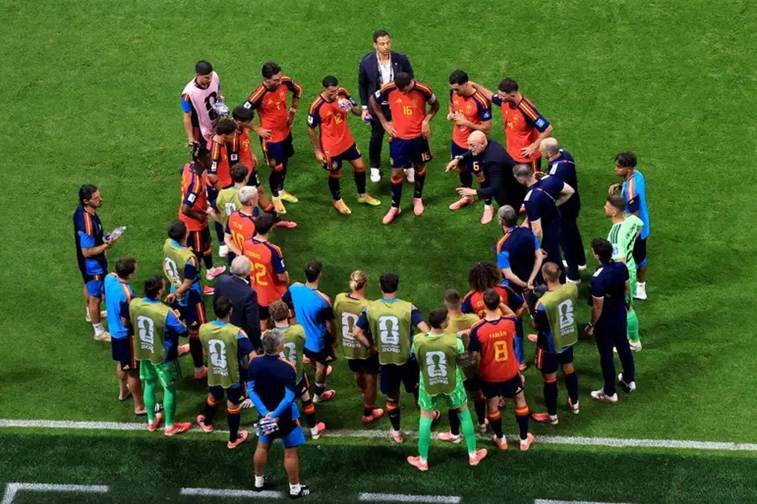
Figure 1: Spanish manager Luis de la Fuente addresses his squad during a hydration pause in their match against Saudi Arabia.
Note. From “How do World Cup athletes and managers view hydration pauses?” by J. McKenzie, 2026 (https://www.nytimes.com/athletic/7379136/2026/06/24/hydration-breaks-fifa-world-cup-players/). Copyright 2026 by Getty Images.
What discourse(s) does hydration break facilitate?
The use of hydration breaks during the 2026 World Cup sparked a broader conversation about how they affected the game. The breaks took place at the midpoint of each half, were three minutes long each, and created two scheduled interruptions during the game. By interrupting the game while momentum is building, they can shift the flow of play. They offer coaches a chance to make tactical adjustments. From this perspective, the break becomes both a welfare measure and a competitive resource.
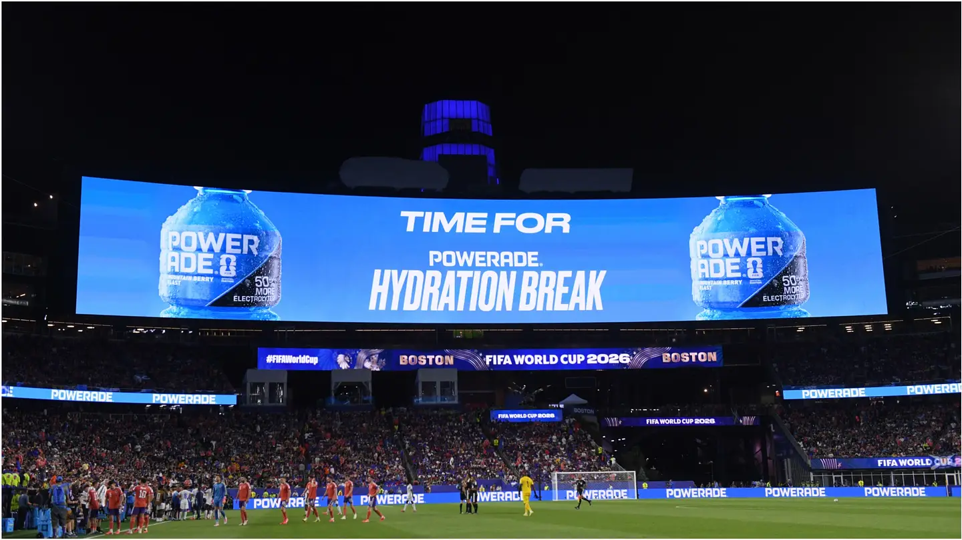
The breaks also change the experience for fans depending on whether they were watching from inside the stadium or at home. Fans inside the stadium were shown “time for Powerade hydration break” on the stadium screens, while viewers at home were shown advertisements during the break. These examples connect hydration to both sponsorship and broadcasting, although the experience may vary across venues and broadcasters. This has also created frustration around the fan experience because fans were being asked to accept a new interruption to the game while advertisements were being shown. It raises questions about how commercial opportunities become integrated into a measure presented as protecting players. Player safety and commercial benefit can coexist. The issue is how these interests shape the organization and presentation of the break.
There is also the question of whether a hydration break is really needed for every game, even when the weather and conditions are not the same at every stadium. FIFA’s announcement explains that universal application is intended to ensure equal conditions for all teams. However, a consistent rule does not necessarily respond to the different levels of heat exposure across matches. The rule was presented as a way to protect player safety, especially as athletes are playing in hotter conditions, but the conversation around the breaks has expanded beyond just hydration.
A changing climate is forcing sport to adapt. The effects of climate change, from rising global temperatures to increases in the frequency and intensity of some extreme weather events, pose threats to athlete safety. As conditions get hotter, sports are having to find ways to adapt and keep athletes safe. Hydration breaks are one example of this, but they show that adapting to climate change can have effects that go beyond player safety. When adaptation is discussed mainly as a way to keep the game going, decisions about when, where, and under what conditions the game takes place may receive less scrutiny. The question is therefore whether hydration breaks expand the discussion of responsibility or allow that discussion to stop at helping players cope.
Figure 2: BOSTON, MASSACHUSETTS – JUNE 13: Electronic screen displaying hydration break information during the FIFA World Cup 2026 Group C match between Haiti and Scotland at Boston Stadium on June 13, 2026 in Boston, United States.
Note. From “World Cup hydration breaks draw continued backlash” by Sport Business Journal, 2026 (https://www.sportsbusinessjournal.com/Articles/2026/06/15/world-cup-hydration-breaks-draw-continued-backlash/). Copyright 2026 by Getty Images.
Whose perspectives are represented?
To examine whose perspectives shape the discussion around hydration breaks, I reviewed 20 mainstream media articles and 20 videos of news segments, podcasts and interviews. I considered whose views appeared in these sources and which aspect of the breaks they emphasized.
The coaches I found talked about the breaks as a tactical resource more than a health measure. England’s Thomas Tuchel said he used the breaks to benefit his team but that they change the identity of games (Olley, 2026). According to James Robson, Mexico’s head coach shared that he uses the time tactically (Robson, 2026). Jürgen Klopp thought the breaks were too long, and in one clip even called them a break to go to the restroom (BBC, 2026). Whether coaches liked the breaks or not, they judged them by what they do to the match, not by why they exist.
Other sources questioned whether the breaks were really about the players. A video from journalist Caleb Bostic (Active Wave, 2026) explained how the body absorbs water and argued that the breaks do not actually hydrate athletes, asking who they are for? Brodie Brazil (Bazil, 2026) pointed to games in Dallas, where the matches were indoors with air conditioning but the breaks still took place. Joshua Robinson (Robinson, 2026) reported that the breaks add about 10.5 hours of ad time to the tournament, and Ben Strauss (Strauss, 2026) reported that U.S. media made at least $250 million from them. People went as far as calling them ad breaks. Together, these sources suggest the commercial side of the breaks was hard to ignore.
The safety argument did appear, but it was rarely the main frame. According to Corinne Purtill, (Corinne, 2026) the U.S. team doctor explained why extreme heat makes the breaks necessary, even as fans complained that they disrupt play. Infantino made a different case saying that applying the breaks to every match creates equal conditions for all teams (FOX Sports, 2026). The people with the most authority to defend the breaks mostly argued for them as a principle, not with evidence.
Water itself was not the main topic of interest, even though the breaks are built for hydration. Ale Espinosa (KCTV 5, 2026) explained why fans are not allowed to bring their own water bottle into the stadium. An opinion piece by Liziwe McDaid, (Daily Maverick, 2026) described water access in stadiums as an ethical and environmental dilemma, since spectators are banned from bringing their own water yet still charged high prices inside. Epic Cleantec (Epic Cleantec, 2026) looked at the tournament’s water use, reporting that 8 of the 11 U.S. host venues face severe water stress and that large amounts of drinking water go to field watering and cooling systems . Outside of these three, the sources I reviewed focused on what the breaks do to the game, not on the water itself.
How is the relationship between sport and water defined?
In the sources I reviewed, water is mostly treated as a resource that protects athletes, keeps them performing, and allows the game to continue. Hydration breaks are one way sport is adapting to hotter conditions as climate change creates more risks for athletes. Yet few sources asked about the conditions that make these protections necessary, such as how decisions about when and where games are held expose athletes to more heat. The focus was on how to cope with heat, not why athletes have to cope with it in the first place. This also raises the question of access to water as a human right. Athletes are given water to keep them safe, while fans may not be allowed to bring their own bottles into a stadium and may have to buy water once inside. Water’s value seems to depend on who is using it. For athletes, it is a basic need for health and safety. For fans, it can become part of the business of the event.
The sources discussed player safety, interruptions, tactics, advertising, and revenue far more than access to water or the environmental conditions surrounding the tournament. This suggests that water is understood as something that sustains the event, not as something the event depends on. When the priority is keeping the game going and making it profitable, public attention goes to managing the heat, and the questions of who is exposed to it and who has access to water are left unasked. Rethinking the relationship between water and sport shall begin with questions that go beyond keeping the game going. Does providing water become the end of sport’s responsibility, or the starting point for questioning the conditions under which it asks people to play and watch?
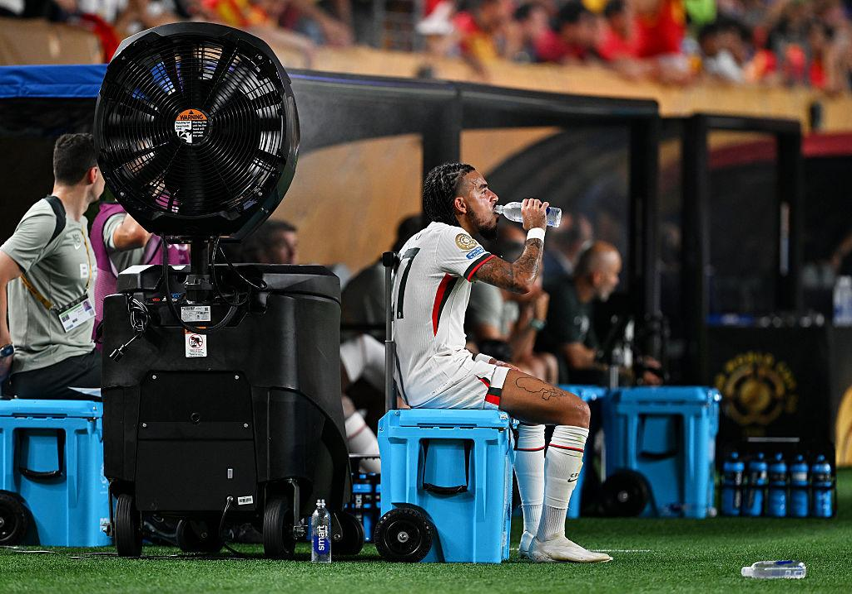
Figure 3: Malo Gusto of Chelsea FC drinks water while being cooled by a misting fan during the FIFA Club World Cup 2025 in Philadelphia, Pennsylvania
Note. From “Extreme Heat Is a Major Concern for the 2026 FIFA World Cup” by TIME, 2025 (https://time.com/7303535/extreme-heat-fifa-world-cup-2026/). Copyright Darren Walsh/Chelsea FC—Getty Images.
About the student author
Dominique Phelps is a Sport Management student with a minor in Business Administration at Washington State University, expected to graduate in Spring 2027. She has been actively involved in faculty-guided research throughout her undergraduate studies, exploring topics related to sport, media, and social issues.
References
Active Wave. (2026, July 7). Are World Cup hydration breaks actually for the players? [Video]. YouTube. https://www.youtube.com/watch?v=4eMtGn0ZZq8
BBC Sport. (2026, June 24). Jurgen Klopp on World Cup hydration breaks [Video]. https://www.bbc.com/sport/football/videos/cx2djzn83j0o
Epic Cleantec. (2026, June 12). 8 FIFA World Cup host cities are running low on water. What’s the tournament’s water footprint? https://epiccleantec.com/blog/8-fifa-world-cup-host-cities-are-running-low-on-water
KCTV5 News. (2026, June 5). Why FIFA is banning bringing water bottles for World Cup games [Video]. YouTube. https://www.youtube.com/watch?v=JUGC4WM3B0Q
McDaid, L. (2026, July 6). Red card for FIFA cooling breaks? The real culprit is climate change. Daily Maverick. https://www.dailymaverick.co.za/opinionista/2026-07-06-red-card-for-fifa-cooling-breaks-the-real-culprit-is-climate-change/
McKenzie, J. (2026, June 24). How do World Cup athletes and managers view hydration pauses? The Athletic. https://www.nytimes.com/athletic/7379136/2026/06/24/hydration-breaks-fifa-world-cup-players/
Olley, J. (2026, June 23). England’s Thomas Tuchel criticises hydration breaks, “change identity” of games. ESPN. https://www.espn.com/soccer/story/_/id/49148570/england-thomas-tuchel-criticises-world-cup-2026-hydration-breaks
Purtill, C. (2026, July 7). World Cup hydration breaks keep athletes safe, U.S. team doctor says. Los Angeles Times. https://www.latimes.com/science/story/2026-07-07/how-world-cup-hydration-breaks-keep-athletes-safe-according-to-u-s-mens-soccer-doctor
Robson, J. (2026, June 23). Infantino: FIFA to analyze use of hydration breaks at future World Cups. AP News. https://apnews.com/article/world-cup-hydration-breaks-infantino-73cd13c4c9a17736b934f6af9e7aba9c
Sports Business Journal. (2026, June 15). World Cup hydration breaks draw continued backlash. https://www.sportsbusinessjournal.com/Articles/2026/06/15/world-cup-hydration-breaks-draw-continued-backlash/
Strauss, B. (2026, July 13). Why World Cup hydration breaks have media “salivating”. ESPN. https://www.espn.com/soccer/story/_/id/49326566/hydration-breaks-world-cup-soccer-broadcast-rights
Timms, G. (2025, July 18). Extreme heat is testing FIFA’s ability to protect 2026 World Cup athletes. TIME. https://time.com/7303535/extreme-heat-fifa-world-cup-2026/
Why are there hydration breaks at the World Cup? FIFA president explains. (2026, July 2). FOX Sports. https://www.foxsports.com/stories/soccer/why-hydration-breaks-world-cup-fifa-president-explains