Media Literacy Resources
Media Literacy Infographic
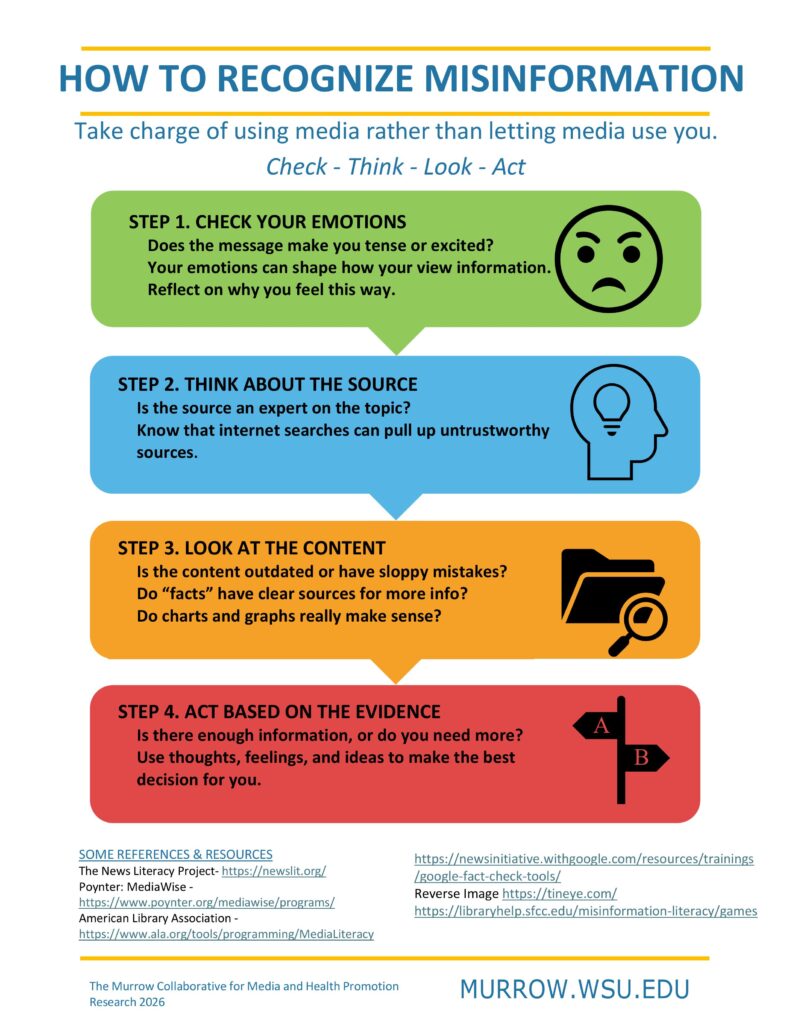
The following infographic offers advice on how people can apply their media literacy skills by encouraging people to:
- 1) Check and be aware of your emotions
- 2) Think about the source’s expertise and credibility
- 3) Look at the Content by analyzing and comparing multiple sources
- 4) Act based on the evidence.
The infographic is backed by previous research and developed by the Edward R. Murrow Collaborative for Media and Health Promotion Research at Washington State University, with the goal of providing an accessible resource and advice on media literacy
If you are interested in accessing the infographic, click here to download the document.
Washington OSPI Media Literacy & Digital Citizenship
The goal of Washington’s K–12 education system is to prepare every student for postsecondary pathways, careers, and civic engagement. One such program is the Media Literacy and Digital Citizenship, which focuses on content areas that integrate into everyday topics that are taught in today’s classrooms. These programs help develop media literacy skills, such as teaching students to think critically about the messages they consume, create, and engage with through a variety of forms of communication. Those associated with Digital Citizenship enable students to use technology in ways that are safe, responsible, ethical, and kind.
National Association for Media Literacy Education (NAMLE)
NAMLE is a community of educators committed to advancing media literacy education for their students and within their community. NAMLE hosts various events and provides teaching resources that could help enhance media literacy for students, instructors, and the community.
News Literacy Project
The News Literacy Project offers resources for educators to help all students develop skills in news literacy before high school graduation, giving them the knowledge and ability to participate in civic society as well-informed, critical thinkers. These resources include their SIFT newsletter, which provides informative insight into misinformation trends, journalism, and press freedom. As well as their Checkology e-learning program also provides interactive lessons that focus on how to identify misinformation, evaluate media bias, and engage in fact-checking strategies.
Project Look Sharp
A nonprofit out of Ithaca College, Project Look Sharp provides a variety of resources to help K-12 and higher education educators enhance students’ critical thinking, metacognition, and civic engagement through media literacy materials and professional development.
Poynter Institute: MediaWise
The Poynter Institute is a global nonprofit that strengthens democracy by improving the relevance, ethical practice, and value of journalism. One of their programs is MediaWise, which empowers diverse communities with the skills to identify misinformation through engaging, innovative media literacy education by inspiring savvy digital citizens who know that when facts prevail, democracy wins.
University of Washington: Center for an Informed Public
Even though the University of Washington is our rival, in the landscape of education and research, we strive together to learn more and foster a more informed public. Their mission is to resist strategic misinformation, promote an informed society, and strengthen democratic discourse. The Center for an Informed Public supports a variety of valuable research in misinformation, informative seminars, and various educational resources. Members of Murrow College of Communication regularly participate in the Center for an Informed Public’s MisInfo Day, an annual media literacy educational event bringing together high school students, teachers, and librarians to learn how to navigate complex information environments and make informed decisions about what to believe online.