 Facial Electromyography (EMG)
Facial Electromyography (fEMG) is a technique used to measure the tiny electrical signals produced by facial muscles when they contract. These subtle muscle activations—often too faint to detect with the naked eye or a camera—can reveal a person’s emotional state, engagement level, and underlying reactions to media content.
Unlike webcam-based facial expression analysis, fEMG provides higher sensitivity, allowing us to capture micro-expressions and covert reactions, even when participants are wearing a VR headset or trying to suppress their facial expressions.
How it Works
When you experience emotions—whether you’re smiling, frowning, or even trying to suppress an expression—your facial muscles produce small electrical signals. These are generated by the activation of motor units within your muscles, which can be detected using surface electrodes placed over specific facial regions.
These signals do not always result in visible expressions, but EMG can still pick them up, making it especially useful for measuring covert or suppressed emotional reactions. By amplifying and analyzing this data, we can track:
- Subtle muscle contractions that indicate emotional expressions like joy, frustration, or concentration.
- Electrical patterns that reflect the time course and intensity of those emotions.
Typical facial regions measured include:
- Corrugator supercilii – associated with frowning or negative affect.
- Zygomaticus major – linked to smiling or positive affect.
- Orbicularis oculi – involved in more genuine expressions of joy (i.e., “Duchenne smiles”).
Why Do We Measure Facial EMG in Our Studies?
At the Murrow Media Mind Lab, facial EMG gives us a powerful lens into the emotional and cognitive engagement of media users. Unlike self-reports or visible behavior, EMG captures subtle muscle activations—sometimes occurring without the participant’s awareness.
Measuring Emotional Response
- Detects fine-grained emotional expressions, including subtle smiles and frowns that aren’t visibly noticeable.
- Provides a highly accurate index of emotional valence, distinguishing positive (zygomatic) from negative (corrugator) reactions.
Understanding Attention & Engagement
- Reveals how facial expressions change during emotionally compelling or cognitively demanding content.
- Highlights peak engagement moments through increased muscle activity.
Studying Social and Internal Influences
- Allows researchers to study startle responses, emotional regulation, and muscle activity during decision-making.
- Allows us to understand audience reactions that are culturally, personally, or socially shaped.
How We Measure Facial EMG in Our Lab
We use BIOPAC and iMotions systems to collect high-resolution facial EMG data from participants. This helps us understand how people emotionally respond to various types of media and stimuli.
Facial EMG Recording Process:
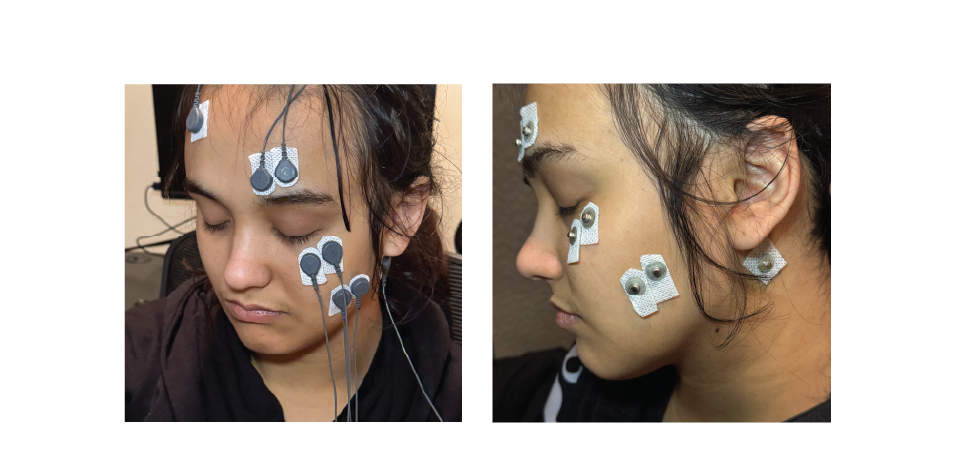
- Electrode Placement:
- Electrodes are placed on key facial muscle regions, such as the cheek (zygomaticus), brow (corrugator), and under the eye (orbicularis oculi).
- These placements allow us to track muscle activation linked to positive and negative emotions, as well as reflexive reactions.
- iMotions Software – Synchronizes EMG with other physiological data such as ECG, EDA, and eye tracking to create a full picture of user engagement.
- BIOPAC Systems – Offers high-resolution muscle recordings with automated signal processing tools to track and analyze facial expressions.
- Signal Analysis – Real-time tracking of amplitude and frequency changes allows us to assess muscle tension and reaction timing in response to content.
Why it matters
Facial EMG offers unparalleled sensitivity for detecting emotional reactions in media research. Because it captures even invisible or suppressed expressions, fEMG helps us understand:
- How audiences really feel about content
- When emotional moments hit hardest
- What facial muscle patterns tell us about attention and cognitive load
From market research to educational media to social behavior, fEMG reveals the nuances of emotional expression that shape how people connect with content.