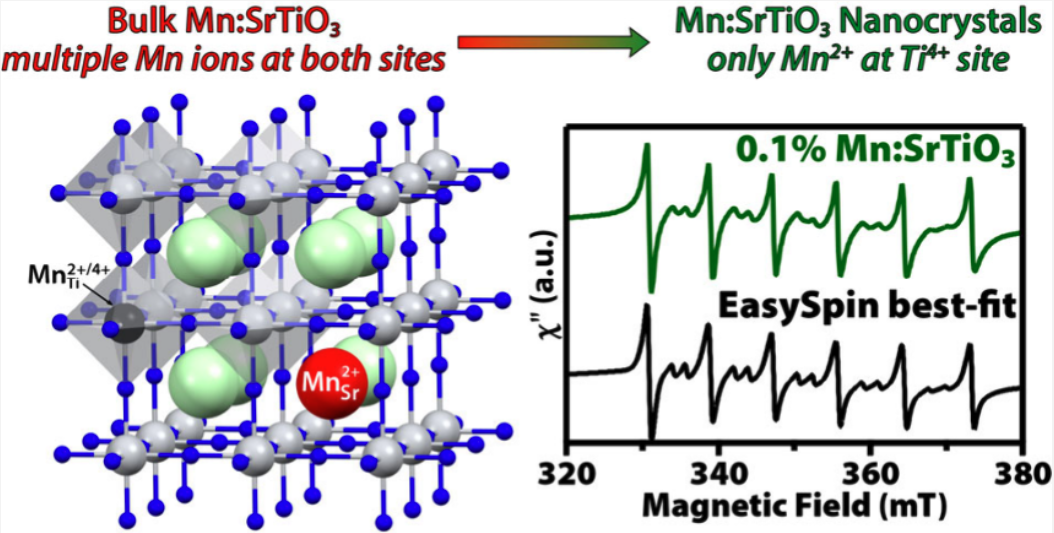
Mitra, Gaurav; *Kittilstved, Kevin R. “Colloidal Synthesis of Mn2+-Doped SrTiO3 Nanocrystals: B‑Site Substitution and Spin-Relaxation Dynamics” J. Phys. Chem. C, 2025, 129, 19440-19449. (View data used to prepare the figures in this publication.)Text along top stating “Bulk Mn-doped SrTiO3 – multiple Mn ions at both sites” and an arrow pointing to “Mn-doped SrTiO3 nanocrystals – only Mn2+ at the Ti4+ site. There is a graphic of the SrTiO3 perovskite lattice with Mn2+/4+ substituted at the Ti4+ site and Mn2+ substituted at a Sr2+ site. Experimental electron paramagnetic resonance spectra are also shown for 0.1 % Mn-doped SrTiO3 nanocrystals and a best-fit from EasySpin.
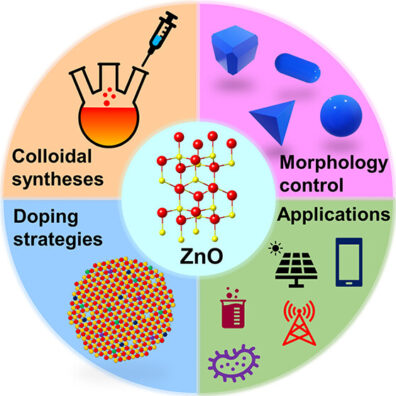
van Embden, J.; Gross, S.; Kittilstved, K. R.; *Della Gaspera, E. “Colloidal Approaches to Zinc Oxide Nanocrystals” Chem. Rev., 2023, 123, 271-326. Multiple panel graphic descriptions of ZnO nanocrystal research that is covered in the Chemical Review in new tabs publication. There are four pictures for colloidal synthesis, morphology control, doping strategies, and applications.
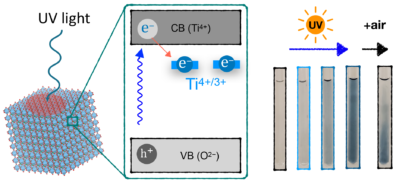
Abdullah, M.; Nelson, R. J. (undergraduate), *Kittilstved, K. R.; “Sub-bandgap trap sites for high-density photochemical electron storage in colloidal SrTiO3 nanocrystals” Chem. Commun., 2022, 58, 11835-11838. Included as part of the special themed collection: 2022 Pioneering Investigators Graphical abstract for the manuscript showing a cartoonish cubic nanocrystal absorbing a UV photon leading to creation of a Ti3+ site and a change in the color of the suspension from transparent to deep blue.
Denhardt, Jillian E.; *Kittilstved, Kevin R.; “Core-Doped [(Cd1–xCox)10S4(SPh)16]4– Clusters from a Self-Assembly Route” Inorg. Chem., 2021, 60, 15270-15277. Graphic showing the progression of Co2+ incorporation into [Cd10S4(SPh)14]2- product fragments by negative mode electrospray ionization mass spectrometry.
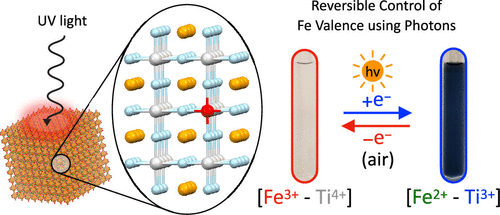
Abdullah, Muhammad; Nelson, Ruby J. (undergraduate), *Kittilstved, Kevin R.; “Tunable Redox Activity at Fe3+ Centers in Colloidal ATiO3 (A = Sr and Ba) Nanocrystals” Chem. Mater., 2021, 33, 4196-4203. Schematic representation of a cubic Fe-doped SrTiO3 nanocrystal that has been irradiated with UV light. Photographs of a transparent looking suspension changing to deep blue after UV irradiation to add electrons to the material. Text above the photos says, “Reversible control of Fe valence using photons.” Under the photos of the transparent suspension is “Fe3+ and Ti4+” and the blue suspension is “Fe2+ and Ti3+.”
Zhou, Zimu; López-Domínguez, Pedro; Abdullah, Muhammad; Barber, Dylan M.; Meng, Xiangxi; Park, Jieun; Van Driessche, Isabel; Schiffman, Jessica D.; Crosby, Alfred J.; Kittilstved, Kevin R.; *Nonnenmann, Stephen S. “Memristive Behavior of Mixed Oxide Nanocrystal Assemblies” ACS Appl. Mater. Interfaces, 2021, 13, 21635-21644.
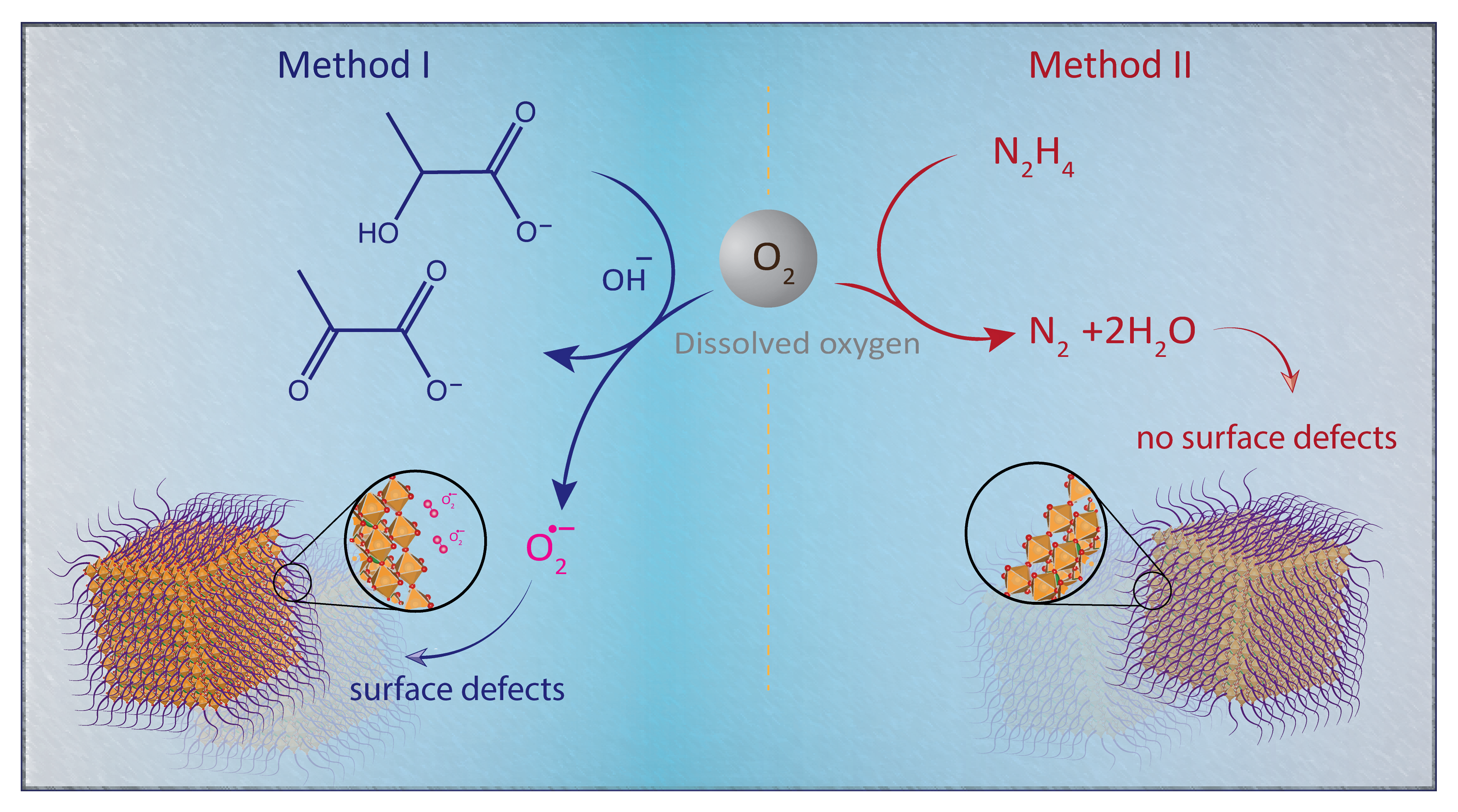
Abdullah, Muhammad; Nelson, Ruby J. (undergraduate), *Kittilstved, Kevin R. “On the formation of superoxide radicals on colloidal ATiO3 (A = Sr and Ba) nanocrystal surfaces” Nanoscale Adv., 2020, 2, 1949-1955. (open access!) Included as part of the themed collection: Nanoscale Advances HOT Article CollectionGraphic showing the influence of hydrazine on the surface chemistry of SrTiO3 NCs. Specifically, hydrazine is suggested to remove free oxygen in the reaction vessel by reducing to N2 and water. If hydrazine is not present, then dissolved oxygen is able to oxidize lactate to pyruvate and produce surface superoxide radicals.
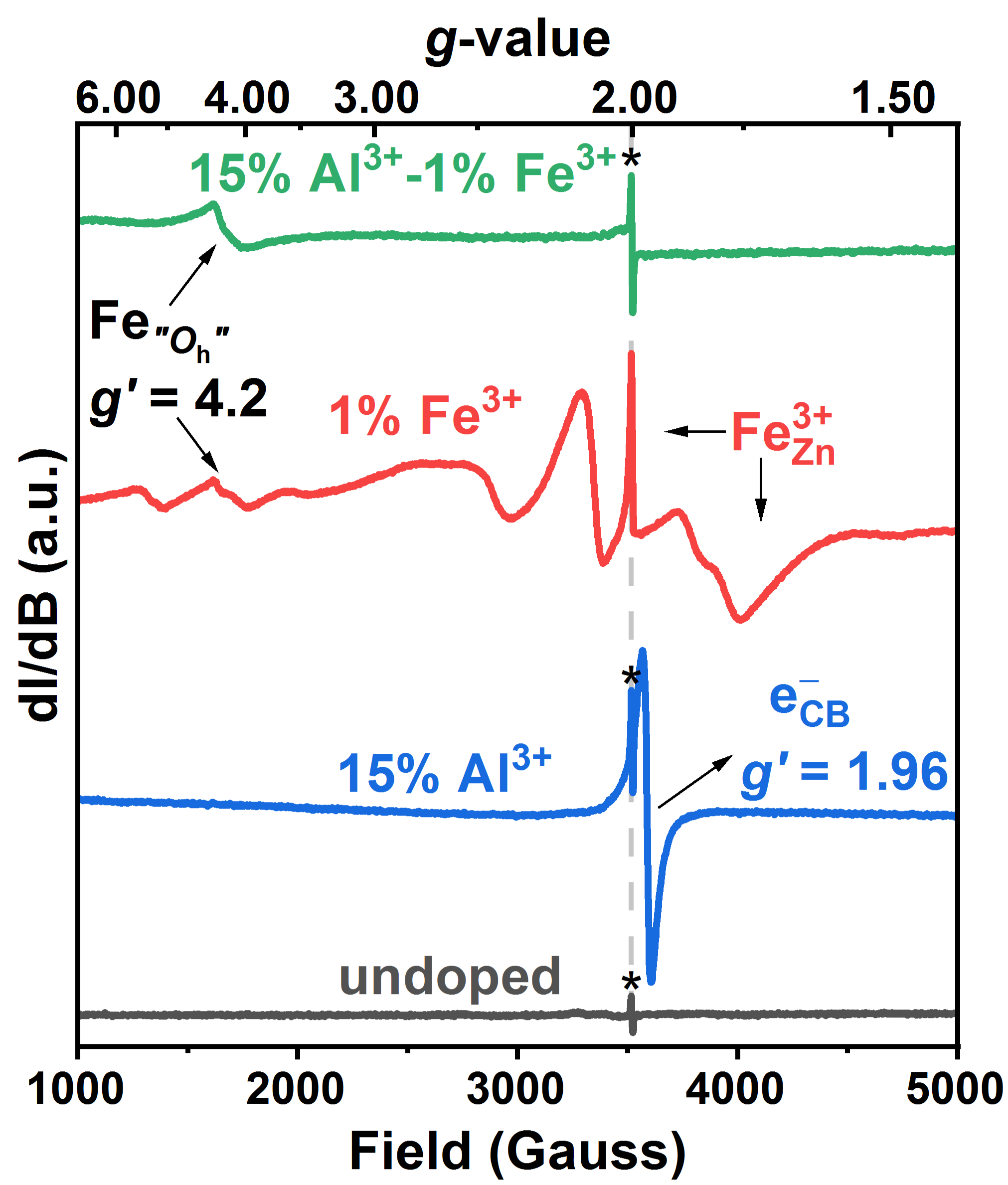
Buz, Enes; Zhou, Dongming; *Kittilstved, Kevin R. “Air-stable n-type Fe-doped ZnO Colloidal Nanocrystals” J. Chem. Phys., 2019, 151, 134702. Invited contribution JCP Special Topic on Colloidal Quantum DotsFigure showing the electron paramagnetic resonance spectra of three doped ZnO nanocrystalline samples: (1) 15% Al3+ and 1% Fe3+, (2) 1% Fe3+, and 15% Al3+. The spectra of the co-doped sample, 15% Al3+ and 1% Fe3+, shows only the distorted Fe3+ signal at low field suggesting the substitutional Fe3+ has been reduced to the EPR-silent Fe2+ ion.
Mansoor, Haneen; Harrigan, William L.; Lehuta, Keith A.; *Kittilstved, Kevin R. “Reversible Control of the Mn Oxidation State in SrTiO3 bulk powders” Front. Chem., 2019, 7, 353. (open access!) Invited contribution to the Frontiers in Chemistry: Rising Stars special issue.
Collett, Charles A.; Ellers, Kai-Isaak; Russo, Nicholas (undergraduate), Kittilstved, Kevin R.; Timco, Grigore A.; Winpenny, Richard E. P.; *Friedman, Jonathan R. “A Clock Transition in the Cr7Mn Molecular Nanomagnet” Magnetochemistry, 2019, 5, 4/1-8. (open access!)
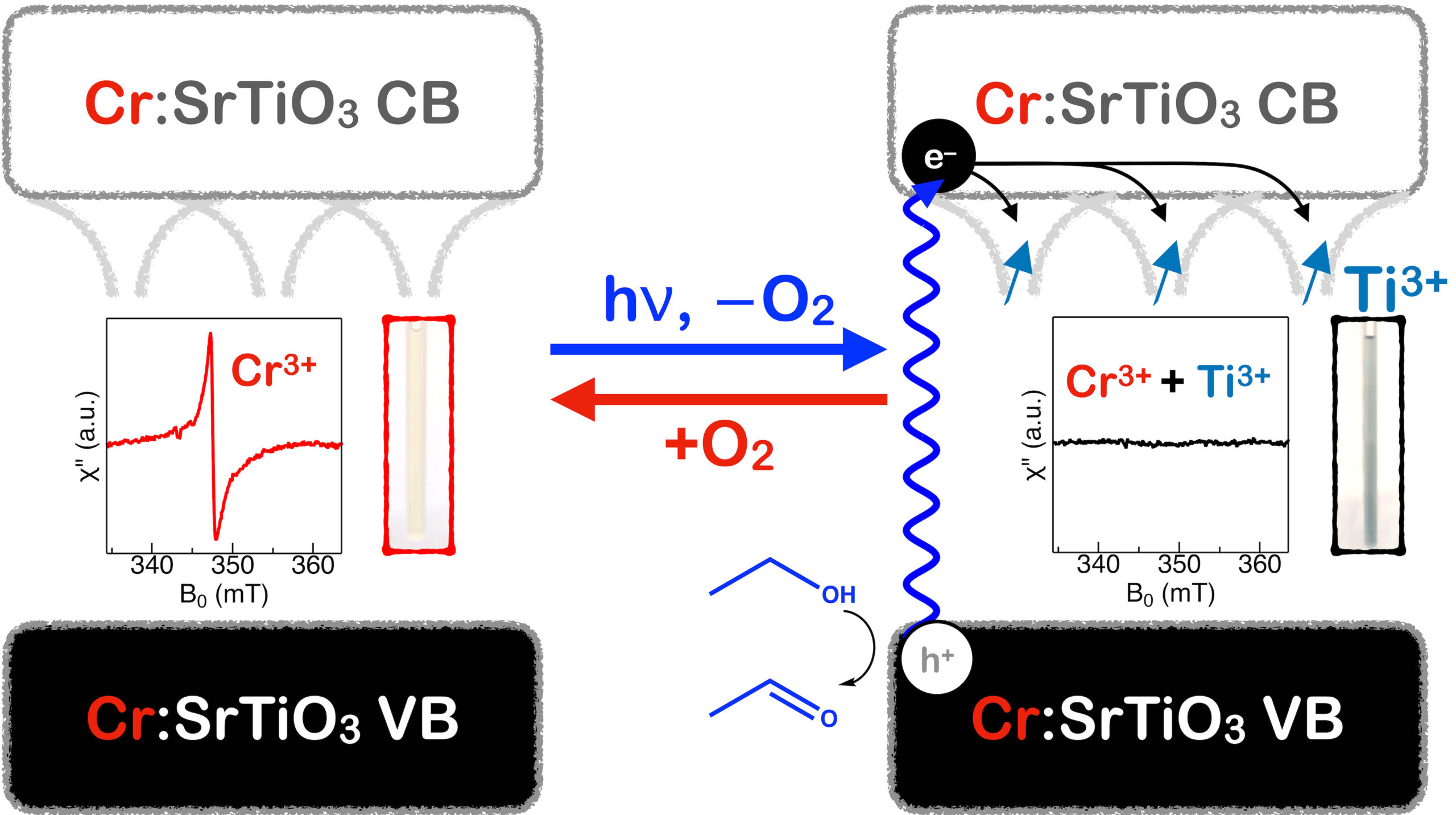
Harrigan, William L.; *Kittilstved, Kevin R. “Reversible Modulation of the Cr3+ Spin Dynamics in Colloidal SrTiO3 nanocrystals” J. Phys. Chem. C, 2018, 122, 26652–26657. Invited contribution to The Journal of Physical Chemistry virtual special issue “Young Scientists”. Graphic showing the effect of photodoping on the electronic structure of chromium doped SrTiO3 nanocrystals. The Cr3+ EPR signal is observed before photocopying but disappears after photodoping due to the introduction of Ti3+ defects turns the color of the suspension from yellow to blue. The EPR signal of Cr3+ disappears due to efficient cross-relaxation with Ti3+ defects.
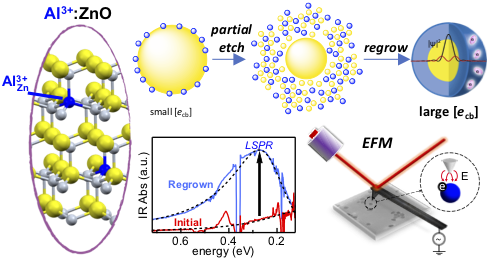
Zhou, Dongming; Wang, Peijian; Roy, Christopher R. (undergraduate), *Barnes, Michael D.; *Kittilstved, Kevin R. “Direct Evidence of Surface Charges in n-Type Al-doped ZnO” J. Phys. Chem. C, 2018, 122, 18596–18602. Graphic explaining the substitution of Al3+ into the ZnO lattice. A synthetic scheme showing the increase of conduction band electrons through the etching-regrowth-doping method described in this article. The difference in carrier concentration is shown in the infrared spectrum showing the shift in the localized surface plasmon resonance after regrowth doping. A schematic image representing electron force microscopy measurements is also included.
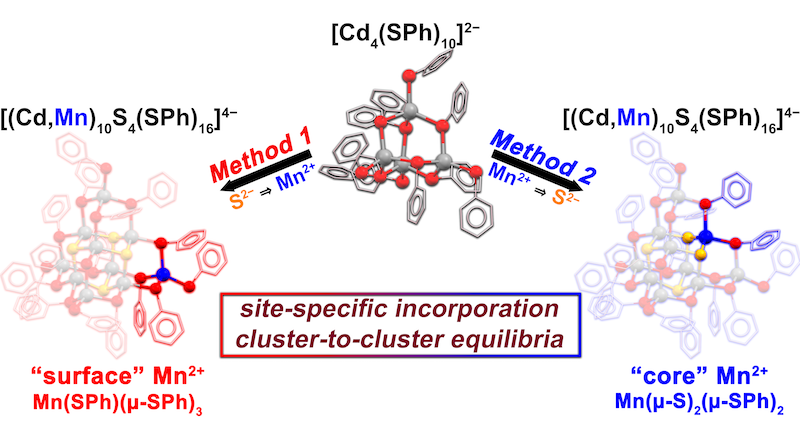
Kato, Fumitoshi; *Kittilstved, Kevin R. “Site-Specific Doping of Mn2+ in a CdS-based Molecular Cluster” Chem. Mater., 2018, 30, 4720–4727. Graphic showing the site-specific substitution of Mn2+ dopants in the [Cd10S4(SPh)16]4- molecular cluster through two different methods. The text box in the center of the graphic states “site-specific incorporation” and “cluster-to-cluster equilibria.”
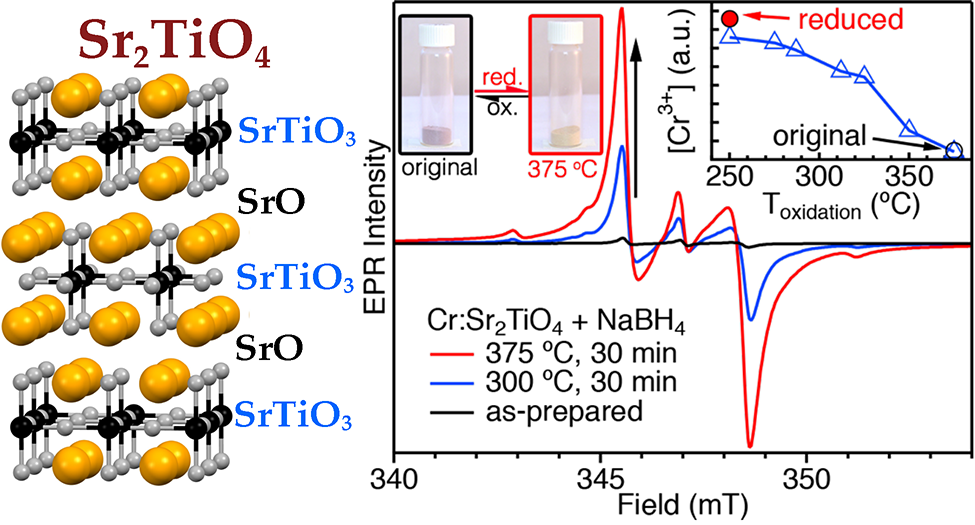
Lehuta, Keith A.; Haldar, Anubhab (undergraduate), Zhou, Dongming; *Kittilstved, Kevin R. “Spectroscopic study of the reversible chemical reduction and reoxidation of substitutional Cr ions in Sr2TiO4” Inorg. Chem., 2017, 56, 9177-9184. Graphic showing the structure of Sr2TiO4, which is comprised of alternating sheets of perovskite SrTiO3 and rock-salt SrO. The electron paramagnetic resonance spectra of the anisotropic Cr3+ signal in Sr2TiO4 is shown as a function of different reduction temperatures for 30 minutes. The Cr3+ signal increases significantly with low-temperature reduction (375 °C).
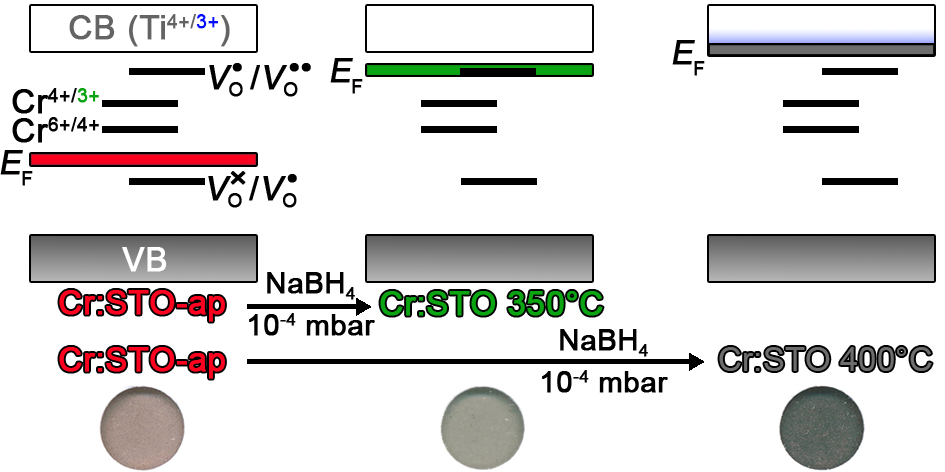
Lehuta, Keith A.; *Kittilstved, Kevin R. “Reversible control of the chromium valence in chemically reduced Cr-doped SrTiO3 bulk powders” Dalton Trans., 2016, 45, 10034-10041. Invited contribution to the New Talent: Americas special themed issue. Graphic showing a simplified band structure of SrTiO3 including defect levels associated with chromium dopants and oxygen vacancies. The reduction process moves the Fermi energy from mid-gap in as-prepared SrTiO3 towards the bottom of the conduction band with increasing temperature.
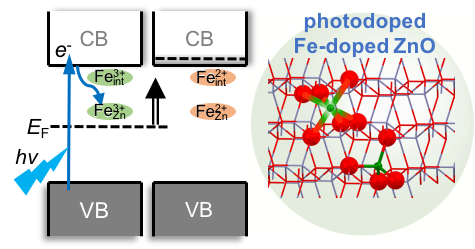
Zhou, Dongming; *Kittilstved, Kevin R. “Reversible electron trapping on Fe3+ sites in photodoped ZnO colloidal nanocrystals” Chem. Commun., 2016, 52, 9101-9104. Invited contribution to the 2016 Emerging Investigators themed collection. View the investigators’ biographies. Graphic showing substutional iron at the Zn2+ site of ZnO and the effect of raising the Fermi energy through the Fe3+/2+ redox level of Fe-doped ZnO. The reversible change in the Fermi energy is controlled by anaerobic introduction of electrons into Fe:ZnO by UV light.
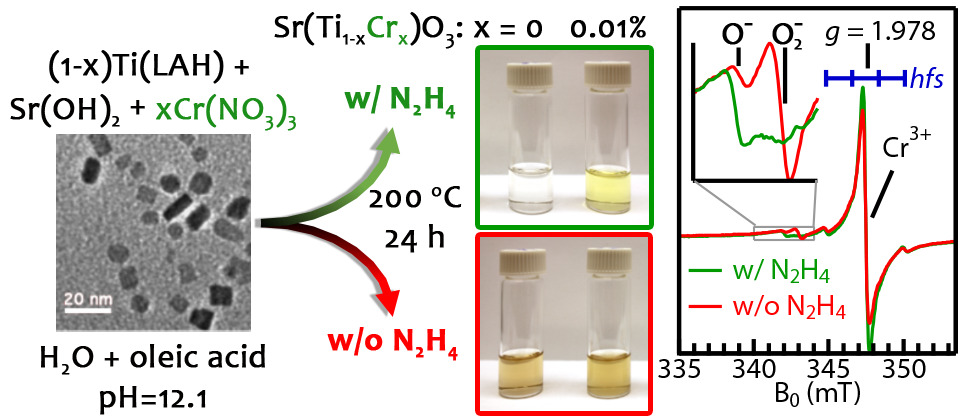
Harrigan, William L.; Michaud, Samuel E. (undergraduate), Lehuta, Keith A.; *Kittilstved, Kevin R. “Tunable electronic structure and surface defects in chromium-doped colloidal SrTiO3-δ nanocrystals” Chem. Mater., 2016, 28, 430-433. Graphic showing a representative transmission electron microscopy image of the Cr-doped SrTiO3 nanocrystals, photographs of the product suspensions with no dopants and 0.01% nominal Cr3+ doping. Electron paramagnetic resonance spectra show the isotropic Cr3+ signal characteristic of Cr3+ at the octahedral Ti4+ site of SrTiO3.
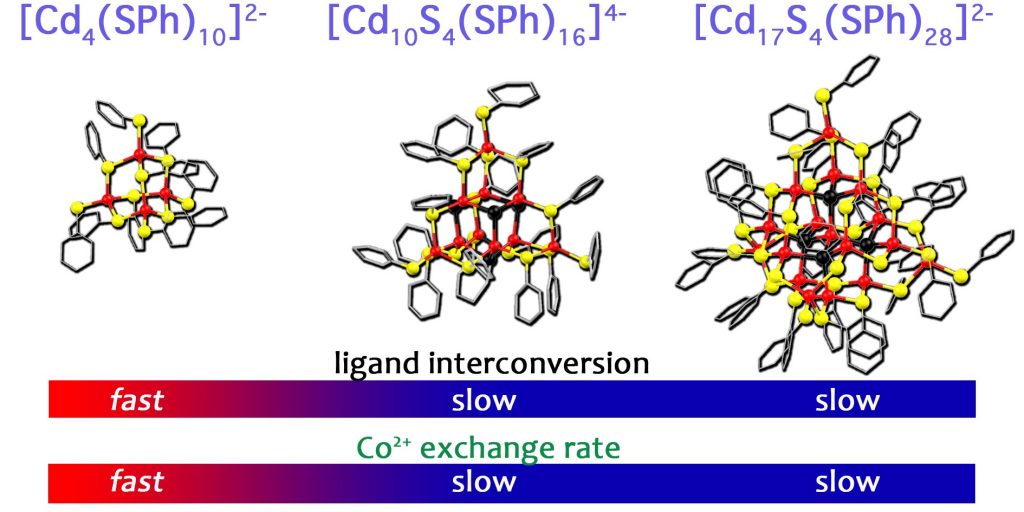
Pittala, Swamy; Mortelliti, Michael J. (undergraduate), Kato, Fumitoshi; *Kittilstved, Kevin R. “Substitution of Co2+ in small CdS-based molecular clusters” Chem. Commun., 2015, 51, 17096-17099. Graphic showing the structures of molecular clusters with increasing nuclearity from left to right. The clusters are: [Cd4(SPh)10]2-, [Cd10S4(SPh)16]4-, [Cd17S4(SPh)28]2-. Across the bottom of the graphic are color bar with text reading “fast slow slow” with respect to the thiophenolate ligand interconversion rate and the Co2+ exchange rate for the corresponding clusters above.
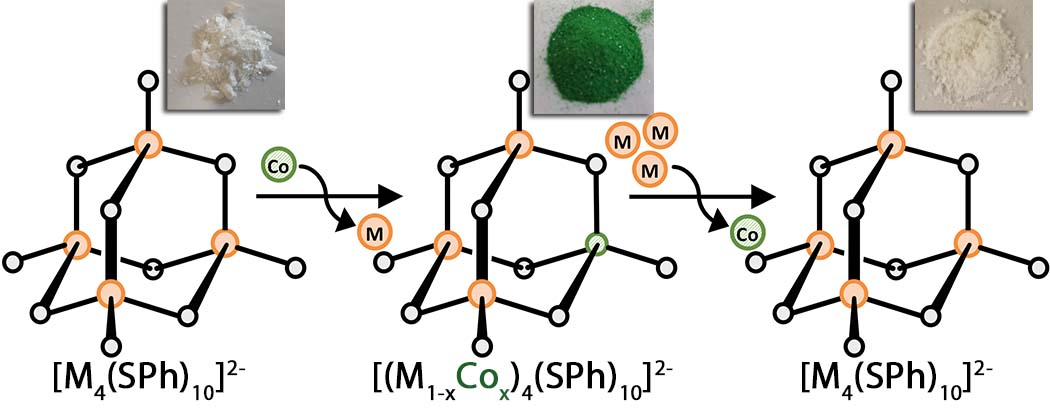
Pittala, Swamy; Mortelliti, Michael J. (undergraduate), Kato, Fumitoshi; *Kittilstved, Kevin R. “Substitution of Co2+ in small CdS-based molecular clusters” Chem. Commun., 2015, 51, 17096-17099. Schematic representation of the reversible cation exchange reaction of Zn or Cd thiophenolate clusters with Co2+. Photographs show the colorless powders of the [Zn4(SPh)10]2- or [Cd4(SPh)10]2- clusters changing to green after adding Co2+. The green color is indicative of tetrahedral Co2+. The green color can be removed by redissolving the molecular clusters in solution and adding excess Zn2+ or Cd2+, respectively.
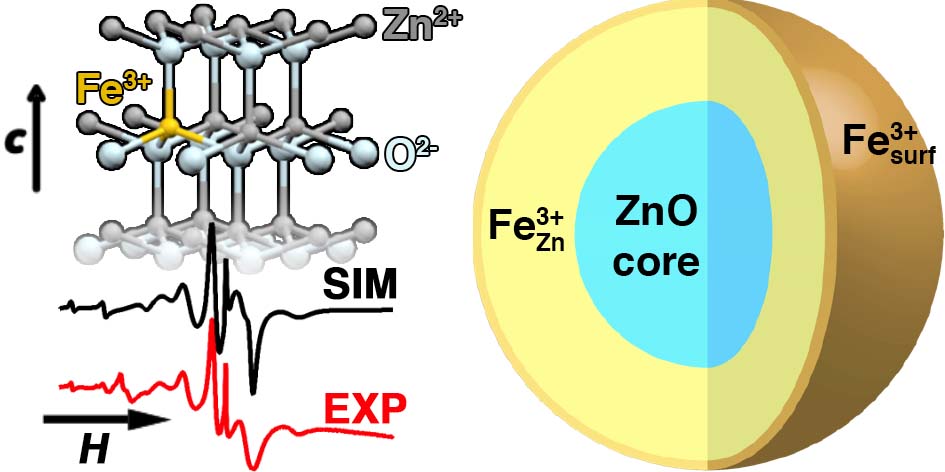
Zhou, Dongming; *Kittilstved, Kevin R. “Control over Fe3+ speciation in colloidal ZnO nanocrystals” J. Mater. Chem. C, 2015, 3, 4352-4358. Named “Hot Paper” by Editors of Journal of Materials Chemistry C.Graphic depiction of substitutional Fe3+ at the Zn2+ of wurtzite ZnO, experimental and simulated EPR spectra showing good agreement, and a schematic view of a spherical particle with a pure ZnO core and substitutional and surface Fe3+ in the sub-shell and surface, respectively.
Bo, Shou-Hang; Veith, Gabriel M.; Saccomanno, Michael R.; Huang, Huafeng; Burmistrova, Polina V.; Malingowski, Andrew C.; Sacci, Robert L.; Kittilstved, Kevin R.; Grey, Clare P.; *Khalifah, Peter G. “Thin-Film and Bulk Investigations of LiCoBO3 as a Li-Ion Battery Cathode” ACS Appl. Mater. Interfaces, 2014, 6, 10840-10848.
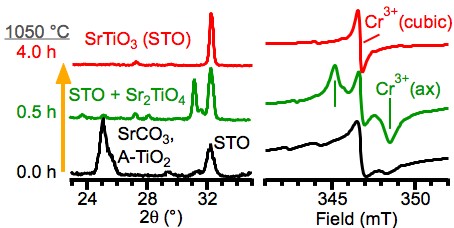
Lehuta, Keith A.; *Kittilstved, Kevin R. “Speciation of Cr(III) in intermediate phases during the sol-gel processing of Cr-doped SrTiO3 powders” J. Mater. Chem. A, 2014, 2, 6138-6145.Graphic showing the powder diffraction patterns and electron paramagnetic resonance spectra of chromium doped SrTiO3 at different calcination times at 1050 °C. Between time zero and 30 minutes there is an intense peak from Sr2TiO4 (a Ruddlesden-Popper phase) and correlated anisotropic EPR spectrum of Cr3+.
![Graphic showing the progression of Co2+ incorporation into [Cd10S4(SPh)14]2- product fragments by negative mode electrospray ionization mass spectrometry.](https://wpcdn.web.wsu.edu/wp-labs/uploads/sites/3402/2024/01/TOC_FINAL.gif)