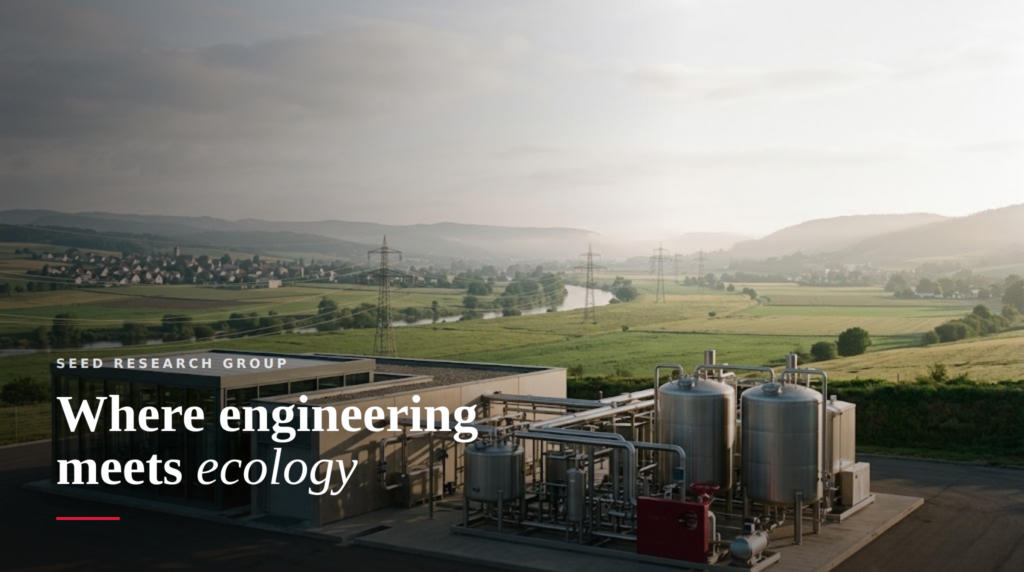
The SEED Research Group at Washington State University Tri-Cities develops coupled, multiscale models of energy and industrial systems, spanning the unit process, the supply and value chain, the regional economy, and policy. We formulate life-cycle, economic, and ecological performance inside process and systems optimization, so that design and consequence are evaluated together, and we aim to produce analyses that industry, regulators, and investors can act on. The group is led by Dr. Tapajyoti Ghosh in the Gene and Linda Voiland School of Chemical Engineering and Bioengineering and the Institute for Northwest Energy Futures (INEF).
How we work
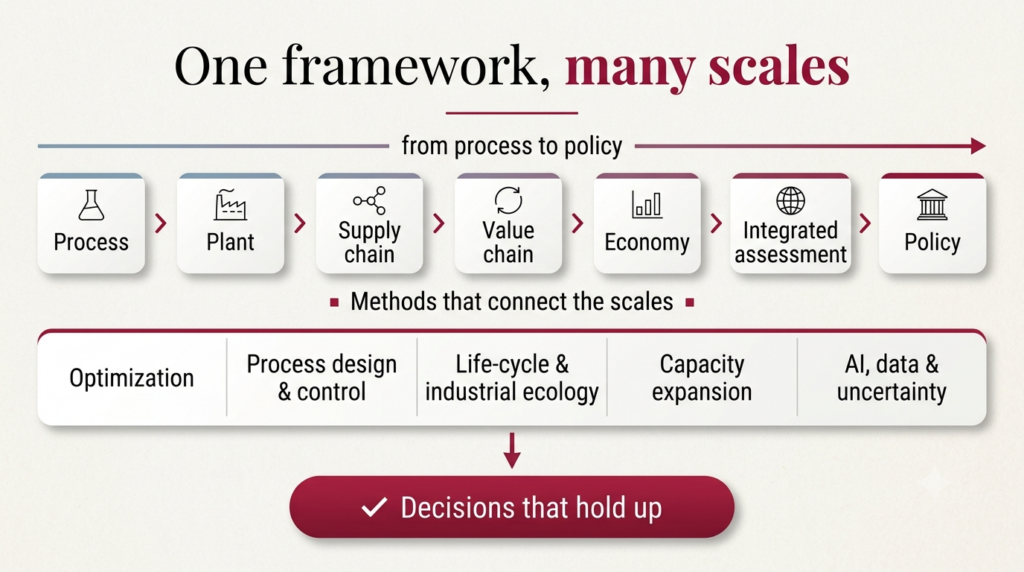
A decision at one scale depends on the scales above and below it. SEED builds models that connect these scales and embed life-cycle, economic, and ecological assessment inside the design and optimization. Core capabilities:
- Multiscale modeling that couples the unit process, the plant, the supply and value chain, the economy, and policy in a single framework
- Process and flowsheet design, dynamic simulation and control, and mixed-integer and superstructure optimization
- Process-based, hybrid, prospective, and consequential life-cycle assessment and techno-economic analysis, formulated inside the optimization
- Absolute-sustainability assessment against planetary boundaries, with techno-ecological synergy that treats ecosystem services and equity as design variables
- Industrial ecology and dynamic material-flow analysis across supply and value chains, including circular-economy and critical-material recovery pathways
- Capacity-expansion and integrated-assessment coupling (ReEDS, GCAM, IMAGE) for climate-aware, forward-looking decision-making, with input-output and general-equilibrium economy-wide modeling
- Automated life-cycle inventories using large language models and retrieval, surrogate and physics-informed modeling, and optimization under uncertainty, both stochastic and robust
What we work on
The same coupled approach applies across energy and industrial sectors. Our research spans a broad and growing set of systems, including, for example:
- Low-carbon fuels and the bioeconomy: sustainable aviation fuel, hydrogen, and biorefinery supply chains
- Advanced nuclear and grid decarbonization: small modular reactors and grid capacity expansion
- Circular economy and critical materials: wind blades, photovoltaics, batteries, and plastics
- Food, energy, and water systems: agrivoltaics, agricultural electrification, and biomass supply
- Process and manufacturing industries: chemicals, pulp and paper, food processing, aluminum, and semiconductors
Join the group
SEED is recruiting PhD and MS students, and welcomes undergraduate researchers, with interests in process systems engineering, optimization, industrial ecology, and AI.