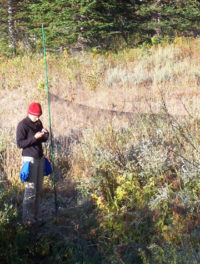
Broadly, research in my lab seeks to understand how animals adjust their behavior in response to changing environmental conditions. This work draws from the fields of behavior, physiology, ecology, and evolution. We are interested in both how environmental cues are used to adjust behavior and the physiological mechanisms underpinning such responses. We also study the consequences of variation in these mechanisms. A key theme in our research is understanding the timing of annual cycle events, such as breeding and migration. Ultimately, research in our lab addresses the fundamental biological question of how animals cope with environmental variability.
Major areas of our recent and current research are highlighted below.
Much of this research has been supported by NSF IOS 1456954/1756976 and NSF IOS 1755227.
Facultative migration
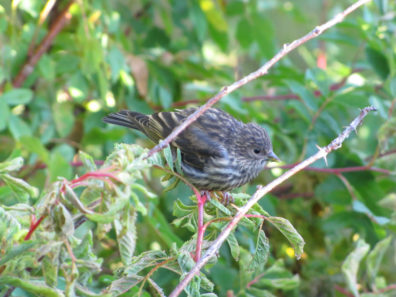
Every year billions of animals around the world and across the animal kingdom undertake migrations. These migrations are critical to the dynamics of ecosystems, have impacts on human health, and are especially prone to disturbance by global environmental change. Much of what we know about migratory biology comes from migrations that reflect regular and predictable movements that take animals to and from the same places each year, at the same time each year. But not all migrations are this predictable. Migrations can also occur much less predictably with respect to timing and/or destination. These less predictable migrations, known as facultative migrations, have proven to be much more difficult to study. Our research has been among the first to systematically and comprehensively study the drivers of facultative migration. This has been possible because of our development of the pine siskin as a captive model with which to experimentally study facultative migration. We have been investigating both the environmental cues (e.g., food availability, temperature, social cues) that animals use to time facultative migratory transitions and the hormonal mechanisms involved in mediating these transitions.
Social cues in decision making
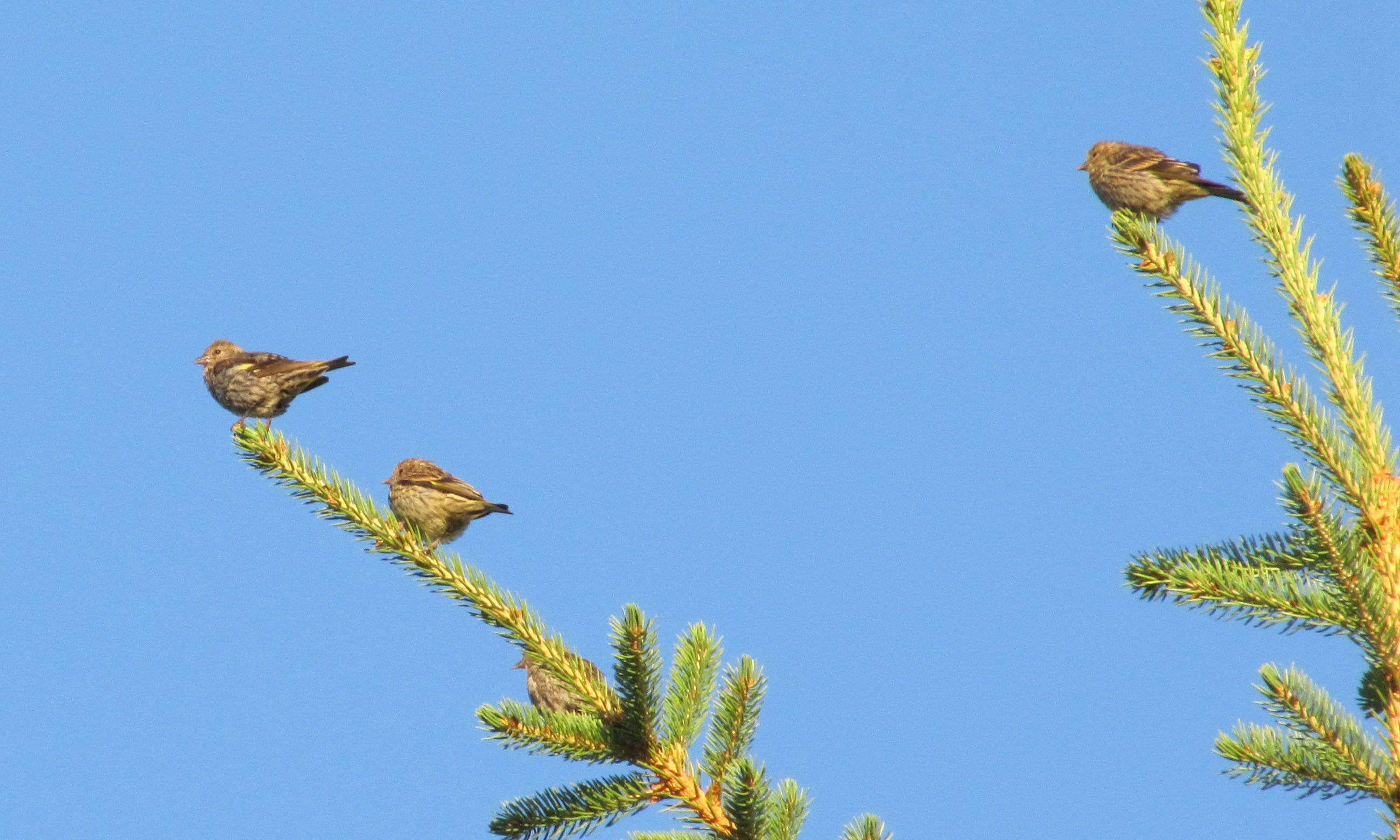
Social interactions and social cues are potentially important in myriad decisions that animals make throughout their lives. We are interested in understanding the use of social cues in behavioral decision-making, particularly in the context of reproductive and migratory decisions. Social cues, which can also be termed social information, may be especially important when animals must make decisions in the face of considerable uncertainty about environmental conditions. The process of migration is particularly fraught with uncertainty and the potential for the use of social cues is quite high; yet, until recently we have known very little about how social cues influence migratory timing decisions. Therefore, a recent emphasis of our research has been to investigate the use of social cues in migratory initiation and termination decisions. We are also conducting research aimed at understanding the mechanisms by which social information is transferred between animals, particularly the role of vocalizations in transmitting information about local food availability. We have also used modeling to investigate how social information can influence the accuracy of environmental assessments.
Endocrine regulation of transitions across the annual cycle
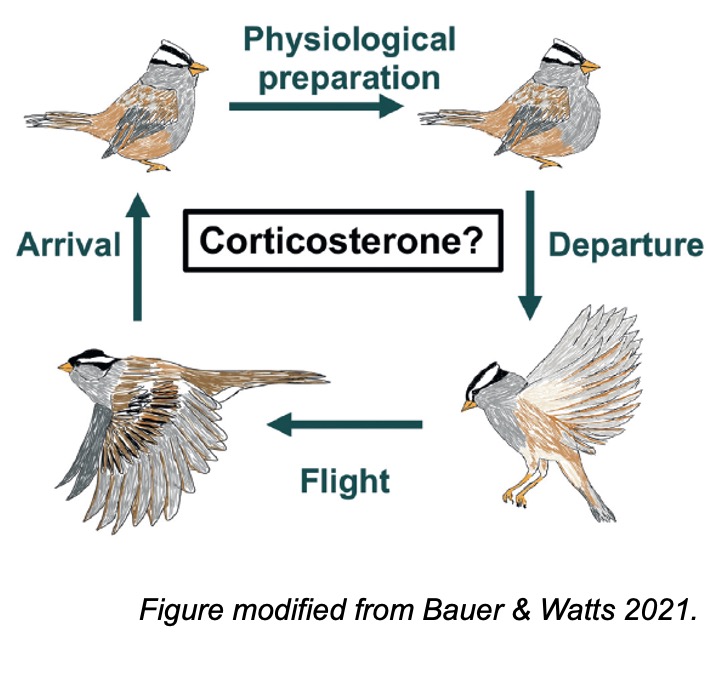
Another theme of research in my lab is to develop a more complete understanding of the endocrine mechanisms that regulate migration and life stage transitions more broadly. Recent and ongoing research is examining the role of hormonal signaling in migratory transitions. We are examining both changes in circulating hormone levels as well as other elements in endocrine signaling pathways. Thus, we are investigating the potential role of changes in local hormone synthesis and inactivation (via enzymatic activity) and changes in availability of hormone receptors in both the brain and peripheral tissues (e.g., skeletal muscle). The goal of this approach is to considerably broaden our understanding of how multiple components of the endocrine system interact to regulate migratory timing, and life stage transitions more generally.
Environmental cue integration
It is widely assumed that animals use multiple environmental cues to time life stage events, but our understanding of how suites of cues are integrated to generate observed patterns of timing across the annual cycle remains nascent. Thus, research in my lab investigates environmental cue integration. Past and ongoing work has experimentally tested how multiple cues are integrated to time reproduction and migration. The understanding of cue integration has taken on particular importance in the context of climate change, because evolved mechanisms of cue use – including cue integration – may facilitate or limit the capacity of organisms to adjust phenology in a changing world. In additional to our empirical work, we have developed a theoretical model to explore how variation in modes of cue integration may impact the ability of organisms to adjust phenology adaptively in the face of climate change. This theoretical approach allows us to explore complex scenarios that are logistically challenging to study in vivo but that capture important complexity of the natural world.
Coordination of life stages across the annual cycle
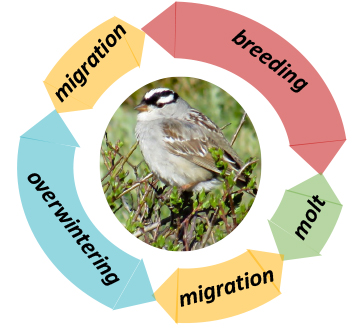
Although much research in my lab has focused on timing of particular life stages (e.g., reproduction, migration), a long-term goal is to understand coordination across stages of the annual cycle. Thus, we are interested in how timing in one stage impacts timing and performance in subsequent stages. We are also interested in potential trade-offs between adjustments in timing of one stage and coordination across multiple stages. Much of our research in this area is using field studies of mountain white-crowned sparrows.