Research
Our research interests focus on catalysis and reaction engineering innovation to address the carbon and energy efficiency issues in sustainable conversion of fossil and biomass feedstocks to fuels and chemicals. We closely collaborate with Pacific Northwest National Laboratory (PNNL) to use a full array of (in situ) state-of-the-art characterization techniques, coupled with reactivity measurements and theoretical calculations, to understand catalysts and catalysis processes at the atomic/molecular level. These techniques include attenuated total reflectance (ATR-IR), vibrational spectroscopies (FTIR and Raman), sum frequency generation spectroscopy (SFG), X-ray photoelectron spectroscopy (XPS), ultraviolet-visible (UV-Vis) spectroscopy, solid-state nuclear magnetic resonance (NMR), high-resolution electron microscopy (SEM and TEM), atom probe tomography (APT), and synchrotron-based X-ray techniques (EXAFS and XANES). Extensive collaborations with other researchers and organizations including PNNL are unique advantages of our group. Our ultimate goal is twofold: (i) developing safer, greener and more efficient catalytic processes; (ii) obtaining fundamental knowledge to direct future catalysis research. This general strategy network is shown below:
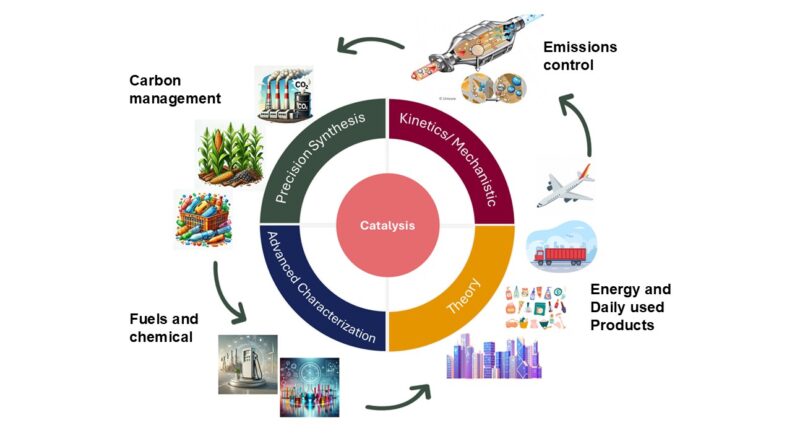
Addressing energy and resource efficiency challenges in converting carbon sources (fossils, biomass, CO2, and plastic waste) into sustainable fuels and chemicals while minimizing environmental impact.