Brief descriptions of selected ongoing projects are provided below. Please reach out to us to provide feedback or know more.
AI Institute for Transforming Workforce and Decision Support (AgAID Institute)
Our lad co-leads the Water Intelligence Theme of the AgAID Institite. We work on intgerated AI, biophysical and remote sensing approaches to understand the food-water nexus, capture the human influence on agroecosystems, and forecast water availability. See the project webpage for more details.
Strengthening Pear and Apple Resilience to Climate (SPARC)
This is a team of scientists who are working to provide actionable solutions to pear and apple growers who are facing difficulties from changing heat and cold conditions. The team is:
- Evaluating temperature damage mitigation strategies
- Building models that allow for risk assessment and cultivar selection
- Characterizing physiological and genetic mechanisms of cold and heat tolerance
- Identifying temperature-related traits to be used in future scion and rootstock breeding
- Developing durable extension materials on heat and cold damage mitigation in pome fruit
Our lab lead the modelil group within this project. See the project website for more details.
Water for Extreme Weather Management: Implications for Agriculture and the Environment
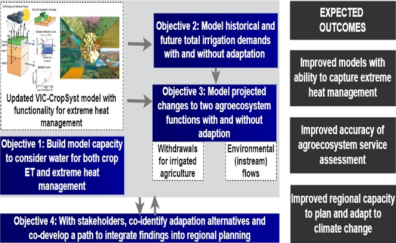
The overarching goal of this project is to advance the state-of-the-art of agroecosystem climate change impacts assessment by building capacity to incorporate the “important but currently neglected” aspect of “water needs for extreme heat management” into regional modeling, planning, and decision-making efforts.
Objective 1: Build biophysical modeling capacity that accounts for agricultural water demands for extreme heat management.
Objective 2: Comprehensively characterize historical and future agricultural water demands (with and without adaptation), and quantify associated uncertainties.
Objective 3: Quantify changes (with and without adaptation) to two agroecosystem services—timing and magnitude of water availability for crop production and for environmental flows—as a result of future changes in water supply and demands.
Objective 4: (a) Co-identify, with stakeholders, adaptation alternatives that minimize negative impacts to agroecosystem services and enhance irrigated-agroecosystem sustainability and (b) co-develop a path to integrate project findings into regional planning.
Remote sensing applications
We have several ongoing collaborations that are exploring remote sensing data and AI approaches to quantify the double cropping extent in Western US, tillage practices in areas with large crop diversity, and soil carbon. We are working on best practices for uncertainy assessment in remote sensing applications and leveraging uncertainty to support intelligent new data collection efforts for contexts where data is lacking, extremely important to collect, and time- and cost intensive to collect.
How might the risk of water rights curtailment evolve in the future?
Many parts of Washington State face curtailment of irrigation water rights and low environmental flow conditions in streams. The magnitude and frequency of these events vary spatially and temporally. We are working on improved modeling efforts to capture these regulatory and human- behavior influenced effects more realistically. We are interested in exploring strategies to reduce the potential negative effects of water shortages, and strengthen the resilience of regional agricultural and natural systems to fluctuations in weather and changes in climate.