Current Research
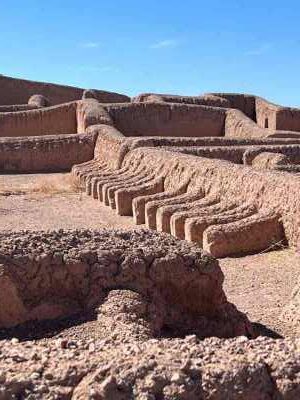
Pre-Hispanic Turkey Rearing at Paquimé (Casas Grandes, Chihuahua, Mexico): Implications for North American Turkey Domestication and Diffusion
With current funding from the National Science Foundation (2025-2027), our group of collaborators (see below) will analyze archaeological turkey remains from an area located between the two currently recognized origin centers of ancient turkey domestication (Central Mexico and the American Southwest). Through combined genetic, isotopic, and morphometric analyses, the investigators will reconstruct past turkey husbandry practices, and determine whether the region’s domestic turkeys were adopted from the American Southwest, or Mesoamerica, or whether they represent a novel domestic lineage derived from local wild turkey populations. The existence of a third, but now extinct, domestic turkey lineage has been suggested, but not confirmed. The proposed work thus contributes to a more holistic understanding of North America turkey domestication and diffusion, and to more detailed reconstructions of trade, economy, and both ritual and subsistence bird use throughout ancient North America.
Collaborators:
- Caitlin Ainsworth, Ph.D. candidate (University of New Mexico)
- Dr. Camilla Speller (University of British Columbia, Canada)
- Dr. Cyler Conrad (Pacific Northwest National Laboratories)
- Dr. Eduardo Gamboa (Paquimé Archaeologist, Instituto Nacional de Antropología e Historia – Chihuahua, México)
New Edited Volume – Turkey Domestication and Diffusion
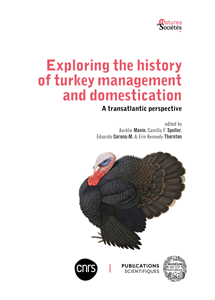
Edited by: Aurélie MANIN, Camilla F. SPELLER, Eduardo CORONA-M. & Erin Kennedy THORNTON
Published on 26 June 2025
The turkey (Meleagris gallopavo) is an iconic bird, widely associated with festive dishes in Europe, North America, and Central America, and extensively raised worldwide. Yet, its long-term interactions with human societies remain poorly synthesized, with significant regional imbalances in research. The role of turkeys in North America has been extensively studied, while their post-colonial dispersal and evolving cultural significance globally have received far less attention.
This volume brings together specialists to explore the paleontology of Meleagris, the early stages of turkey management and domestication in North America, and its subsequent global expansion. Following a chronological structure, the first part examines turkey-human interactions in the Americas before European contact (~500 years ago), with chapters on well-studied regions (Southwestern USA, Northern Mexico, and Mesoamerica) alongside lesser-known areas (Southern Central America and Eastern USA). The second part traces the last 500 years of turkey history, exploring artistic depictions, historical accounts, and archaeozoological evidence from multiple European countries, spanning Western Europe to the Baltic and Central Europe. It also examines the global spread of domestic turkeys, their reintroduction to the Americas through the colonial economy, and their further dispersal across the Pacific.
Blending comprehensive syntheses with original case studies, this volume offers new insights into the history of turkey management, domestication, and cultural symbolism through to the 21st century.
Biologica Podcast – Turkey Domestication (November 2025)
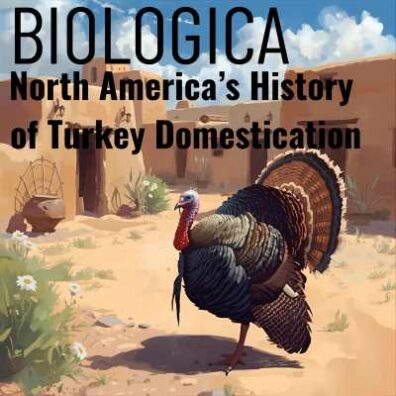
Just in time to listen in on your drive to Grandma’s house for Turkey Day (or even to Friendsgiving for Tofurkey), join Dr. Susan to learn all about domestic turkeys. Dr. Erin Thornton (an Archaeologist from Washington State University) explains the surprising discoveries that archaeological bones and ancient DNA reveal about the domestic turkey. Dr. Susan also weaves in some interviews with friends and family about turkey at Thanksgiving dinner, and bridges the gap from ancient history to now with some stories gleaned from the book The Turkey- an American Story. Two research highlights, a poem, and some fun samples from modern media will round out the episode. It’s a great episode to enjoy over the Thanksgiving holiday or to share with friends and family.
Additional research is on-going in collaboration with my current graduate students.
You may also wish to check out my publication and faculty pages.