01 /Project Description
Assessment design, with teachers at the center.
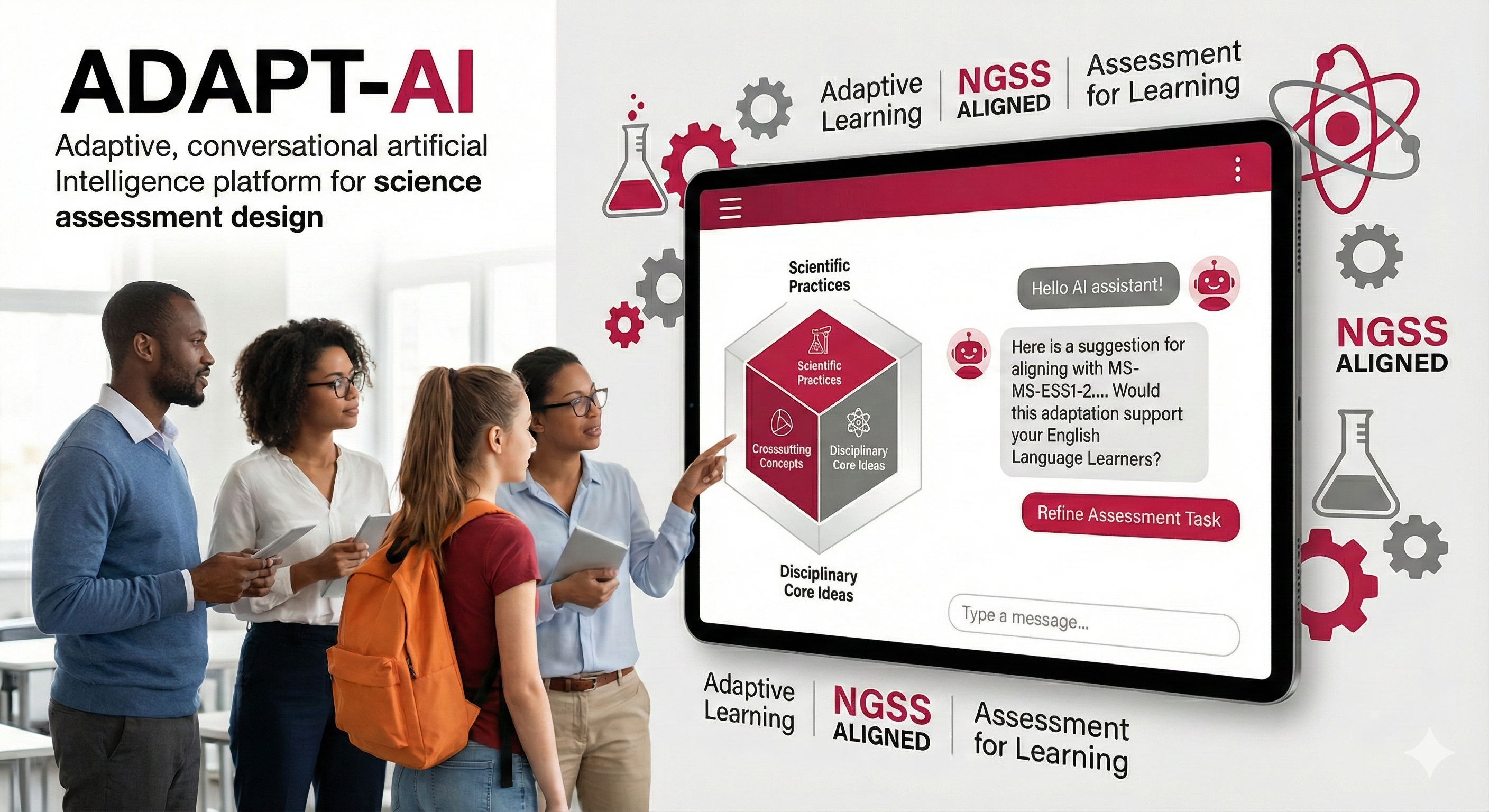
The Adaptive AI (ADAPT-AI) project focuses on the design and evaluation of an AI-empowered assessment system to support three-dimensional science learning aligned with the Next Generation Science Standards (NGSS).
The project responds to a persistent challenge in K–12 science education: teachers, particularly in under-resourced and rural contexts, often lack the time, tools, and support needed to design high-quality formative assessments that capture students’ scientific reasoning in use.
ADAPT-AI develops an adaptive, conversational AI system that supports teachers in co-designing, refining, and interpreting science assessment tasks. Rather than automating assessment decisions, the system is designed to work with teachers, allowing them to guide assessment design while drawing on AI support for alignment, adaptation, and feedback. The project brings together system design, learning sciences research, and independent evaluation to understand how AI can meaningfully support assessment practice in real classroom settings.
Additional information about the ADAPT-AI project is available on the AIR Communications website: Can AI Help Teachers Design Formative Assessments in Science Education? Evaluating the ADAPT-AI Tool
02 /Project Vision
A partner, not an autopilot.
Rather than automating assessment decisions, ADAPT-AI positions AI as a collaborative partner — supporting teachers’ professional judgment while enhancing transparency, adaptability, and usability in assessment practice.
Teachers play a central role in assessment design, yet often lack sufficient time, tools, and support to develop high-quality formative assessments that capture students’ scientific reasoning in use, particularly in under-resourced and rural contexts.
03 /Project Goals
From design to classroom evidence.
Three connected strands bring together system design, human–AI collaboration research, and independent evaluation.
System Design & Development
Building a scalable, AI-powered, multi-agent system that enables teachers to design NGSS-aligned science assessments responsive to classroom context, student diversity, and instructional goals.
Human–AI Collaboration Research
Investigating how teachers interact with AI systems, how professional judgment and AI suggestions are negotiated, and how trust, agency, and decision-making evolve when AI is a partner rather than an automated tool.
System Evaluation
Independently evaluating usability, implementation, and impacts on teacher practice and student assessment experiences in authentic classroom settings — evidence to inform future scaling and refinement.
04 /People & Partnership
Team & Collaborators
Project Team
- Peng He
- Zeyuan Wang
- Julia Lee
- Freeman Chen
- Honglu Liu
Collaborators
- Microsoft AI for Good Lab
- National Academy of Education
- American Institutes for Research
Partners
- Washington Educational Service District 101
- Washington ESD 112
- Washington ESD 123