Project Description
This project develops an AI-powered Group Argumentation Coordinator to support argumentation-based science learning in middle school classrooms in Washington State. Scientific argumentation is a core practice in science education, yet many teachers struggle to provide real-time, equitable support during small-group discussions, particularly in large or under-resourced classrooms.
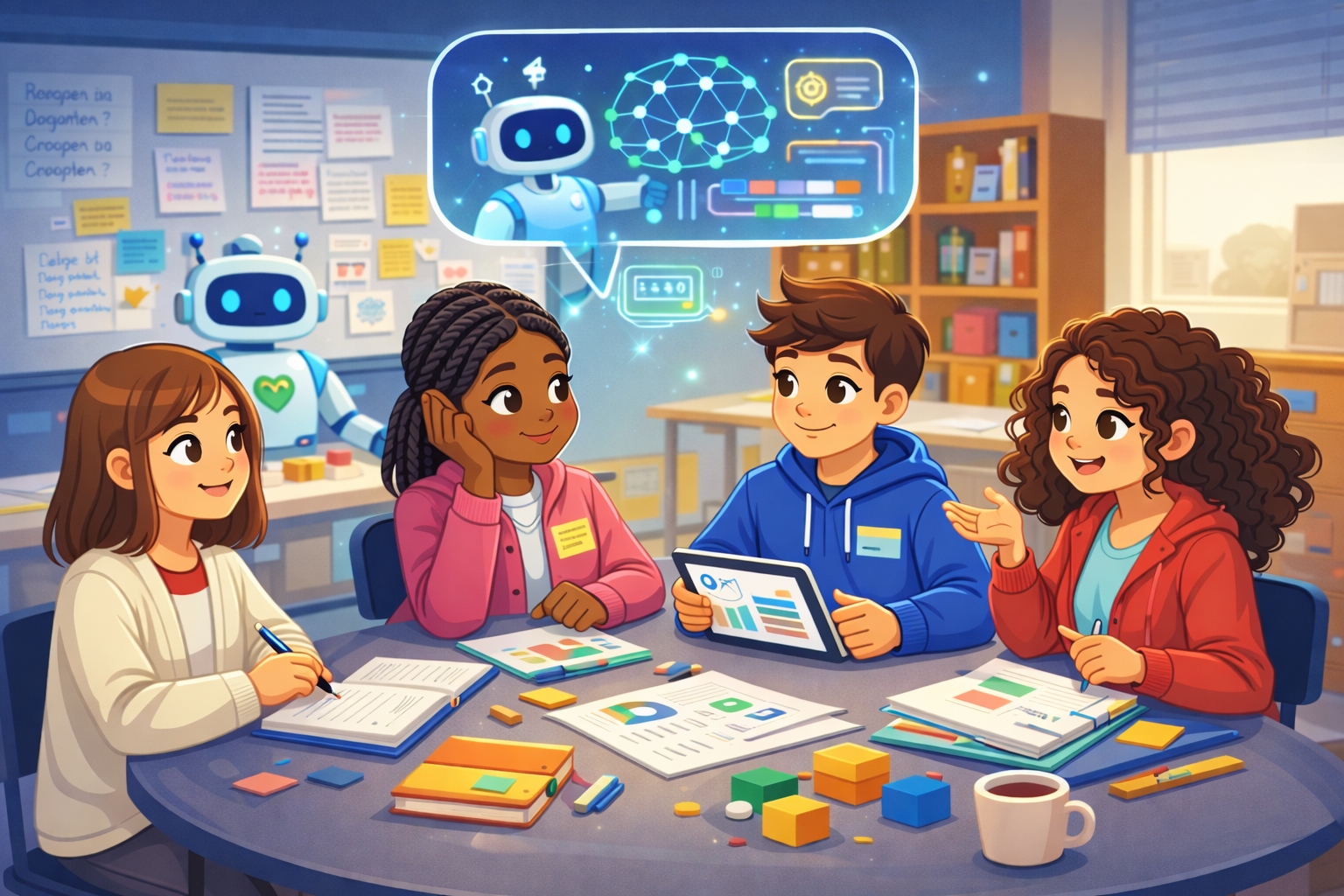
The Group Argumentation Coordinator is designed to assist teachers by tracking students’ discussion progress, generating adaptive prompts, and summarizing key ideas during group argumentation activities. Using a multi-agent AI system, the tool supports teachers in monitoring multiple groups simultaneously while promoting more inclusive and productive student participation. Rather than replacing teacher facilitation, the system is designed to work alongside teachers, providing real-time instructional support that enhances transparency, fairness, and usability in classroom discussions.
Project Information
Project Period: 2025–2027
Project Lead: Peng He
Funding Agencies:
This project is supported by Microsoft AI for Good Lab.
Project Vision
Scientific argumentation is a core practice in science education, yet many teachers struggle to provide real-time, equitable support during small-group discussions, particularly in large or under-resourced classrooms.
Rather than replacing teacher facilitation, the system is designed to work alongside teachers, providing real-time instructional support that enhances transparency, fairness, and usability in classroom discussions.
Project Goals
- Goal 1: Design an AI-powered Group Argumentation Coordinator
Develop a scalable, multi-agent AI system that can track student discussions, generate real-time argumentation prompts, and summarize key ideas to support teacher facilitation of group work. - Goal 2: Support equitable participation in science argumentation
Use AI-based scaffolding to promote inclusive and balanced student participation, with particular attention to students in under-resourced and diverse classroom contexts. - Goal 3: Pilot and refine the system in authentic classrooms
Conduct small-scale classroom pilots in Washington State to gather teacher and student feedback, refine system usability, and improve AI transparency, fairness, and instructional relevance.
Team & Collaborators
Project Team:
Tingting Li, Andy Cavagnetto, Honglu Liu, Parteek Kumar, Julia Lee, Jacob Fox, Dillon Sherling, Freeman Chen
Collaborators:
Microsoft AI for Good Lab
Partners
Washington Educational Service Districts (ESD 101), Pullman School District, Moscow School District