Teaching
- ME501: Continuum Mechanics (Fall 2024)
- ME/MSE 241: Engineering Computations (Spring 2025, Spring 2026)
- ME483: Machine Learning for Engineering Applications (Fall 2025)
- ME579: AI in Manufacturing (Fall 2026)
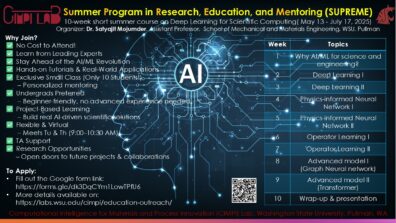
Summer Program in Research, Education, and Mentoring (SUPREME)
SUPREME is a free, two-week summer course run by the CIMPI Lab, designed primarily for undergraduate students though open to and regularly attended by graduate students as well. Each cohort works through hands-on tutorials and a project-based curriculum in small classes with direct mentorship from the lab. SUPREME will return in 2027 — updates will be posted on this page.
SUPREME 2026
The 2026 cohort met every weekday from 9:00–11:00 AM (PDT), June 1–June 12, for a course on AI in manufacturing. Applications closed April 15, 2026.
Program outline
| Day | Lecture theme | Core topics covered | Hands-on tutorial |
|---|---|---|---|
| 1, M | AI in manufacturing — the big picture | Manufacturing AI problem types: quality control, predictive maintenance, anomaly detection, process control. Industry 4.0 context. | Python review tutorial, dataset cleaning and preparation, feature engineering, sensor-to-insight pipeline for predictive maintenance |
| 2, T | Practice, TA hours, Q&A, mini-project progress on dataset preparation | ||
| 3, W | Supervised learning methods | Decision trees, random forests, support vector machines, regularization, model selection | Defect prediction and remaining useful life (RUL) |
| 4, Th | Practice, TA hours, Q&A, mini-project progress on supervised learning | ||
| 5, F | Unsupervised learning methods | Clustering, dimension reduction using PCA, SVD | Anomaly detection in production lines |
| 6, M | Deep learning methods | Intro to feed-forward neural networks, convolutional neural networks | Visual quality inspection with CNNs |
| 7, T | Practice, TA hours, Q&A, mini-project progress on unsupervised learning & deep learning | ||
| 8, W | Reinforcement learning | Markov decision processes, reward functions, Q-learning, policy gradient methods (PPO) | Process control optimization (closed-loop control) |
| 9, Th | Practice, TA hours, Q&A, mini-project progress on reinforcement learning | ||
| 10, F | Mini-project presentations | ||
Cohort of 2026
- Parsa Akbari (PhD, MME, WSU)
- Stan Teagho (MME, WSU)
- Erroll Aaron (UG, ChemE, WSU)
- Christopher Munson (UG, CSE, Wash U St Louis)
- Ted Charles Norton (UG, Honors College, WSU)
- Michael B. Myers (PhD, MME, WSU)
- Nathan W. Zuckschwerdt (PhD, MME, WSU)
- Bryon Nicholas White (PhD, MME, WSU)
- Wyatt Ballweber (UG, MME, WSU)
- Matthew Schlichting (UG, MME, WSU)
- Katana Mehtabel (UG, MME, WSU)
- Benjamin Polovnikoff (UG, MME, WSU)
- Colten A. Ladd (UG, MME, WSU)
- Rayman Angulo Gutierrez
- Akash Kanji (UG, MME, Jadavpur University)
- Ratanjali Pandey (PhD, MME, WSU)
- Joseph Patrick Drapal (MS, MSE, WSU)
- Dr. Nandita Biswas (MME, WSU)
- Dr. Emily A. Larsen (MME, WSU)
- Pallock Halder (PhD, MME, WSU)
- Tiana Tonge (PhD, MME, WSU)
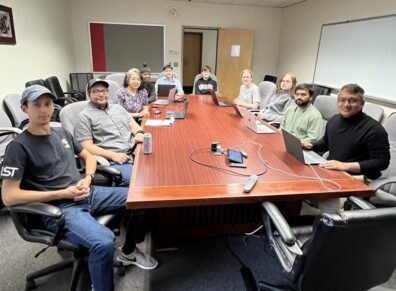
SUPREME 2025
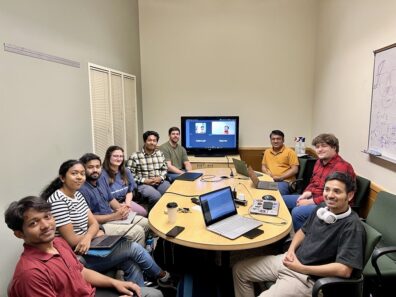
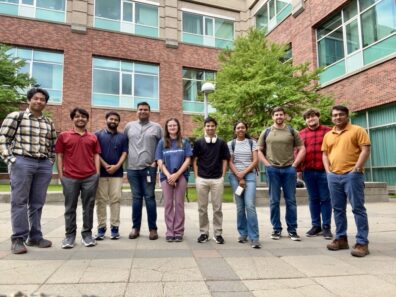
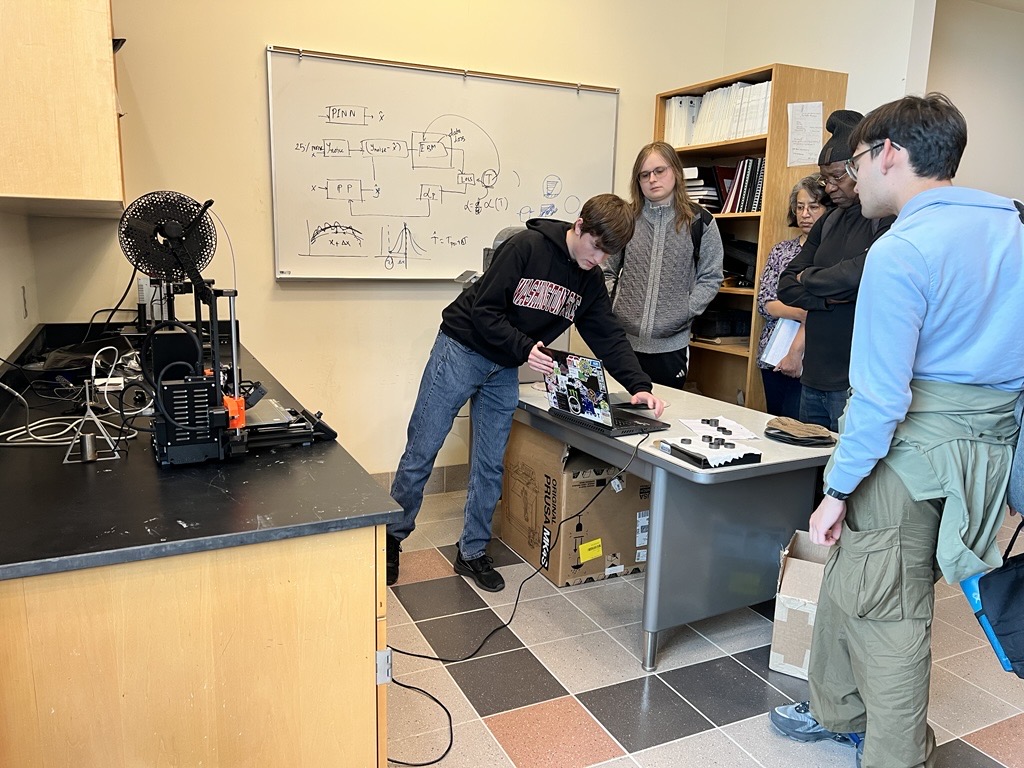
The 2025 cohort met every weekday from 9:00–11:30 AM (PDT), June 16–June 27, for an in-person course on deep learning for scientific computing. Eleven students from four departments —
Mechanical Engineering (ME), Computer Science and Engineering (CSE), Electrical and Electronic Engineering (EEE), and Materials Science and Engineering (MSE) — took part, including three undergraduates and one master’s student, with two participants coming from outside WSU. Over the two weeks, students worked through lectures and hands-on sessions covering recent developments in deep learning and its applications in scientific computing.
Cohort of 2025
- Aruntapan Dash (PhD, MME, WSU)
- Akash Kanji (UG, MME, Jadavpur University)
- Lochan Upadhayay (PhD, MME, WSU)
- Jeremy Colon-Castro (UG, CS, WSU)
- Nolan Howard (UG, MME, WSU)
- Priya Kushram (PhD, MME, WSU)
- Dipan Kar (PhD, EECS, WSU)
- Shohom Bandyopadhyay (PhD, ME, CMU)
- William Hogg (MS, MME, WSU)
- Pallock Halder (PhD, MME, WSU)
- Tiana Tonge (PhD, MME, WSU)
Student feedback
The structured workflow and real problem-solving approach made it easier to conceptualize how to apply deep learning to physics-based models in my research.
The workshop provided clear explanations and practical engineering examples, which helped strengthen my understanding. I feel more prepared and confident to use deep learning methods in engineering problems.
I already had a bit of a background from this last semester, but I learned a lot over the two-week course.
Knew nothing going in and feel like I could create a simple network, and a complex one with help.