In recent years, advanced manufacturing technologies, better computational hardware, and sophisticated algorithms for big data have created new opportunities for product, materials, and process design. The main question is how to use these technologies, like additive manufacturing, along with AI and powerful hardware, to promote sustainable manufacturing for future products. Our research focuses on this question by exploring the intersection of mechanics, materials, and manufacturing to advance the next generation of materials and product development. Currently, we are exploring the following research topics in our group.
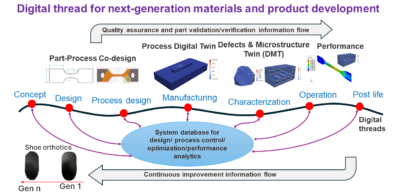
Digital thread for next-generation materials and product development
Building on our group expertise and previous research in developing simulation tools for material design, manufacturing, and performance prediction in additive manufacturing, we aim to establish a ‘digital thread’ that integrates these elements to simulate the entire life cycle of next-generation products manufactured using additive processes. This digital thread is founded on creating high-fidelity computational models and digital twins for process-informed design, process modeling and optimization, performance testing, and operation assessment. We communicate this information by developing a system database for iterative design processes, enabling the development of optimized product versions that offer the desired performance while accounting for uncertainties and multi-functionality.
Mechanistic data science for advanced intelligent materials system development
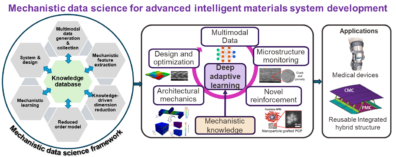
Multiscale, multiphysics, and multi-fidelity modeling can unveil the governing mechanism of the materials’ response and enable us to design intelligent materials systems. The advent of 3D/4D printing has opened up opportunities for creating multifunctional materials, including high-temperature materials like ceramic composites. In particular, we are interested in the following key challenges in this area: (i) characterizing non-stationary microstructures at different scales and interpreting their process signatures, (ii) gaining insights into novel reinforcements and interface multiresolution mechanics to enhance damage control and structural integrity, (iii) developing efficient data-driven reduced-order multiresolution models for rapid performance prediction and analysis, (iv) integrating the above aspects into the design of multifunctional materials systems, incorporating uncertainty quantification and optimization. Our approach is to develop a mechanistic data science framework by integrating theoretical, experimental, and computational data to understand the process-structure-propoerty-performance of advanced material systems. This framework will facilitate the design, performance analysis, optimization, and uncertainty quantification of intelligent materials systems for a wide range of applications, spanning from space technology to soft robotics and beyond.