Interacting stressors in splashpools
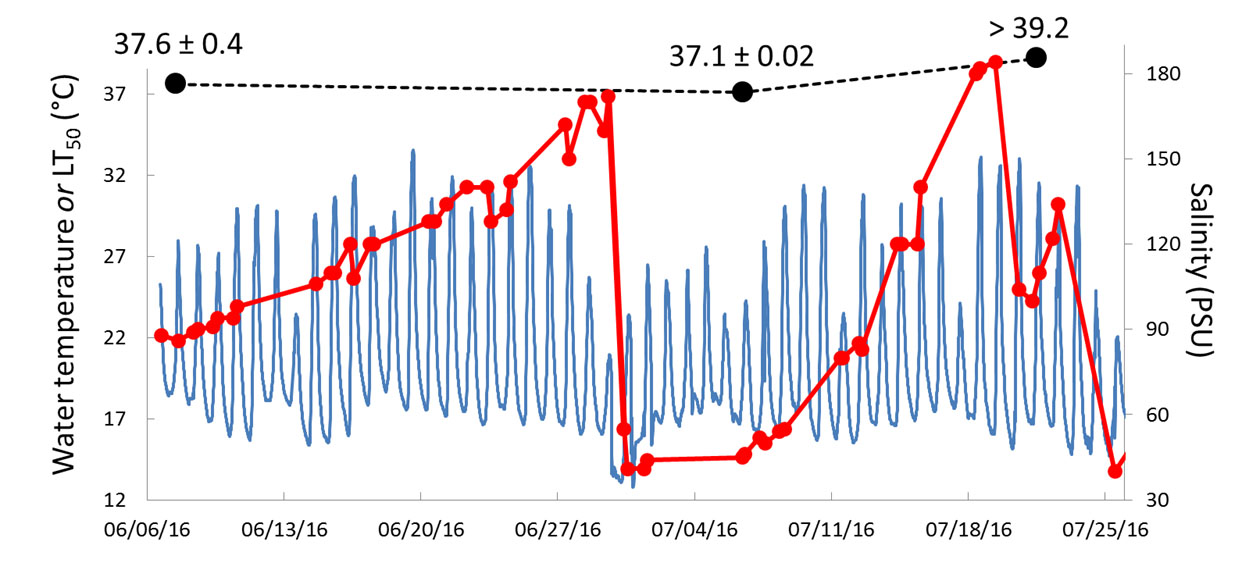
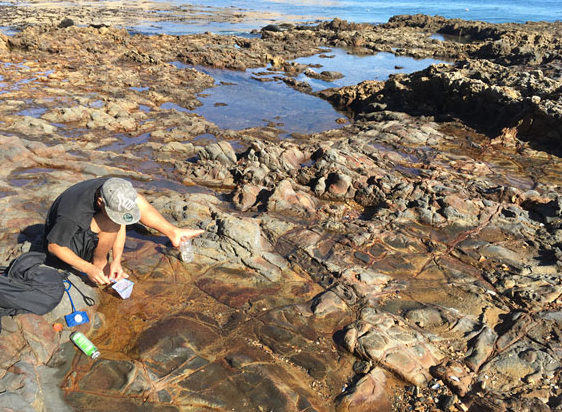
Environmental conditions in the highest intertidal pools are extremely dynamic
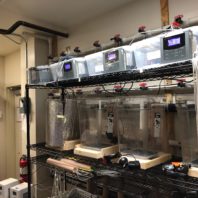
The newest line of work in the lab, funded by a collaborative National Science Foundation IOS grant with Dr. Mark Denny of Stanford’s Hopkins Marine Station, explores responses of the copepod Tigriopus californicus to multiple, interacting stressors in its splashpool habitat. This tiny arthropod is an excellent model system and exhibits remarkable physiological tolerances. Salinity, temperature, oxygen, and pH all cycle in sometimes dramatic – and unpredictable – fashion in these splashpools. Our work to date has largely focused on interactions between salinity and temperature and their effects on thermal tolerance. Higher salinity (to a point) confers enhanced tolerance of heat stress, an effect possibly mediated by the accumulation of small organic osmolytes in the hemolymph. We have developed instrumentation to recreate realistically cycling environmental conditions in the laboratory and to then quantify the physiological phenotype of individual copepods following exposure to these conditions. We intend to integrate these organismal observations with corresponding information at the molecular level. Current projects are quantifying protein expression patterns and metabolite profiles under single and multiple-stressor scenarios.
- Dinh, K. V., Cuevas-Sanchez, A. Y., Buehl, K. S., Moeser, E. A., and W. W. Dowd. 2020. Heat tolerance and thermal preference of the copepod Tigriopus californicus are insensitive to ecologically relevant dissolved oxygen levels. Sci. Rep. 10:18885.
- Denny, M. W. and W. W. Dowd. 2022. Elevated salinity rapidly confers cross-tolerance to high temperature in a splash-pool copepod. Integr. Organ. Biol. 4:obac037
We aim to gain a better understanding of the ways in which present-day patterns of variation in multiple environmental parameters influence organismal physiology. This is an important prerequisite for forecasting the physiological effects of likely future environmental scenarios, in which we expect more than one environmental parameter to change.