Research Highlight
Highlight — Ecological niche modeling and potential dispersal of emerald ash borer in the Pacific Northwest
The emerald ash borer, Agrilus planipennis Fairmire (Coleoptera: Buprestidae), is a notorious invasive pest that can devastate ash trees, Fraxinus spp. L., and embedded communities. While emerald ash borer is established in eastern North America, it was recently detected in Forest Grove, Oregon and in Vancouver, British Columbia, raising concerns that it may spread across the Pacific Northwest riparian ecosystems dominated by ash. A quarantine zone has been established in Oregon, but future mitigation depends on assessing the spread to new regions. Here, we used habitat suitability models and dispersal simulations to predict the potential spread of emerald ash borer. Specifically, we compared climate spaces occupied by Oregon and British Columbia populations with other native and introduced populations, and then used habitat suitability models and dispersal simulations to predict future distributions. We show that the newly established Oregon and British Columbia populations currently occupy relatively narrow climate niche, and many suitable niche spaces are unoccupied in the Pacific Northwest, indicating potential for range expansion. We also show there are vast areas of suitable habitat that extend south of the present quarantine zone throughout inland western Oregon and north into Washington. In Vancouver, the most suitable habitat was found along the Fraser River, where emerald ash borer could disperse inland. Dispersal models suggest that, without intervention, emerald ash borer could disperse into Washington within 2 yr, throughout western Oregon in 15 yr, and reach California in 20 yr. Our work supports intensive quarantine efforts for emerald ash borer and identifies areas where monitoring and management efforts should focus.
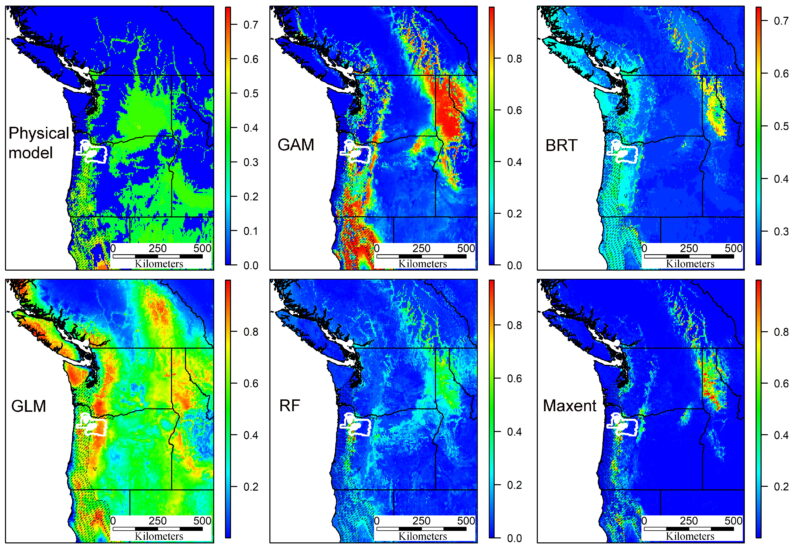
The habitat suitability was estimated by a physiological model (physical model) and 5 correlative niche models, i.e., GAM, BRT, GLM, RF, and Maxent. Warm red colors indicate high suitability, white dots denote emerald ash border detections in Oregon and British Columbia, white solid line denotes the quarantine areas established by the Oregon Department of Agriculture, and the slash area denotes Oregon ash distribution.
Gengping Zhu, Max Ragozzino, Mark Cody Holthouse, Mattthew Mills, Jessica L Celis, Stacy Johnson, David W Crowder (2025) Ecological niche modeling and potential dispersal of emerald ash borer in the Pacific Northwest. Journal of Economic Entomology, toaf175, https://doi.org/10.1093/jee/toaf175.
Highlight — Potential distribution and spreading of Japanese Beetle in Washington State
The Japanese beetle, Popillia japonica, was first detected in southern Washington State in 2020. Widespread trapping efforts ensued, and over 23,000 individuals were collected in both 2021 and 2022 in this region known for specialty crop production. The invasion of Japanese beetle in Washington State is of major concern as it feeds on over 300 plant species and has shown an ability to spread across landscapes. Here we created a habitat suitability model for Japanese beetle in Washington and used dispersal models to forecast invasion scenarios. Our models predict that the area of current establishment occurs in a region with highly suitable habitat. Moreover, vast areas of habitat that are likely highly suitable for Japanese beetle occur in coastal areas of western Washington, with medium to highly suitable habitat in central and eastern Washington. Dispersal models suggested that the beetle could spread throughout Washington within 20 years without management, which justifies quarantine and eradication measures. We believer our timely map-based predictions can be useful tools to guide management of invasive species while also increasing citizen engagement to invaders. All model predictions were deposited in Open Science Framework at https://osf.io/7spjf, they can be viewed and modified in any GIS platform. Check the publication here: https://doi.org/10.1093/jee/toad116.

Potential distributions of Japanese Beetle in Washington State based on ensemble models (Zhu et al. 2023).
We developed this interactive map to facilitate its application, check it out HERE. Our work was heightened in WSU Insider, check this out: Japanese beetles could spread across Washington in 20 years.