Quantum Education
There are many opportunities to learn about quantum technologies at WSU. While there are many popular explanations of quantum phenomena, to truly appreciate the quantum nature of the world requires some mathematical sophistication. The foundation is linear algebra: if you have a strong background here – unitary matrices, eigenvalues and eigenvectors, singular value decomposition (SVD) etc. – then you can essentially and accurately understand the formulation of the theory, including all of the puzzling phenomena related to superposition, entanglement, measurement, and Schrödinger’s cat. This is the basis for Physics 455/555 Quantum Technologies and Computation which provides an overview for students from all departments of WSU with minimal prerequisites.
To understand the actual physical realization of quantum mechanics, and the technology behind quantum devices, requires a solid background in physics. Here you will learn both theoretical and experimental techniques, gaining the hands-on skill needed to pursue a career in quantum technology and adjacent industries.
Undergraduates from across the country are encouraged to apply to our REU program “Waves in Physics” where you will can engage in cutting-edge quantum research, with both theory and experimental opportunities.
If you are just curious, and not sure yet if you want to commit to taking a course, please send us an email to iQ@wsu.edu.
Outreach
To schedule a tour with one of the labs listed below, please send an email to iQ@wsu.edu.
- Ultracold Quantum Gas Lab
- Quantum Optics Lab
- Nonlinear Optics Lab
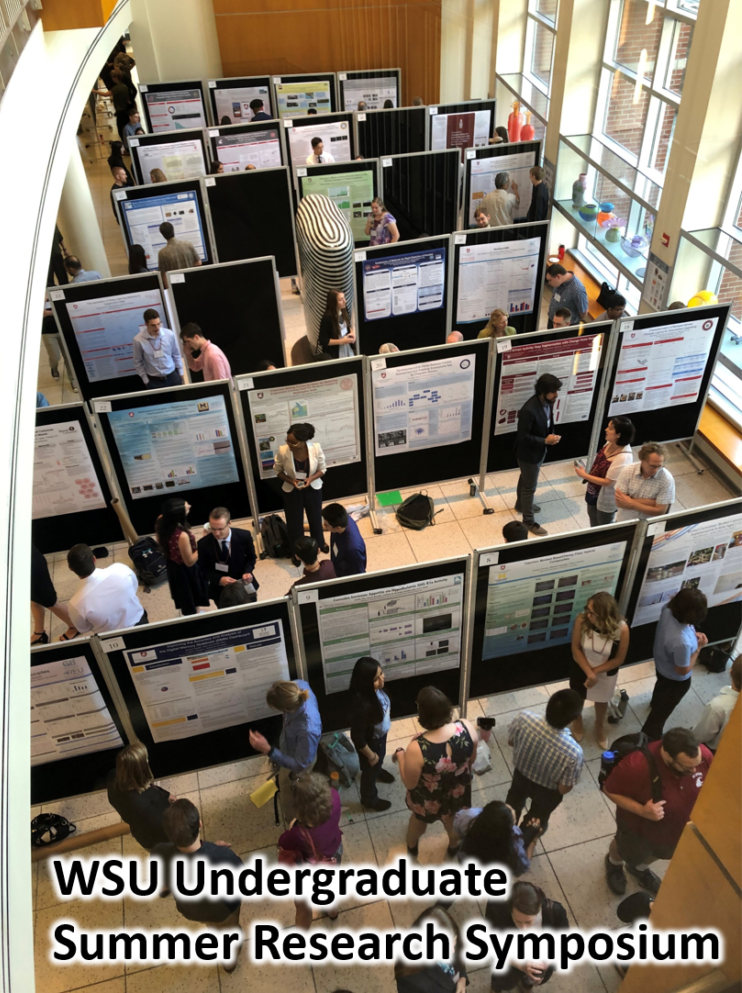
- Undergraduate Academic Showcase
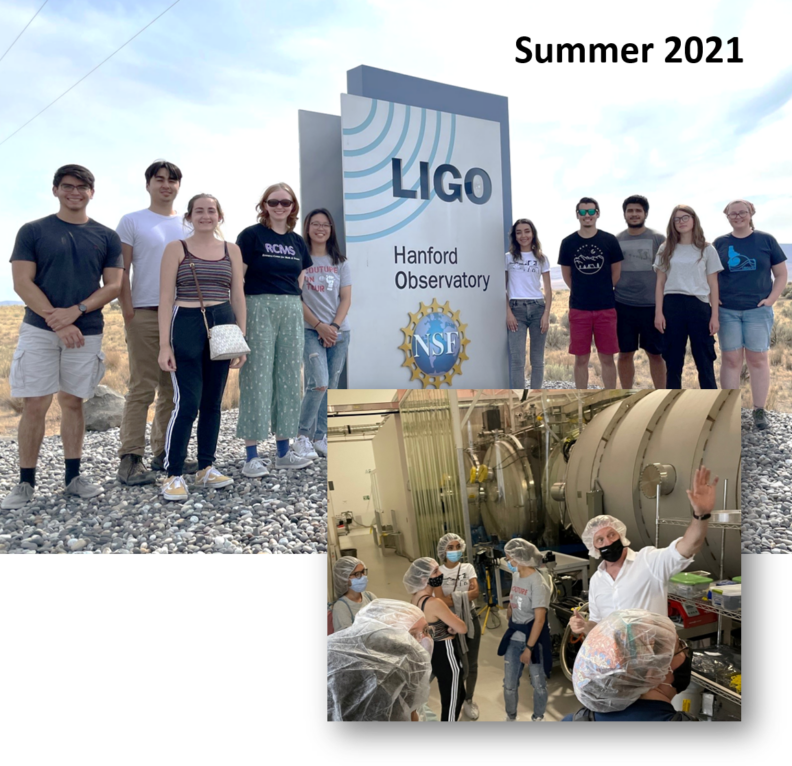
- Tour to LIGO
- Visit Pacific Northwest National Laboratory (PNNL)
- Collaborate with NASA JPL
Undergraduate Student Resources
REU Program
Each summer, the WSU Physics and Astronomy department runs a 10-week research experience for undergraduate students program. Students work on their own research project together with a faculty mentor and a team of graduate students and postdocs within a research group. Projects span four major themes, many with direct connection or strong overlap with quantum research.
- Phonons and Shockwaves
- Quantum Wavefunctions
- Photons in Applied Materials
- Waves Revealing the Cosmos

Undergraduate Courses
- Phys. 303: Modern Physics I
- Phys. 304: Modern Physics II
- Phys. 320: Mechanics
- Phys. 330: Thermal Physics
- Phys. 341/342: Electricity and Magnetism I/II
- Phys. 415: Quantum Physics Laboratory
- Phys. 443: Optics
- Phys. 450: Introduction to Quantum Mechanics
- Phys. 455: Quantum Technologies and Computation
- Phys. 461: Introduction to Atomic and Molecular Physics
- Phys. 463: Introduction to Solid State and Material Physics
- Phys. 465: Introductory Nuclear Physics
Graduate Student Resources
Graduate Courses
- Phys. 511: Advanced X-ray Characterization
- Phys. 514/515: Optoelectronics Lab I/II
- Phys. 521/522: Classical Mechanics I/II
- Phys. 533/534: Thermal and Statistical Physics I/II
- Phys. 541: Electromagnetic Theory
- Phys. 542: Electrodynamics
- Phys. 545: Nonlinear Optics
- Phys. 546: Quantum Electronics
- Phys. 550/551/552: Quantum I/II/III
- Phys. 555: Quantum Technologies and Computation
- Phys. 561: Atomic and Molecular Physics
- Phys. 563: Physics of Solid State
- Phys. 571: Methods of Theoretical Physics
- Phys. 575: Advanced Solid State Physics