We investigate geometric and electronic structures, chemical bonding interactions, redox behavior, thermodynamic properties, reactivity, and spectroscopic signatures of novel compounds to solve challenging problems in the areas of nuclear chemistry and energy storage.
Our Focus
In our group we employ computational chemistry to solve various problems focusing on three major areas: (I) complex electronic structures of f-block compounds, (II) rational design of charge carriers for next-generation energy storage, and (III) exotic clusters which exhibit fascinating bonding properties.
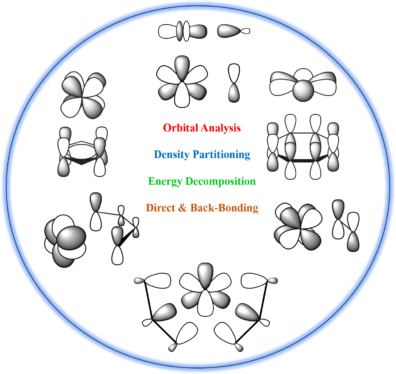
(I) Research on f-block materials is relatively new due to their scarcity and strange behavior, but it has garnered a vast amount of attention in recent decades due to technological enhancements. Over the past few years, lanthanides have been used as optical devices (such as lasers, night vision goggles, and phosphorescent materials), catalysts in petroleum refining, and a tool for imparting strength to metal alloys. Actinides are most recognizable for their use as nuclear fuel, but they are also used for a variety of technologies, such as cardiac pacemakers and smoke alarms. There is a tremendous interest in improving chemical separation techniques and coordination chemistry of actinides in order to facilitate a more efficient disposal of nuclear waste. In our research, we elucidate the behavior of lanthanides and actinides in relation to their chemical reactivity, redox properties, electronic structure, spectroscopic features, and unique multi-nodal metal-ligand bonding interactions.
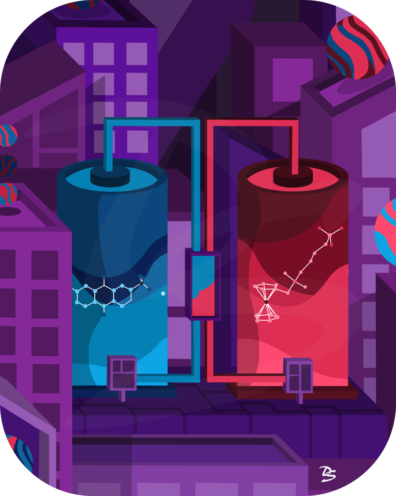
(II) Energy consumption in recent decades has increased dramatically, which has had an enormous effect on the environment. To combat this ever growing need for more energy and strain on the environment, alternative and renewable fuel sources have garnered a large amount of attention. While there are plenty of devices currently available to provide renewable energy, storage of the energy proves to be a difficult task. One of the most promising future technologies for large-scale energy storage is the redox flow battery (RFB). In our research, we computationally assess various factors to increase the efficiency of RFBs including redox potentials, stability, and solubility of the redox active species and also complement theoretical instigations with experimental validation through well-established collaborations with universities and national laboratories. Our research is crucial for making the environment a cleaner and safer place for future generations.
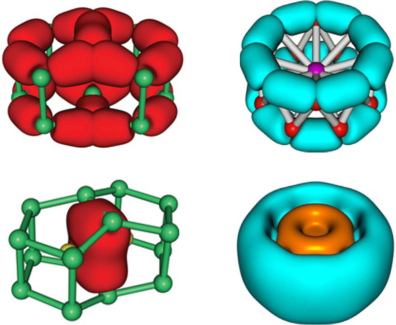
(III) A cluster, an ensemble of bound atoms or molecules that is intermediate in size between a molecule and a bulk solid, may exhibit various stoichiometries and nuclearities. Clusters are the key for developments in catalysis, crystal growth, optical and magnetic applications, environment and energy, biological systems, miniature devices, and designing novel cluster-assembled materials. Properties of the clusters can be fine-tuned to the researcher’s desire. In our research, we focus on the analysis of their electronic structure, deciphering the role of localized and multicenter bonding interactions in relation to their stability and reactivity. We assess their bonding characteristics by evaluating their electron density though the electron localization methods, topological analyses, and molecular orbital theory. One of the major goals is the rational design of the clusters to control their geometric and electronic structures that can impact their physical and chemical properties. We work in close collaboration with experimentalists who synthesize such clusters in a solid state or observe them in a molecular beam employing anionic photoelectron spectroscopy.