Switchable Surfactants for Nanoparticles Paper Accepted in Langmuir!
A new paper from the Saunders Lab was accepted for publication in Langmuir! This work was led by Ph.D student Kristin Bryant along with former MS student Gasim Ibrahim.
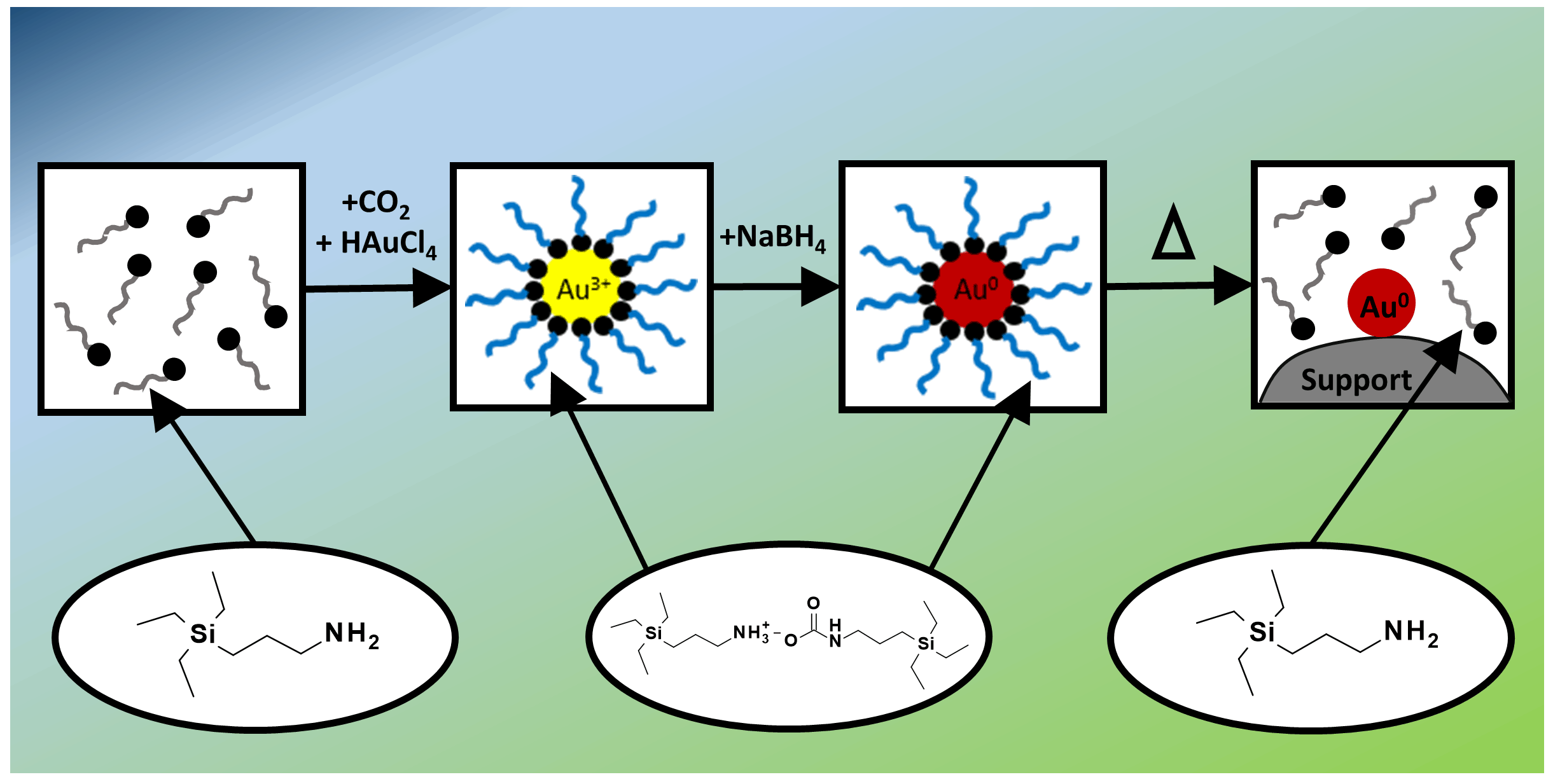
The work investigated the use of switchable surfactants (one that can be turned on or off like a light switch) to prepare nanoparticles. The novelty of this system is seen in the switchability of the surfactant: in the on state, the surfactant stabilizes and helps disperse gold nanoparticles while in of the off-state, the surfactant doesn’t interact strongly with the gold. We leverage this to prepare supported nanoparticle catalysts that are more active than traditionally prepared nanoparticle catalysts with less processing!
This work was funded by the NSF CAREER Award we received earlier this year.
See the work at http://dx.doi.org/10.1021/acs.langmuir.7b02983 or at http://pubs.acs.org/doi/abs/10.1021/acs.langmuir.7b02983
Abstract:
Synthesis methods for the preparation of monodisperse, supported nanoparticles remain problematic. Traditional synthesis methods require calcination following nanoparticle deposition to remove bound ligands and expose catalytic active sites. Calcination leads to significant and unpredictable growth of the nanoparticles resulting in polydisperse size populations. This undesired increase in nanoparticle size leads to a decrease in catalytic activity due to a loss of total surface area. In this work, we present the use of silylamines, a class of switchable solvents, for the preparation of monodisperse, supported nanoparticles. Silylamines are switchable molecules that convert between molecular and ionic forms by reaction with CO2. Upon addition of an alkane, the switchable solvent behaves as a switchable surfactant (SwiS). The SwiS is used to template nanoparticles to aid in synthesis and subsequently used to release nanoparticles for deposition onto a support material. The use of SwiS allowed for the preservation of nanoparticle diameter throughout the deposition process. Finally, it is demonstrated that supported gold nanoparticle catalysts prepared using SwiS are up to 300% more active in the hydrogenation of 4-nitrophenol than their traditionally prepared analogs.