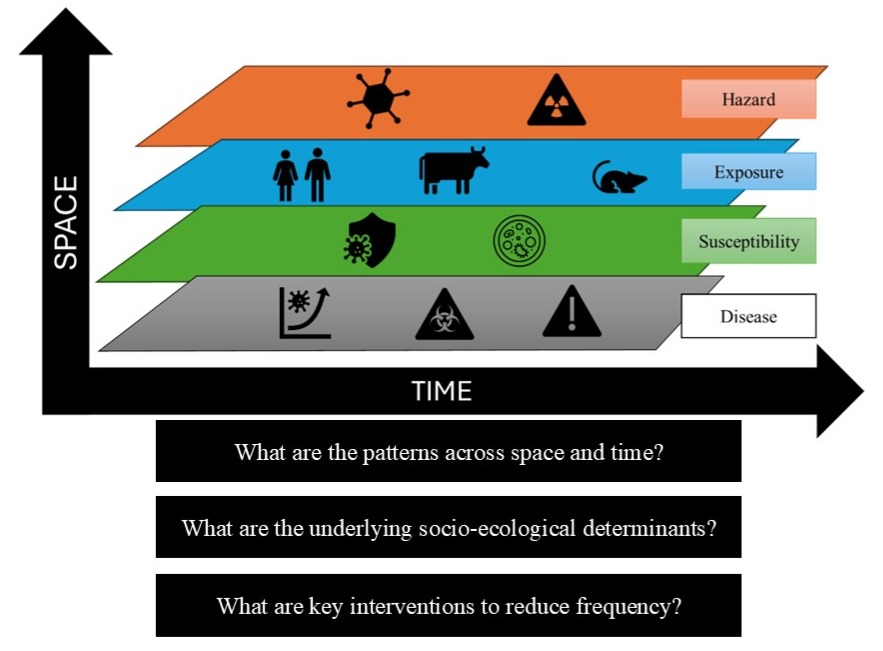
We conduct investigations to answer place-oriented questions about the ecology and epidemiology of pathogens and toxicants at the human-animal-environment interface:
- What are the epidemiological patterns of pathogens and toxicants with medical and veterinary significance?
- How do socio-ecological determinants modulate spatiotemporal patterns of such pathogens and toxicants?
- How does heterogeneity in host and vector traits influence spread of such pathogens and toxicants?
- What evidence-based interventions can be applied to reduce the frequency of pathogens, toxicants and disease?
We focus on systems where rodents play a role but are open to other systems
Rodents are the largest order of mammals with critical roles in ecosystem functioning. Several rodents are synanthropic (live close or with people). Many species, such as house mice (Mus musculus), and select Peromyscus spp., serve as reservoirs (or carriers) for pathogens that can affect human and animal health. Some examples of pathogens include orthohantaviruses, mammarenaviruses, Borrelia spp., Babesia spp., and Leptospira spp.
Many rodent species can also serve as environmental bioindicators of toxicants, such as heavy metals, because of their life histories and close association with soil. Because many rodent species can also be agricultural and urban pets, anti-coagulant rodenticides are used to control them. However, rodents can become resistant to these and can transfer rodenticides to predatory wildlife, such as raptors, which can become poisoned.
We investigate the interface where the health of wild rodents overlaps with the health of humans and animals (domestic and wild) with the goal of reducing spread of hazards, promoting population health, preventing disease, and optimizing the best health outcomes for animals, humans, and shared environments.