__________________________________________________________________________
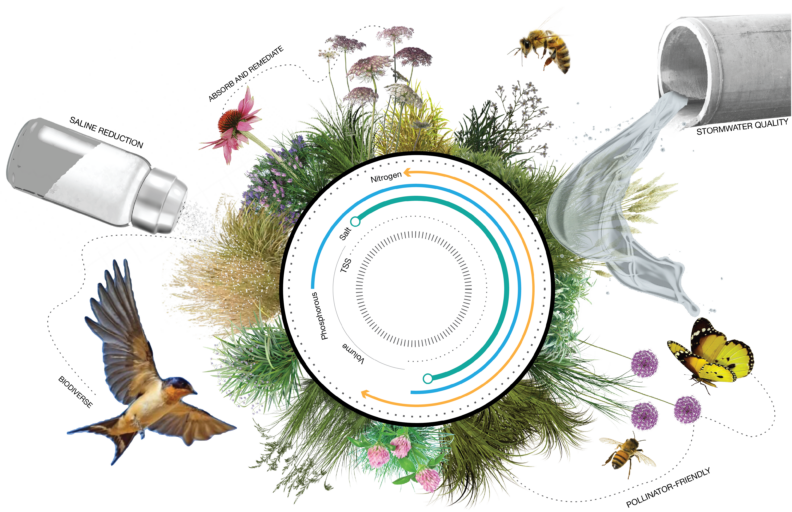
This study advances green infrastructure by offering practical guidance on salt remediation and ecological stormwater solutions. Its findings support designers, land managers, and turfgrass growers in adopting resilient, nature-based approaches to on-site water management across Washington State.
__________________________________________________________________________
THE ISSUE
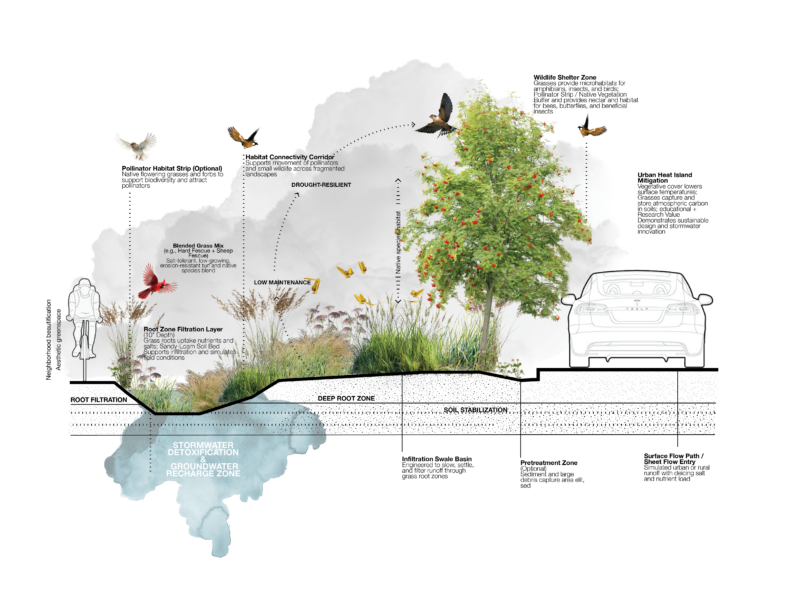
Freshwater resources are diminishing as demands rise faster than water tables can replenish, making grasses or grass blends that are most effectively pulled pollutants out of the groundwater vital for water quality and sustainability practices. The goal of this research was to evaluate the efficiency of contaminant removal and nutrient extraction of a variety of native and non-native turfgrass blends; Common hard fescue (Festuca ovina), Chewing fescue (Festuca rubra), Sheep fescue (Festuca ovina) and blends of these grasses. This study addresses the need for Green Infrastructure and Best Management Practices, focusing on salt remediation. Sodium chloride (NaCl) is a prevalent deicing salt used on impermeable surfaces in cold climates that ends up washing into watersheds in large amounts. This then has consequences in water quality concerns as the carried Na+ and Cl ions causes high levels of contamination when used in lawns, soil, plants, and any receiving waters. Results from this research are significant to designers exploring the implications of best management practices, stormwater management facilities seeking to incorporate more ecological oriented approaches to on-site stormwater management, and turfgrass farmers within Washington State who wish to breed more diverse blends of native grass species.
WHAT WE DID
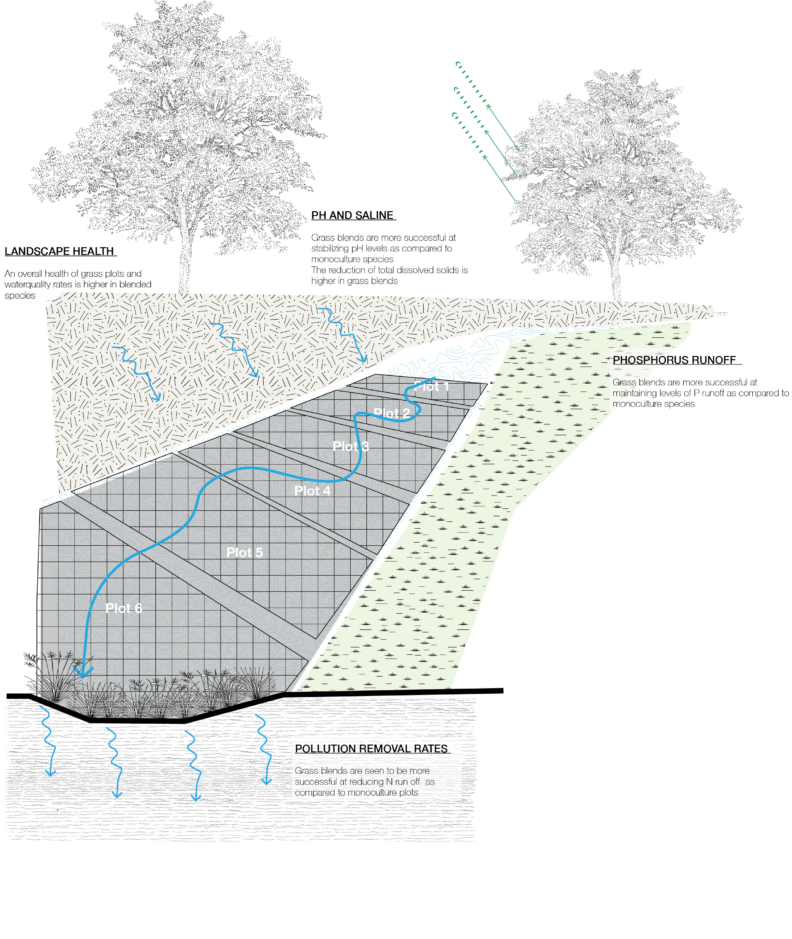
In this work, six grass species and blends were investigated for their salt tolerance and pollutant management by tracking their year-round field performance in five plots along a drainage swale at a research farm facility in eastern Washington State. By flooding the swales with simulated stormwater containing fertilizer and deicing salt. This study was repeated over three different occurrences, where simulated stormwater runoff conditions were kept the same in all events and for all grass species tested. To assess possible salt transport reservoirs, we measured changes in total saline, total diluted solids (TDS), and Ph levels. Using this knowledge, we examined the potential of each grass species’ and blends’ infiltration ability and tolerance as a means of reducing salt transfer, and we identified areas that require additional research.
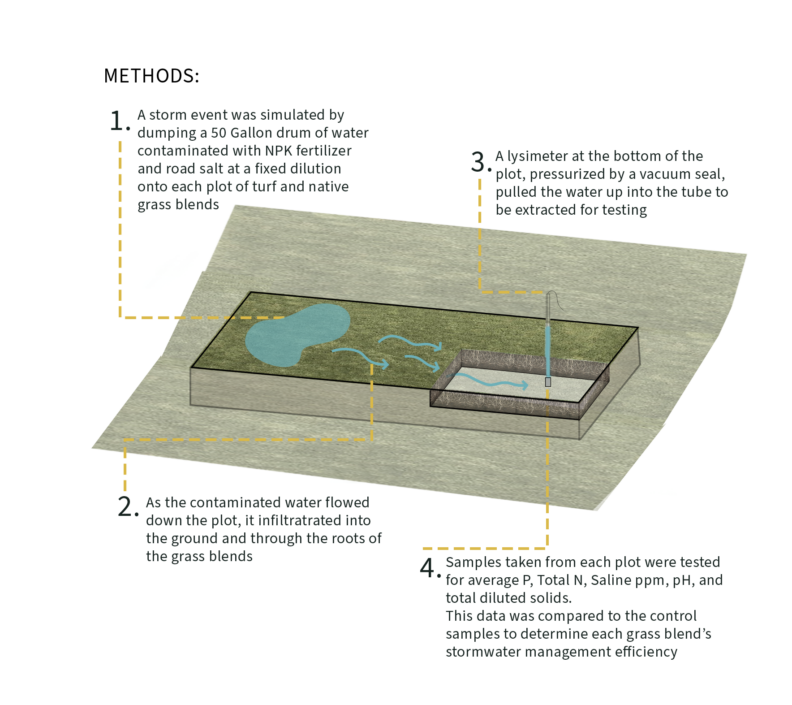
A storm event was simulated by dumping a 50 Gallon drum of water contaminated with fertilizer and road salt at a fixed dilution onto each plot of turf and native grass blends. As the contaminated water flowed down the plot, it infiltrated into the ground and through the roots of the grass blends. A lysimeter at the bottom of the plot, pressurized by a vacuum seal, pulled the water up into the tube to be extracted for testing. Samples were then taken from each plot were tested for average Phosphorus, Total Nitrogen, Saline ppm, pH, and total diluted solids (TDS). This data was compared to the control samples to determine each grass blend’s stormwater management efficiency.
WHAT WE DISCOVERED
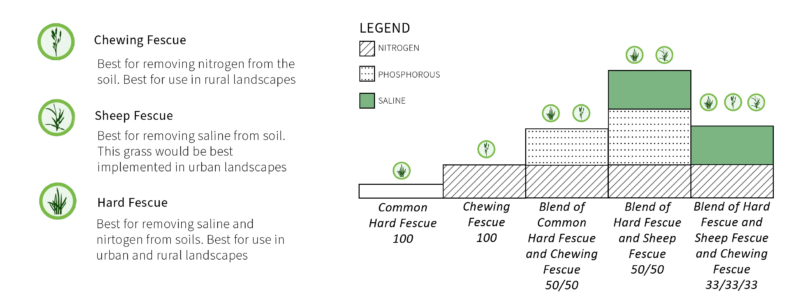
Native grass species and the blends with greater diversity of grass species will outperform and have higher efficiencies in water quality than the monocultures and non-native grass species. The tested blended grass species had the highest success rate at improving stormwater runoff water quality by reducing Total Phosphorus and Total Nitrogen levels, and a greater reduction could be achieved by allowing the contaminants to interact with the grass species longer. All three blends of grass species (Common fescue and Chewing Fescue, and hard fescue and sheep fescue, and Hard fescue, Sheep fescue and Chewing Fescue) were the most successful at reducing the saline levels in all three replications, and hard fescue and sheep fescue was the most successful at reducing saline leaves of all five plots. Other key findings suggest that, compared to monoculture, Grass Blends are seen to be more successful at reducing Nitrogen run off and maintaining levels of Phosphorus runoff. Additionally, the reduction of total Nitrogen is higher in grass blends, and the overall health of grass plots and water quality rates is higher in blended species.
WHAT IT MEANS
The water quality of many communities face significant challenges when trying to improve stormwater runoff quality from contamination from fertilizers. These issues are made even more pressing in light of depleted resources relating to climate change issues. These obstacles can be addressed through new design initiatives in stormwater management through GI and BMPs, as well as policies that encourage conservation and increase water use efficiency. This can be achieved through the conscious use of turf and native grass in stormwater management sites. According to the results of this study, blended grass species had the highest success rate at improving our simulated stormwater runoff water quality by reducing our Saline and Total Diluted Solids levels as well as balancing the Ph levels.
GREENING URBAN AND RESIDENTIAL SPACES| Turfgrass Design Typologies in Residential and Urban Landscapes
PREFERENCES AND PERCEPTIONS STUDY | | Survey and Analysis of Homeowners’ Preferences and Perceptions of Turfgrass Design and Water Maintenance
PERFORMANCE AND RECOVERY OF TURFGRASS | Survey of the Performance and Recovery of Turfgrass in Grass Pavers
RESILIENT TURFGRASS MANAGEMENT | Insights from High-Use Landscapes in Washington State
STORMWATER REMEDIATION & TOLERANCE | Understanding Salt and Nutrient Removal from Stormwater by Turf and Native Grasses