Our research team has partnered with several rural Washington county sheriffs’ offices to examine data on jail bookings between January 2015 and the present to understand jail incarceration trends. Click to download full-length fact sheets. Below are additional resources regarding our research, such as posters and presentations. These resources can be used to learn more about local jail incarceration and talk about potential options for changes in policy and local communities.

Rethinking Rural Recidivism Deason Center (.pdf)
Presentation on YouTube
The Washington Rural Jails Project: Lessons from Rural Places and People
Jennifer Sherman & Jennifer Schwartz
Washington State University
Research Supported by the National Institute of Justice (NIJ), the Vera Institute of Justice, and Arnold Ventures
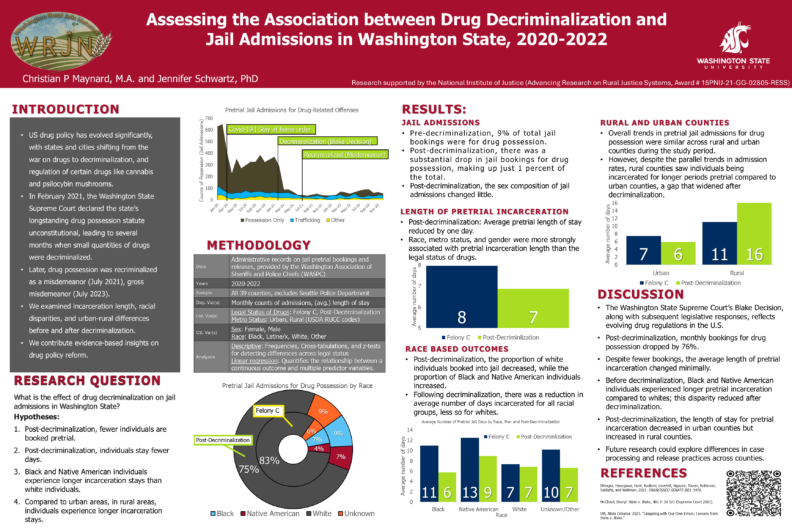
Assessing the Association between Drug Decriminalization and Jail Admissions in Washington State, 2020-2022
Christian P Maynard, M.A. and Jennifer Schwartz, PhD
Washington State University
Research supported by the National Institute of Justice (Advancing Research on Rural Justice Systems, Award # 15PNIJ-21-GG-02805-RESS)
Introduction
- US drug policy has evolved significantly, with states and cities shifting from the war on drugs to decriminalization, and regulation of certain drugs like cannabis and psilocybin mushrooms.
- In February 2021, the Washington State Supreme Court declared the state’s longstanding drug possession statute unconstitutional, leading to several months when small quantities of drugs were decriminalized.
- Later, drug possession was recriminalized as a misdemeanor (July 2021), gross misdemeanor (July 2023).
- We examined incarceration length, racial disparities, and urban-rural differences before and after decriminalization.
- We contribute evidence-based insights on drug policy reform.
Research Question
What is the effect of drug decriminalization on jail
admissions in Washington State?
Hypotheses:
- Post-decriminalization, fewer individuals are booked pretrial.
- Post-decriminalization, individuals stay fewer days.
- Black and Native American individuals experience longer incarceration stays than white individuals.
- Compared to urban areas, in rural areas, individuals experience longer incarceration stays.
Methodology
Data
Administrative records on jail pretrial bookings and
releases, provided by the Washington Association of
Sheriffs and Police Chiefs (WASPC)
Years
2020-2022
Sample
All 39 counties, excludes Seattle Police Department
Dependent Variables
Monthly counts of admissions, (avg.) length of stay
Independent Variables
Legal Status of Drugs: Felony C, Post-Decriminalization
Metro Status: Urban, Rural (USDA RUCC codes)
Control Variables
Sex: Female, Male
Race: Black, Latine/x, White, Other
Analyses
Descriptive: Frequencies, Cross-tabulations, and z-tests
for detecting differences across legal status
Linear regression: Quantifies the relationship between a
continuous outcome and multiple predictor variables.
Results
- Pre-decriminalization, 9% of total jail bookings were for drug possession.
- Post-decriminalization, there was a substantial drop in jail bookings for drug possession, making up just 1 percent of the total.
- Post-decriminalization, the sex composition of jail admissions changed little.
Length of Pretrial Incarceration
- Post-decriminalization: Average pretrial length of stay reduced by one day.
- Race, metro status, and gender were more strongly associated with pretrial incarceration length than the legal status of drugs.
Race Based Outcomes
- Post-decriminalization, the proportion of white individuals booked into jail decreased, while the proportion of Black and Native American individuals increased.
- Following decriminalization, there was a reduction in average number of days incarcerated for all racial groups, less so for whites.
Rural and Urban Counties
- Overall trends in pretrial jail admissions for drug possession were similar across rural and urban counties during the study period.
- However, despite the parallel trends in admission rates, rural counties saw individuals being incarcerated for longer periods pretrial compared to urban counties, a gap that widened after decriminalization.
Discussion
- The Washington State Supreme Court’s Blake Decision, along with subsequent legislative responses, reflects evolving drug regulations in the U.S.
- Post-decriminalization, monthly bookings for drug possession dropped by 76%.
- Despite fewer bookings, the average length of pretrial incarceration changed minimally.
- Before decriminalization, Black and Native American individuals experienced longer pretrial incarceration compared to whites; this disparity reduced after decriminalization.
- Post-decriminalization, the length of stay for pretrial incarceration decreased in urban counties but increased in rural counties.
- Future research could explore differences in case processing and release practices across counties.
Progress Report
Report to Whatcom County Stakeholders on Progress towards Reducing the Jail Population
Dr. Jennifer Schwartz with Emma Deneau, Safiya Hafiz, Seth Wood, Christian P Maynard, & Dr. Jennifer Sherman
Rural Washington Jails Analysis 2016-2021
Research Findings and policy Recommendations
Vera Institute of Justice
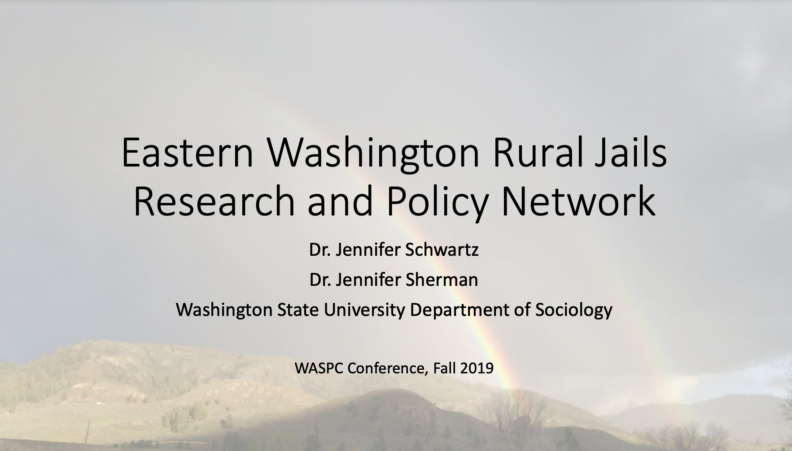
Eastern Washington Rural Jails Research and Policy Network
Dr. Jennifer Schwartz
Dr. Jennifer Sherman
Washington State University Department of Sociology
WASPC Conference, Fall 2019