Washington Rural Jails Network
By Jennifer Schwartz, Jennifer Sherman, Clay Mosher, Christian Maynard, Megan Parks, Marisa Cervantes, Sandra Yokley.
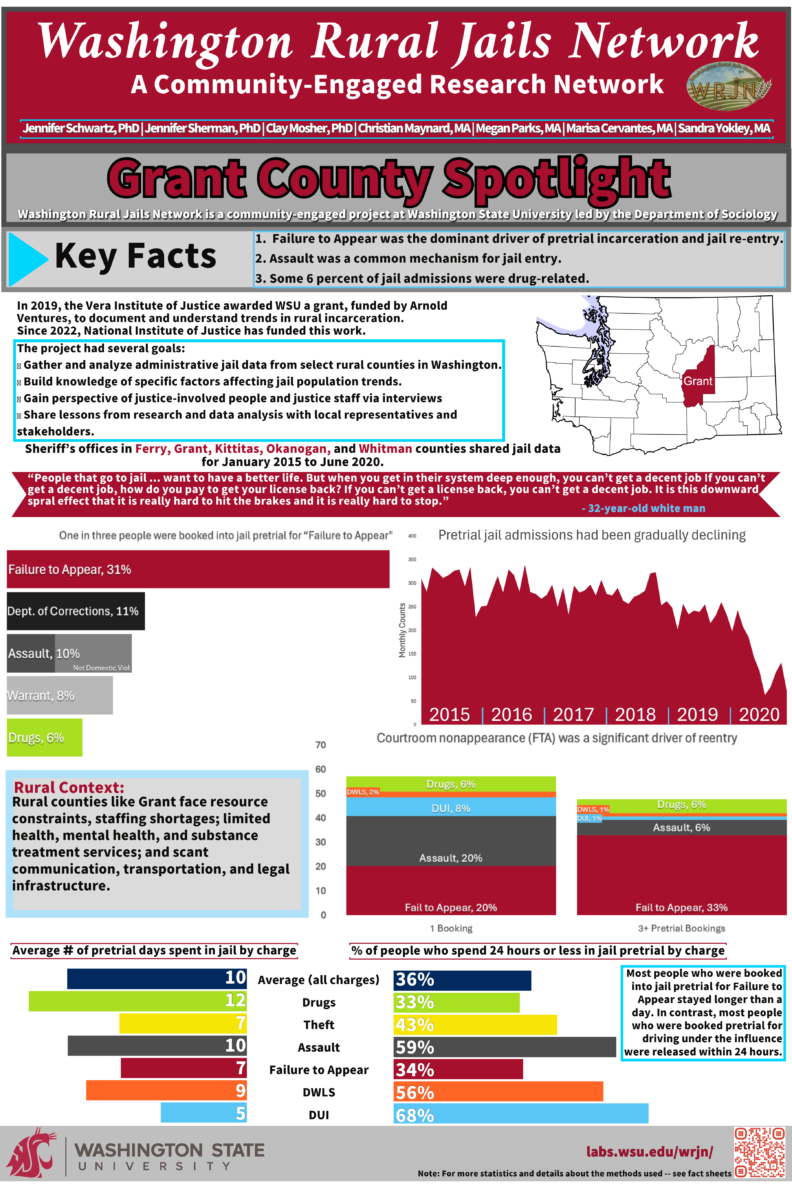
Grant County Spotlight
Sheriff’s Offices in Ferry, Grant, Kittitas, Okanogan, and Whitman counties shared jail data for January 2015 to June 2020
Key Facts
- Failure to Appear was the dominant driver of pretrial incarceration and jail re-entry.
- Assault was a common mechanism for jail entry.
- Some 6 percent of jail admissions were drug-related
The project had several goals
- Gather and analyze administrative jail data from select rural counties in Washington.
- Build knowledge of specific factors affecting jail population trends.
- Gain perspective of justice-involved people and justice staff via interviews
- Share lessons from research and data analysis with local representatives and stakeholders.
One in four people were booked for “failure to appear”
- Failure to appear, 31%
- Department of Corrections, 11%
- Assault, 10%
- Warrant, 8%
- Drugs, 6%
Pretrial jail admissions had been gradually declining
Admissions averaged about 200 admissions from 2015 to 2019, with a sharp decline during the COVID-19 pandemic
Rural Context:
Rural counties face resource constraints, staffing shortages; limited health, mental health, and substance treatment services; and scant communication, transportation, and legal infrastructure.
Failure to appear is a significant driver of reentry
- One booking
- Drugs, 6%
- DWLS, 2%
- DUI, 8%
- Assault, 20%
- Failure to Appear, 20%
- Fail to Appear, 16%
- Three or more bookings
- Theft, 6%
- Drugs, 5%
- DWLS, 10%
- DUI, 4%
- Assault, 7%
- Fail to Appear, 31%
Average # of pretrial days spent in jail by charge
- Average (all offenses), 10
- Drugs, 12
- Theft, 7
- Assault, 10
- Failure to Appear, 7
- DWLS, 9
- DUI, 5
% of people who spend 24 hours or less in jail pretrial by charge
- Average (all offenses), 36%
- Drugs, 33%
- Theft, 43%
- Assault, 59%
- Failure to Appear, 34%
- DWLS, 56%
- DUI, 68%
Most people booked into jail pretrial for Failure to Appear stayed longer than a day. In contrast, most people who were booked pretrial for driving under the influence were released within 24 hours.
What is driving jail populations in Grant County, Washington?
Top Findings From Grant County, January 2015 to July 2020
- The leading reason people went to jail pretrial (37percent) was for failure to navigate the local criminal legal system (such as failure to appear in court or pay a fine)—rather than charges against people or property.
- Domestic violence–related charges were the second most common reason for pretrial jail admission (14 percent). Most bookings related to assault and other nonlethal violence involved domestic violence (63 percent of all assault charges).
- About 6 percent of pretrial jail bookings in Grant County Jail were for drug-related charges.
- Nearly 60 percent of people arrested and booked into Grant County Jail did not return on new charges during the five-and-a-half-year period studied.
Grant County, in rural Central Washington, is the
state’s fourth largest county in land area (2,700 square
miles), but it is sparsely populated (98,000 people).
The population is majority white but includes a sizable
Hispanic/Latinx population (42 percent). Grant County’s
economy, which is experiencing growth in all sectors,
relies mostly on fruit and other irrigated agriculture and
related food processing industries. Grant County Jail
began operating in its present location in 1986 and is
a 188-bed facility. This fact sheet presents some of the
key trends in the jail population, based on research
done by Washington State University faculty and
graduate students and Washington Rural Jails Network
using administrative records from January 2015 to July
2020 provided by the Grant County Sheriff’s Office.
From 2015 to 2020, most people were admitted to jail
pretrial, while a smaller share entered to serve a jail
sentence. Since 2016, the jail has housed around 170
people, but the COVID-19 pandemic reduced this by
more than 50 percent (83 people on June 30, 2020).
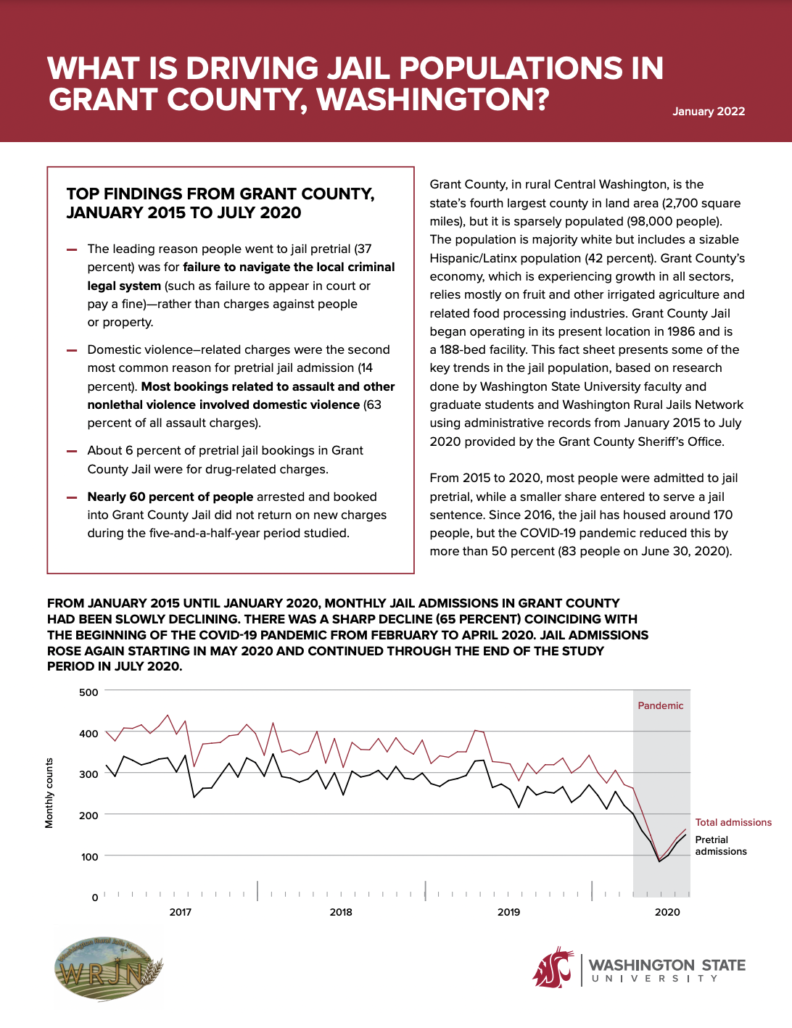
From January 2015 until January 2020, monthly jail admissions in Grant County
Had been slowly declining. There was a sharp decline (65 percent) coinciding with
The beginning of the COVID-19 pandemic from February to April 2020. Jail admissions
Rose again starting in May 2020 and continued through the end of the study
Period in July 2020
REASONS FOR JAIL ADMISSIONS
From 2015 to 2020, more than one-third of people booked into Grant County Jail pretrial were admitted due to failure to appear in court or for not meeting other system requirements (such as paying a fine), rather than on charges for an offense against persons or property.
- The most common reason for pretrial booking into Grant County Jail was for failure to appear in court, making up 30 percent of all pretrial jail bookings.
- Nearly all people (99 percent) arrested and booked into Grant County Jail on a top charge of failure to appear in court had only that charge against them, which means they did not have any new criminal charges and were booked simply for failure to appear.
- Rural residents may fail to appear in court for various reasons: they don’t receive legal notifications, they can’t understand complex legal documents, their overburdened defense lawyers are unable to help ensure clients appear in court, they face housing instability, they have difficulty securing transportation, they don’t trust the criminal legal system, and/or they can’t take time off from work or arrange for childcare.
- Another 7 percent of people booked into jail pretrial were incarcerated for difficulties complying with system requirements other than failure to appear. These included failure to comply (4 percent), driving with a suspended license (2 percent), and assorted other requirements, such as failures to pay fines and fees, pay child support, properly register a car or transfer title, or comply with criminal legal system officials’ orders (1 percent).
I got picked up on a warrant. It was [for] a failure to appear. . . . I was driving
48-year-old Latinx and Native American man
and the state patrol pulled the car over because I had a headlight out. Well, I
kind of had a funny feeling that I might have had a warrant. . . . And he asked
me for my ID . . . and it was discovered I had a warrant. So I went to jail and
then was transported to Grant County the following Tuesday.
- The most common original charge in failure to appear cases was driving with a suspended license (DWLS), which itself can be the consequence for a series of unpaid fees, rather than a driving-related charge.1 Theft and Driving under the influence (DUI) were the next most common original charges.
People that go to jail . . . want to have a better life. But when you get in their
32-year-old white man.
system deep enough, you can’t. You can’t get a decent job. If you can’t get a
decent job, how do you pay to get your license back? If you can’t get a license
back, you can’t get a decent job. It is this downward spiral effect that it is really
hard to hit the brakes and it is really hard to stop
Assault and other violence-related charges accounted for 14 percent of pretrial jail bookings. Of these, 63 percent involved domestic violence charges.
- Most bookings for domestic violence assault for both men and women were for misdemeanor-level charges (90 percent for women and 85 percent for men).
- Domestic violence assault was the second-most common top charge for women booked into jail pretrial (9 percent) and the fifth-most common top charge for men booked into jail pretrial (5 percent).
One out of every five pretrial bookings was to hold someone awaiting transfer elsewhere,
such as to the state Department of Corrections (11 percent) or to another jurisdiction for adjudication
(9 percent).
About 6 percent of pretrial jail bookings in Grant County were for drug-related charges.
This was the fifth most common charge category.
LENGTH OF STAY AND FREQUENCY OF BOOKINGS
Although 36 percent of people were released from Grant
County Jail within one day, the average length of stay
was still nearly 10 days.
People charged with assault were released more
quickly than people with more minor charges like failure
to appear and drugs.
People with drug-related charges and people held
pending transfer to state prisons tended to stay longer
than average—12 and 14 days, respectively. (People being
held for other jurisdictions have higher lengths of stay
(LOS) that drive up the total average, yet the average
length of stay excluding this group was still 9.4 days, only
slightly less than the overall average.) Those jailed for
failure to appear—a minor charge and the most common
charge in Grant County—spent nearly one week (6.9 days)
in jail on average.
Most people (59 percent) who were charged with assault
were released from jail within one day. (However, 2 percent
of people charged with assault were held in jail for more
than four months, and some people were held for longer
than a year.) A smaller proportion of people with failure to
appear or drug-related charges were released within one
day (33 percent and 34 percent, respectively).
Most people who were arrested and booked into Grant County Jail pretrial (60 percent) were incarcerated only once over the nearly six years the research team examined.
- More than one-third of all people with three or more pretrial admissions were held due to failure to appear charges. This demonstrates that many repeat bookings stem from the challenges of meeting legal requirements during the pretrial process rather than new charges.
- The 12 percent of people who were reincarcerated five or more times in Grant County Jail accounted for nearly 40 percent of all pretrial bookings over five-and-a-half years. This group—about 900 people—is having a broad impact on jail trends in Grant County. Research suggests that people cycling in and out of jail are more likely to experience homelessness, substance use, lack of stable income, and mental and physical health problems than the general population.2 Increased social services focused on this relatively small group could have an outsize impact in helping them stabilize, meet their day-to-day needs, and ultimately end the cycle of incarceration
Age at booking. The average age at arrest/booking was 36. Nearly half of people were aged 35 or older when
admitted to jail.
Jail admissions by gender. Women made up nearly onequarter of jail bookings into Grant County Jail. Nationally, women’s presence in jails has been growing.
There are disparities in jail admissions by race and ethnicity. Tracking Grant County’s
population, most pretrial jail admissions were of white and Hispanic/Latinx people. However,
the numbers for Hispanic/Latinx people and people with multiple racial/ethnic identities are
likely underestimated because jail staff may misclassify some people as white at admission.
This pattern is common in jails across the country and can generate misleading estimates of
racial disparities.3
- Black and Native American people were overrepresented in the jail (each making up 4 percent of admissions to jail) compared to the county population (each making up 2 percent of the county population).
Top charges for pretrial jail bookings. Failure to appear
(30 percent), assault and other non-lethal violence (14
percent), and Department of Corrections holds (11 percent)
were the most common top charges, making up more than
half of all pretrial jail bookings.
Assorted other failures to meet system requirements
(failures to pay fines and fees, pay child support, properly
register a car or transfer title, or comply with criminal legal
system officials’ orders) made up another 1 percent of
bookings, not shown in the figure.
Most common domestic violence charge types. Assault
(58 percent) was the most common top charge in cases
involving domestic violence. Violating a protection order
(16 percent) and malicious mischief (11 percent) were the
next most common top charges in domestic violence
cases.
Multiple pretrial bookings. Most people were arrested
and booked into Grant County Jail only once during the
observed period (59 percent of people). However, 25
percent experienced three or more pretrial jail stays over
68 months.
APPENDIX B – METHODOLOGY
The findings in this brief come from analysis conducted by WSU faculty and graduate students
in the Rural Jails Research and Policy Network. The Grant County Sheriff’s Department provided
data on all jail bookings and releases initiated from January 1, 2015, to August 17, 2020. In total,
the WSU team analyzed 22,107 bookings: in 4,586 booking incidents, people were committed
to serve a sentence, and in 17,521 booking incidents, they were booked pretrial (upon arrest).
Among pretrial bookings, there were 7,811 unique people.
The WSU team also conducted qualitative and ethnographic work; future reports will provide
more detailed findings. Quotes come from qualitative interviews conducted from August 2020
to August 2021 with people who had been held in Grant County Jail at some point during that
period. In all, researchers interviewed 37 people for this project who had spent time in rural
Washington jails; six had spent time in the Grant County Jail. Interviews lasted approximately
one to two hours and were conducted by phone by WSU faculty. They were audio recorded and
later transcribed and analyzed for thematic patterns.
The study also included 90 hours of virtual court watching and note-taking from May to
December 2020 by a graduate research assistant. The District and Superior Courts of Whitman
and Grant counties were observed via YouTube streaming of Zoom meetings and WebEx video
conferencing, respectively. Notes from observations were compiled and analyzed for patterns.
Endpoints
- A 2021 Washington State law (SB 5226) eliminated mandatory suspension of license as a consequence for unpaid fines and fees;
courts now have the option to suspend or revoke a license and must assess ability to pay. - Madeline Bailey, Erica Crew, and Madz Reeve, No Access to Justice: Breaking the Cycle of Homelessness and Jail (New York: Vera
Institute of Justice, 2020), https://www.vera.org/downloads/publications/no-access-to-justice.pdf; Jennifer Bronson, Jessica Stroop,
Stephanie Zimmer, and Marcus Berzofsky, Drug Use, Dependence, and Abuse Among State Prisoners and Jail Inmates, 2007-2009
(Washington DC: U.S. Department of Justice, Bureau of Justice Statistics, 2017), https://bjs.ojp.gov/content/pub/pdf/dudaspji0709.
pdf; and Urban Institute, “Five Charts that Explain the Homelessness-Jail Cycle – and How to Break It,” September 16, 2020, https://
www.urban.org/features/five-charts-explain-homelessness-jail-cycle-and-how-break-it. - According to a 2016 report, when people in prison had the opportunity to self-identify, a higher percentage of people reported
Hispanic/Latinx origin or multiple races and fewer identified as non-Hispanic white and non-Hispanic Black than reported in
corrections department administrative data. See E. Ann Carson, Prisoners in 2016 (Washington, DC: Bureau of Justice Statistics,
2018), 7, https://bjs.ojp.gov/content/pub/pdf/p16.pdf.