Washington Rural Jails Network
By Jennifer Schwartz, Jennifer Sherman, Clay Mosher, Christian Maynard, Megan Parks, Marisa Cervantes, Sandra Yokley.
Kittitas County Spotlight
Sheriff’s Offices in Ferry, Grant, Kittitas, Okanogan, and Whitman counties shared jail data for January 2015 to June 2020
The project had several goals
- Gather and analyze administrative jail data from select rural counties in Washington.
- Build knowledge of specific factors affecting jail population trends.
- Gain perspective of justice-involved people and justice staff via interviews
- Share lessons from research and data analysis with local representatives and stakeholders.
Key Facts
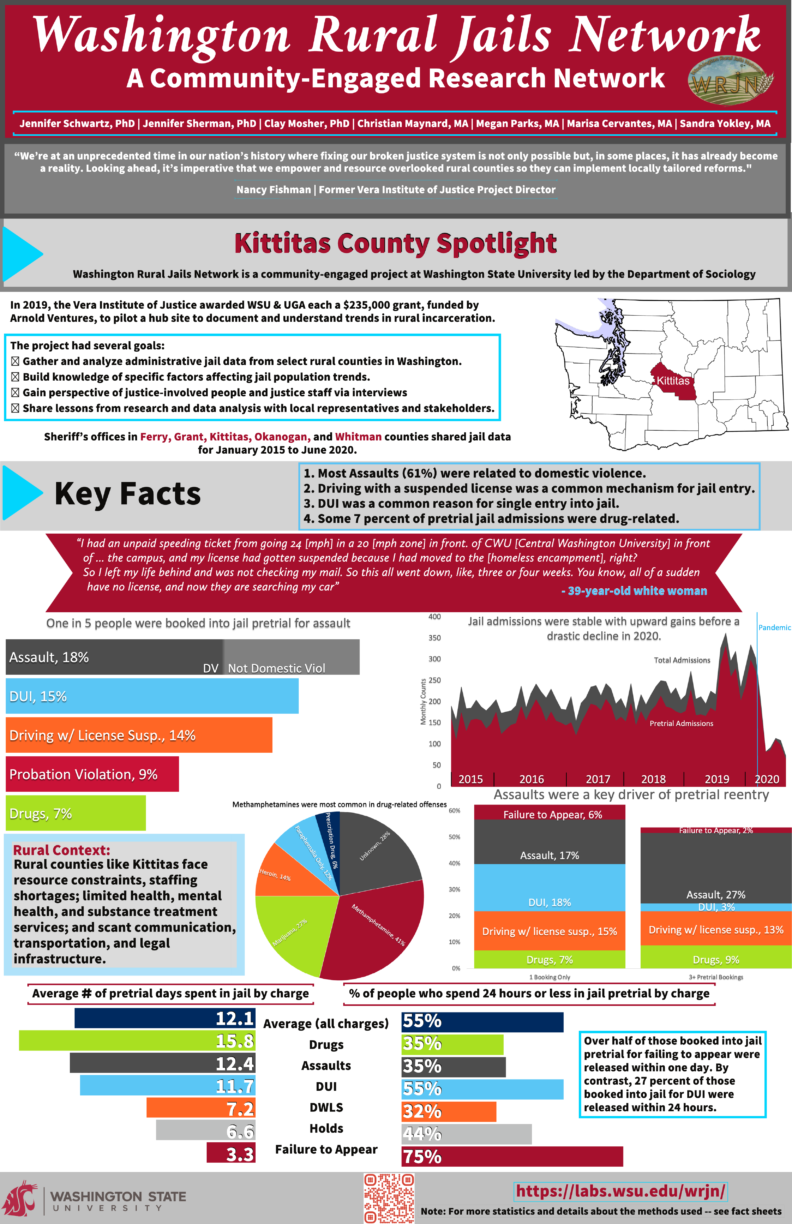
- Most assaults (61%) were related to domestic violence.
- Driving with a suspended license was a common mechanism for jail entry.
- DUI was a common reason for single entry into jail.
- Some 7 percent of pretrial jail admissions were drug-related.
One in five people were booked into jail pretrial for assault
- Assault, 18%
- DUI, 15%
- Driving with a license suspended, 14%
- Probation violation, 9%
- Drugs, 7%
Jail admissions were stable with upward gains during 2019 before a drastic decline around the start of the COVID-19 pandemic
Admissions averaged about 200 admissions from 2015 to 2019, with a sharp decline during the COVID-19 pandemic
Rural Context:
Rural counties face resource constraints, staffing shortages; limited health, mental health, and substance treatment services; and scant communication, transportation, and legal infrastructure.
Methamphetamines were most common in drug-related offenses
- Methamphetamine, 41%
- Unknown, 28%
Assaults were a key driver of pretrial reentry
- One booking
- Failure to Appear, 6%
- Assault, 17%
- DUI, 18%
- Driving with a license suspended, 15%
- Drugs, 7%
- Three or more bookings
- Failure to Appear, 2%
- Assault, 27%
- DUI, 3%
- Driving with a license suspended, 13%
- Drugs, 9%
Average # of pretrial days spent in jail by charge
- Average (all offenses), 12
- Drugs, 16
- Assault, 12
- DUI, 12
- DWLS, 7
- Holds, 7
- Failure to Appear, 3
% of people who spend 24 hours or less in jail pretrial by charge
- Average (all offenses), 55%
- Drugs, 35%
- Assaults, 35%
- DUI, 55%
- DWLS, 32%
- Holds, 44%
- Failure to Appear, 75%
Over half of those booked into jail pretrial for failing to appear were released within one day. By contrast, 27 percent of those booked into jail for DUI were released within 24 hours.
What Is Driving Jail Populations in Kittitas County, Washington?
January 2022
Top Findings From Kittitas County, January 2015 To August 2020
- Two of the leading reasons for people going to jail pretrial were for charges of driving under the infuence (DUI) (15 percent) and charges of driving while license suspended (DWLS) (14 percent).
- Domestic violence–related charges made up 13 percent of pretrial jail admissions. Most bookings related to assault charges involved domestic violence (70 percent).
- About 7 percent of pretrial jail bookings were for drug-related charges.
- Three-quarters of people booked into the jail did not return on any new charges during the five-and-a-half year period studied.
Kittitas County, in rural Central Washington, spans a 2,300 square mile region from the Cascade Mountains to the
upper Yakima River Valley plains and the Columbia River. The county is a major producer of hay, a destination for
recreation activities including biking, hiking, and fishing, and home to Central Washington University. The county
population is nearly 48,000 and has grown by about 2 percent per year since 2015. The jail in Kittitas County,
called the Kittitas County Corrections Center, was built in the 1980s to house 45 people. An annex completed
in 2012 increased capacity to 209 beds. This fact sheet presents some of the key trends in the jail population,
based on research done by Washington State University faculty and graduate students and the Washington Rural
Jails Network using administrative records from January 2015 to August 2020 provided by the Kittitas County
Sheriff’s Office
Kittitas County Corrections Center is a medium-sized jail with an average daily population around 100 people
in 2018. From 2015 to 2020, most people (69 percent) who were booked into the jail pretrial had misdemeanor
charges and stayed for nearly two weeks on average (12 days). During the study period (2015–2020), threequarters of people were admitted to jail pretrial, whereas a smaller proportion of people entered to serve a jail sentence.
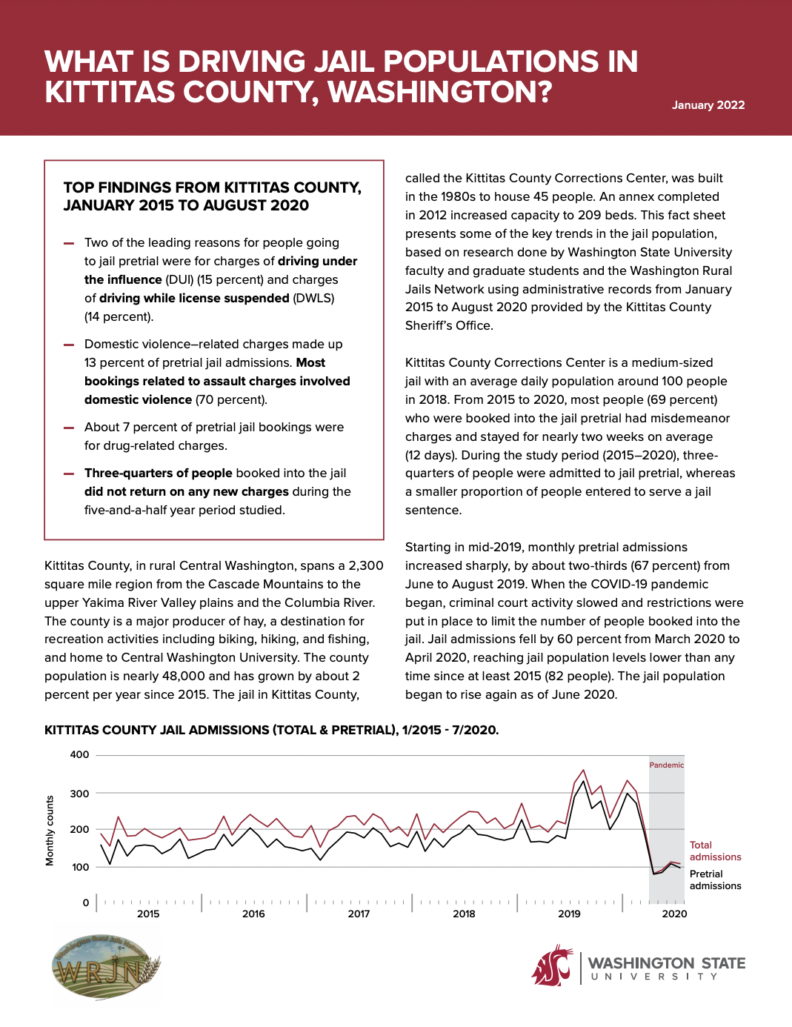
Starting in mid-2019, monthly pretrial admissions increased sharply, by about two-thirds (67 percent) from June to August 2019. When the COVID-19 pandemic began, criminal court activity slowed and restrictions were put in place to limit the number of people booked into the jail. Jail admissions fell by 60 percent from March 2020 to April 2020, reaching jail population levels lower than any time since at least 2015 (82 people). The jail population began to rise again as of June 2020.
REASONS FOR JAIL ADMISSIONS
Approximately 20 percent of people booked pretrial into Kittitas County Correctional Center from 2015 to 2020 were admitted due to charges related to a failure to navigate the requirements of the local criminal legal system or other state agencies, such as driving with a suspended or invalidated license and failure to pay fines or attend a court hearing.
- Fourteen percent of people booked pretrial into Kittitas County Correctional Center were admitted on charges of driving with a suspended or invalidated license (DWLS). DWLS can result from unpaid fines, traffic tickets, or child support; failure to reinstate one’s license after suspension; or failure to appear for hearings or comply with conditions related to traffic infractions, among other reasons.1
- Eighty-five percent of people jailed pretrial for DWLS were charged with a misdemeanor (in other words, minor charges).
I had an unpaid speeding ticket from going 24 [mph] in a 20 [mph zone]
39-year-old white woman
in front of CWU [Central Washington University] in front of the campus,
and my license had gotten suspended because I had moved to the damn
river [homeless encampment], right? So I left my life behind and was not
checking my mail. So this all went down, like, three or four weeks. You
know, all of a sudden I have no license, and now they are searching
my car.
- Failure to appear in court and difficulties complying with other system requirements that do not involve new charges against people or property accounted for 6 percent of all pretrial bookings. Charges include failures to appear in court, pay fines/fees, pay child support, register a car properly, register for a sex offense, or comply with/obey justice officials.
Another 9 percent of people booked into jail were incarcerated for probation
violations.
- Ninety percent of admissions for probation violations were compelled by the state Department of Corrections (DOC). DOC administers probation (called “community custody”) for people convicted of felonies, whereas local counties administer probation for people convicted of misdemeanors
Driving under the influence (DUI) charges were about twice as common as drug-related charges as the reason for people being booked pretrial into Kittitas County’s jail.
- DUI was the most serious charge in 15 percent of bookings, whereas drug-related charges made up about 7 percent of pretrial bookings.
[After losing my job], my mom was like, ‘Oh, I’ll help you get on your feet
44-year-old white woman
again.’ Woohoo. But instead, when I got there—I wound up starting to
drink constantly. So I got two DUIs back to back, and I was . . . devastated
because I had just gone from working . . . and having my own home,
my family, his stepson, my son—you know, everything I could have ever
dreamed of—to living at my mom’s with nothing left. . . . I actually wound
up having to go to jail and do my time for those DUIs—six months
in Kittitas.
Assault accounted for one out of every ten pretrial jail bookings in Kittitas County. Of these, 70 percent involved domestic violence charges.
- The majority of bookings for domestic violence (57 percent) were for assault, predominantly Assault IV (gross misdemeanor) charges. Misdemeanor assaults, by legal definition, do not result in severe bodily harm and do not involve a deadly weapon.2 The second-largest category of domestic violence charges was violation of protection orders (28 percent).
I learned that, well, he one night—he was doing some things and he
60-year-old white woman
started calling me names and stuf, and I slapped him across the face
and he called the police. And. Yeah. And of course, I didn’t really realize
anything about the police, you know, or whatever, and they hauled me
of to jail for slapping him. And I didn’t know that that was something you
couldn’t do
LENGTH OF STAY AND FREQUENCY OF BOOKINGS
More than half (55 percent) of people held in jail pretrial in Kittitas County were released within one day, yet the average length of pretrial stay was more than 12 days. This suggests that some of the 45 percent of people who stay more than one day have very long lengths of stay.
Length of pretrial stay in Kittitas County Corrections Center varied by charge type. People with drug-related charges tended to stay longer than average—nearly 16 days. Those charged with DWLS often spent more than one week behind bars—7.2 days on average.
Three-quarters of people charged with failure to appear/comply and more than half of those charged with DUI (55 percent) were released within 24 hours compared to about one-third of those charged with DWLS, drugs, or assault. Although shorter lengths of stay for failure to appear and some other minor charges is a positive trend, these data suggests that a significant portion of people with minor charges still have lengthy jail stays.
- The 3 percent of people who were booked five times or more accounted for 10 percent of all pretrial bookings. This group—about 200 people—is having a broad impact on jail trends in Kittitas County. Research suggests that people cycling in and out of jail are more likely to experience homelessness, substance use, lack of stable income, and mental and physical health problems than the general public.3 Increased social services focused on this relatively small group could have an outsize impact in helping them stabilize and meet their day-to-day needs and ultimately help end the cycle of incarceration.
- Among people with three or more pretrial jail admissions, bookings for domestic violence charges were twice as common than among people admitted to jail only once (not shown in figure). Additionally, for 18 percent of people with three or more pretrial jail admissions, the top (most serious) charges related to assault or violation of a protection order. This suggests that focused attention on responding to recurrent domestic violence situations outside of the jail setting could have a broad impact.
Appendix A – Additional Charts
Age at booking. The average age at booking was 34. Women made up nearly one-quarter of jail bookings into Grant County. Nationally, women’s presence in jails has been growing.
Top charges for pretrial jail bookings. Driving under the influence (15 percent), driving while license suspended (14 percent), and assault (10 percent, with 70 percent of those for domestic violence).
Most common domestic violence charge types. Fifty-seven percent of pretrial jail admissions for domestic violence involved assault, and 28 percent resulted from violations of protection orders.
Methamphetamine accounted for nearly 28 percent of all drug-related bookings.
Marijuana charges accounted for nearly one out of five drug-related bookings, even though Washington legalized cannabis possession for people over 21 years old in 2012. The majority of marijuana charges were for possession by people under age 21, rather than for distribution.
Multiple pretrial bookings. Most people (74 percent) were arrested and booked into Kittitas County Corrections Center only once during the observed five-and-a-half year period (January 2015 to July 2020).
APPENDIX B–METHODOLOGY
The fndings in this brief come from analysis conducted by WSU faculty and graduate students in the Rural Jails Research and Policy Network. The Kittitas County Sherif’s Department provided data on all jail bookings and all releases initiated from January 1, 2015 to August 20, 2020. The WSU team transformed PDF fles into databases, and they were able to match most release records with booking records based on entry/release dates and amount of time served. In total, the WSU team analyzed 14,379 booking incidents (13,504 releases): in 3,294 booking incidents, people were committed to serve a sentence, and in 11,085 booking incidents, they were booked pretrial (upon arrest). Data on sex, race, and ethnicity were not available.
The WSU team also conducted qualitative and ethnographic work; future reports will provide more detailed fndings. Quotes come from qualitative interviews conducted from August 2020 to August 2021 with people who had been held in Kittitas County Corrections Center at some point. In all, researchers interviewed 37 people for this project who had spent time in rural Washington jails; seven had spent time in the Kittitas County Corrections Center. Interviews lasted approximately one to two hours and were conducted by phone by WSU faculty. They were audio recorded and later transcribed and analyzed for thematic patterns.
Endnotes
- A 2021 (Washington State law SB 5226) eliminated mandatory suspension of license as a consequence for unpaid fnes and fees;
courts now have the option to suspend or revoke a license and must assess ability to pay. - Washington state requires police ofcers to make an arrest when they respond to a domestic violence call and have probable cause
to believe that an incident of domestic violence or a violation of a no-contact order occurred in the last four hours. When an ofcer
believes that more than one party is at fault, they are not required to make more than one arrest—typically, they will arrest only the
party who appears to be the “primary aggressor.” - Madeline Bailey, Erica Crew, and Madz Reeve, No Access to Justice: Breaking the Cycle of Homelessness and Jail (New York: Vera
Institute of Justice, 2020), https://www.vera.org/downloads/publications/no-access-to-justice.pdf; Jennifer Bronson, Jessica Stroop,
Stephanie Zimmer, and Marcus Berzofsky, Drug Use, Dependence, and Abuse Among State Prisoners and Jail Inmates, 2007-2009
(Washington DC: U.S. Department of Justice, Bureau of Justice Statistics, 2017), https://bjs.ojp.gov/content/pub/pdf/dudaspji0709.
pdf; and Urban Institute, Five Charts that Explain the Homelessness-Jail Cycle – and How to Break It, (Washington DC: Urban
Institute, 2020), https://www.urban.org/features/fve-charts-explain-homelessness-jail-cycle-and-how-break-it.