Report to Whatcom County Stakeholders on Progress towards Reducing the Jail Population
Dr. Jennifer Schwartz, PhD with Christian Maynard, M.A., Emma Deneau, Safiya Hafiz, Seth Wood, and Dr. Jennifer Sherman, PhD
Washington State University
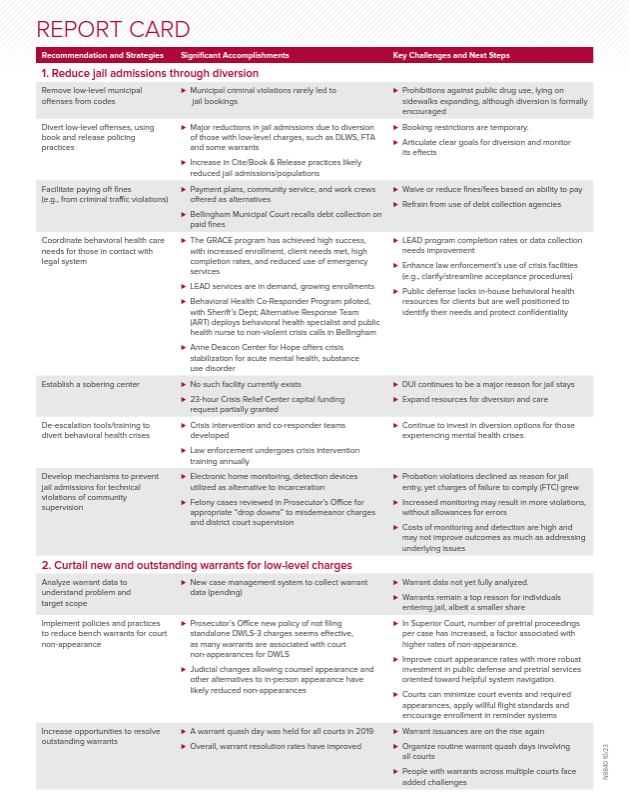
Reduce jail admissions through diversion
| Recommendation and Strategies | Significant Accomplishments | Key Challenges and Next Steps |
|---|---|---|
| Remove low-level municipal offenses from codes | Municipal criminal violations rarely led to jail bookings | Prohibitions against public drug use, lying on sidewalks expanding, although diversion is formally encouraged |
| Divert low-level offenses, using book and release policing practices | Major reductions in jail admissions due to diversion of those with low-level charges, such as DLWS, FTA and some warrants Increase in Cite/Book & Release practices likely reduced jail admissions/populations | Booking restrictions are temporary. Articulate clear goals for diversion and monitor its effects |
| Facilitate paying off fines (e.g., from criminal traffic violations) | Payment plans, community service, and work crews offered as alternatives Bellingham Municipal Court recalls debt collection on paid fines | Waive or reduce fines/fees based on ability to pay Refrain from use of debt collection agencies |
| Coordinate behavioral health care needs for those in contact with legal system | The GRACE program has achieved high success, with increased enrollment, client needs met, high completion rates, and reduced use of emergency services LEAD services are in demand, growing enrollments Behavioral Health Co-Responder Program piloted, with Sheriff’s Dept; Alternative Response Team (ART) deploys behavioral health specialist and public health nurse to non-violent crisis calls in Bellingham Anne Deacon Center for Hope offers crisis stabilization for acute mental health, substance use disorder | LEAD program completion rates or data collection needs improvement Enhance law enforcement’s use of crisis facilities (e.g., clarify/streamline acceptance procedures) Public defense lacks in-house behavioral health resources for clients but are well positioned to identify their needs and protect confidentiality |
| Establish a sobering center | No such facility currently exists 23-hour Crisis Relief Center capital funding request partially granted | DUI continues to be a major reason for jail stays Expand resources for diversion and care |
| De-escalation tools/training to divert behavioral health crises | Crisis intervention and co-responder teams developed Law enforcement undergoes crisis intervention training annually | Continue to invest in diversion options for those experiencing mental health crises |
| Develop mechanisms to prevent jail admissions for technical violations of community supervision | Electronic home monitoring, detection devices utilized as alternative to incarceration Felony cases reviewed in Prosecutor’s Office for appropriate “drop downs” to misdemeanor charges and district court supervision | Probation violations declined as reason for jail entry, yet charges of failure to comply (FTC) grew Increased monitoring may result in more violations, without allowances for errors Costs of monitoring and detection are high and may not improve outcomes as much as addressing underlying issues |
Curtail new and outstanding warrants for low-level charges
| Recommendation and Strategies | Significant Accomplishments | Key Challenges and Next Steps |
|---|---|---|
| Analyze warrant data to understand problem and target scope | New case management system to collect warrant data (pending) | Warrant data not yet fully analyzed. Warrants remain a top reason for individuals entering jail, albeit a smaller share |
| Implement policies and practices to reduce bench warrants for court non-appearance | Prosecutor’s Office new policy of not filing standalone DWLS-3 charges seems effective, as many warrants are associated with court non-appearances for DWLS Judicial changes allowing counsel appearance and other alternatives to in-person appearance have likely reduced non-appearances | In Superior Court, number of pretrial proceedings per case has increased, a factor associated with higher rates of non-appearance. Improve court appearance rates with more robust investment in public defense and pretrial services oriented toward helpful system navigation. Courts can minimize court events and required appearances, apply willful flight standards and encourage enrollment in reminder systems |
| Increase opportunities to resolve outstanding warrants | A warrant quash day was held for all courts in 2019 Overall, warrant resolution rates have improved | Warrant issuances are on the rise again Organize routine warrant quash days involving all courts People with warrants across multiple courts face added challenges |
Individualized, data-driven risk assessment for pretrial release
| Recommendation and Strategies | Significant Accomplishments | Key Challenges and Next Steps |
|---|---|---|
| Ensure defense counsel is present at all bail determinations | Public defense is present at bail determinations Use of release on personal recognizance increased | Public defense should be present at weekend probable cause hearings to assist in securing pretrial release Collaboratively review bail procedures |
| Implement court reminder system to facilitate release on personal recognizance | Courts engage in a text message reminder program for appearances, probation appointments, drug tests | Address deficiencies and improve court reminders using behavioral nudges Encourage appearances via additional Public Defense resources, especially additional staff to offer system navigation services |
| Adopt and validate a data-driven pretrial risk assessment instrument | Extensive evaluation efforts were undertaken to evaluate instruments that produce fair results without worsening inequalities; Superior Court adopted an assessment tool | Future work involves developing guidelines for the tool’s use, validating it, and assessing disparities in pretrial decision-making |
| Establish regional pretrial services for all courts | Pretrial Services Unit established in Superior Court to assist with monitoring individuals awaiting trial | Expand Pretrial Services to further support court appearances, offer service referrals Individuals should not bear costs of pretrial monitoring |
Develop a caseflow management plan to reduce time to disposition and shorten length of jail stays
| Recommendation and Strategies | Significant Accomplishments | Key Challenges and Next Steps |
|---|---|---|
| Develop fair and efficient case management plan to minimize appearances, limit continuances, and resolve cases as early as reasonable | Superior Court now reviews continuance requests for sufficient cause | To reduce delays in proceedings, Public Defense should receive case files with sufficient time for review, time to meet with clients before court, and more resources to avoid caseload limits and conflicts Good faith settlement conferences between prosecution and defense could occur more often and earlier to deflect need for additional hearings |
| Develop and track case processing performance measures | Electronic case management system (pending) | Track sources of backlogs, system functioning |
Create oversight and accountability mechanisms
| Recommendation and Strategies | Significant Accomplishments | Key Challenges and Next Steps |
|---|---|---|
| Reconvene Law and Justice Council with meetings, staff, and research capacity | Council established through ordinance, with robust participation by 20-30 members and strong staff support Four sub-committees actively work on a crisis stabilization facility, legal and justice systems, behavioral health, and information/data needs. Annual reports are produced | Additional staff skilled in data analysis would further support existing research capacities |
| Report and publish data on legal system trends and benchmarks to ensure transparency, accountability | Adopted integrated data platform (Julota) to produce timely reports and analyses for behavioral health and diversion programs Sheriff’s Dept, IPRTF, Emergency Services, and other county entities routinely publish annual or specialized data reports Public data dashboard creation is significantly underway Information Needs and Data Exchange (INDEX) Committee of IPRTF improving data systems, information sharing | Court data and performance reports are not as readily available to the public Integrated data platforms would be useful, along with analysts to manage archives and data analyses More information needed on court case processing, reasons for court non-appearances and warrants |
| Collect data on race, ethnicity, and gender at all system points | Jail now collects self-reported data on race, ethnicity, and gender Behavioral health data include demographics | Data accuracy improved, but non-reporting(missing data) increased Ethnicity data has been inconsistently collected across sources, over time |