

Washington Rural Jails Network
By Jennifer Schwartz, Jennifer Sherman, Clay Mosher, Christian Maynard, Megan Parks, Marisa Cervantes, Sandra Yokley.
Whitman County Spotlight
Sheriff’s Offices in Ferry, Grant, Kittitas, Okanogan, and Whitman counties shared jail data for January 2015 to June 2020
The project had several goals
- Gather and analyze administrative jail data from select rural counties in Washington.
- Build knowledge of specific factors affecting jail population trends.
- Gain perspective of justice-involved people and justice staff via interviews
- Share lessons from research and data analysis with local representatives and stakeholders.
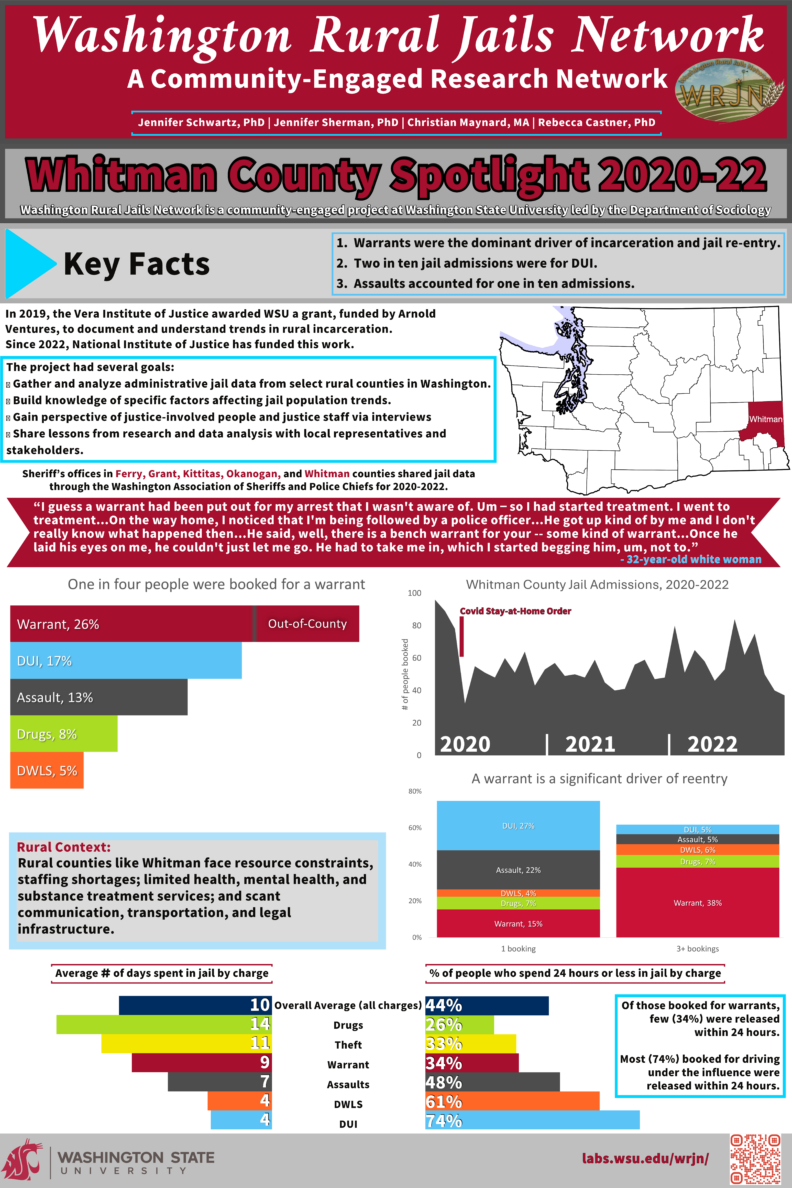
Key Facts
- Warrants were the dominant driver of incarceration and jail re-entry.
- Two in ten jail admissions were for DUI
- Assaults accounted for one in ten admissions.
One in four people were booked into jail pretrial for a warrant
- Warrant, 26%
- DUI, 17%
- Assault, 13%
- Drugs, 8%
- DWLS, 5%
Whitman County Jail Admissions, 2020-22
Admissions averaged about 60 admissions from 2020 to 2022, with a sharp decline during the COVID-19 pandemic
Rural Context:
Rural counties face resource constraints, staffing shortages; limited health, mental health, and substance treatment services; and scant communication, transportation, and legal infrastructure.
Assaults were a key driver of pretrial reentry
- One booking
- DUI, 27%
- Assault, 22%
- DWLS, 4%
- Drugs, 7%
- Warrant, 15%
- Three or more bookings
- DUI, 5%
- Assault, 5%
- DWLS, 6%
- Drugs, 7%
- Warrant, 38%
Average # of pretrial days spent in jail by charge
- Average (all offenses), 10
- Drugs, 14
- Theft, 11
- Warrant, 9
- Assaults, 7
- DWLS, 4
- DUI, 4
% of people who spend 24 hours or less in jail pretrial by charge
- Average (all offenses), 44%
- Drugs, 26%
- Theft, 33%
- Warrant, 34%
- Assault, 48%
- DWLS, 61%
- DUI, 74%
Of those booked for warrants, few (34%) were released within 24 hours. Most (74%) booked for driving under the influence were released within 24 hours.
What Is Driving Jail Populations In Whitman County, Washington?
January 2022
Top Findings From Whitman County, 2016 to 2020
- The leading reason for people going to jail was failure to navigate the local justice system (30 percent). This category includes charges for not meeting technical requirements, such as failure to appear in court or to pay a fine—rather than charges against people or property.
- Domestic violence-related charges were the second most common reason for people going to jail upon arrest (16 percent).
- About 10 percent of pretrial jail admissions were for drug-related charges.
- 80 percent of people arrested and booked into Whitman County Jail did not return on new charges during the four-year period that we examined.
Whitman County, in rural Eastern Washington, is a major producer of wheat, lentils, and peas and is home to
Washington State University (WSU)–Pullman (with a student population of approximately 30,000). Whitman County Jail is under the jurisdiction of the Whitman County Sheriff’s Office, serving 50,000 people over approximately 2,200 square miles.
The jail was built in 1984 with 34 beds, and in 2014, it nearly doubled its capacity to 62 beds. This fact sheet presents some of the key trends in the jail population, based on research done by Washington State University faculty and graduate students and the Washington Rural Jails Network, using administrative records from September 2016 to November 2020, provided by the Whitman County Sheriff’s Office.
Whitman County Jail is a small facility that detains people who are mostly charged with misdemeanors for short-term stays of less than one week. The daily population on census day (June 30) was fairly steady in recent years (31 in 2017, 37 in 2018, 30 in 2019) and then dropped to 17 in June 2020,during the COVID-19 pandemic. Most people were admitted to jail pretrial, while a smaller share was sentenced to serve time.
WHITMAN COUNTY JAIL ADMISSIONS DROPPED BY 62% AT THE START OF THE COVID-19 PANDEMIC, IN APRIL 2020, BUT ROSE AGAIN IN MAY 2020.
REASONS FOR JAIL ADMISSIONS
Nearly 30 percent of people booked into Whitman County Jail pretrial were admitted for failure to appear in court or for not meeting other system requirements (such as paying a fine). These are not charges for offenses against persons or property.
- The most common reason to be booked into jail pretrial was for failure to appear in court, accounting for 25 percent of all pretrial jail bookings.
- Rural residents may fail to appear in court for various reasons: they don’t receive legal notifications, they can’t understand complex legal documents, their overburdened defense lawyers are unable to help ensure clients appear in court, they face housing instability, they have difficulty securing transportation, they don’t trust the criminal legal system, and/or they can’t take time of from work or arrange for childcare.
- Among those who failed to appear, the most common original charge was driving with a suspended license. (See Appendix for details.)
- Another 5 percent of people booked into jail pretrial were charged with failing to pay fines/fees, to pay child support, or to register a car properly. These are not new charges for offenses against people or property.
And this time when I go to jail it is for—I missed a promissory to pay something. I was supposed to pay, like, 30 bucks or something. And that time I really didn’t—I really didn’t have any money. So, I couldn’t pay my way out of it.
32-year-old white woman
Another 12 percent of people booked into Whitman County Jail pretrial were admitted on charges of driving with a suspended or invalidated license (DWLS).
DWLS can result from unpaid fines or traffic tickets or child support, failure to reinstate one’s license after suspension, or failure to appear for hearings or comply with conditions related to traffic infractions, among other reasons. Three out of four people in this category were admitted on charges classed as misdemeanors (in other words, minor charges).
My license is suspended. And the only reason it is suspended is because part of the fines that I have is a fine to the DMV or the DOL. . . . And I just haven’t paid the fine. It is, like, 195 bucks. I haven’t paid the fine. . . . Admittedly, like right now, I don’t have the money to pay the fine.
49-year-old white man
Assault and other violence accounted for one out of every five pretrial jail bookings in Whitman County. Domestic violence charges were involved in 70 percent of those bookings—mostly misdemeanors—and accounted for 16 percent of pretrial bookings into Whitman County Jail overall.
- The majority of bookings for domestic violence assault were for misdemeanor-level charges. (Misdemeanor assaults do not result in severe bodily harm and do not involve a deadly weapon.) Among men, about three out of four domestic violence bookings were for misdemeanors. Among women, nine out of 10 domestic violence bookings were for misdemeanors
About 10 percent of pretrial jail bookings were for drug-related charges. More than two-thirds of these bookings were for possession charges only.
Women constituted nearly 40 percent of people jailed pretrial on drug-related charges and one-third of people sentenced for drug-related charges.
RACE AND GENDER
Black and Native American people were overrepresented in jail admissions.
LENGTH OF STAY AND FREQUENCY OF BOOKINGS
Length of pretrial stay in Whitman County Jail varied by charge type. People charged with driving with a suspended license or failing to appear in court were held more than three times longer, on average, than people charged with driving under the influence (DUI).
Eighty percent of people who were arrested and booked into Whitman County Jail on pretrial status were incarcerated only once over the four years the research team examined.
- Of the 20 percent of people who were arrested and booked more than once on new charges, 2 percent were booked fve times or more, and they accounted for nearly 10 percent of all pretrial bookings.
- More than one-third of all repeated pretrial jail admissions were due to failure to appear charges. This suggests that many repeat bookings stem from challenges of meeting court requirements during the pretrial process.
The average age at booking was 33; more than half admitted to the jail were aged 30 or older.
Women made up one-quarter of all jail bookings into Whitman County Jail. Nationally, women’s presence in jails has been growing.
Top charges for pretrial jail bookings. Failure to appear (24 percent), assault and other violence (20 percent, with
70 percent of those for domestic violence), and driving while license suspended (12 percent)
Most common charge preceding failure to appear (FTA). Nearly a quarter of all jail bookings were due to FTA. The most common original charge on which people failed to appear was driving while license suspended or invalid (DWLS).
Origin of FTA warrant. Many of those jailed in Whitman County for failure to appear were arrested on warrants that originated from a jurisdiction outside of Whitman County— about one-third in total.
Most common domestic violence charge types. Seventyfour percent of pretrial jail admissions for domestic violence involved assault, and 16 percent resulted from violations of protection orders.
Type of drug. Methamphetamine and heroin accounted for 84 percent of all drug-related bookings.
Multiple pretrial bookings. Most people (80 percent) were arrested and booked into Whitman County Jail only once during the observed period.
APPENDIX B–METHODOLOGY
The fndings in this brief come from analysis conducted by WSU faculty and graduate students
in the Rural Jails Research and Policy Network. The Whitman County Sherif’s Department
provided data on all jail bookings initiated between September 1, 2016, and November 30, 2020,
and releases occurring on or before November 30, 2020. In total, the WSU team analyzed 4,219
bookings: in 1,436 booking incidents, people were committed to serve a sentence, and in 2,783
incidents (involving 2,034 individual people), they were booked pretrial (upon arrest).
The WSU team also conducted qualitative and ethnographic work; future reports will provide
more detailed fndings. Quotes come from qualitative interviews conducted from August 2020
to August 2021 with people who had been held in Whitman County Jail at some point. In all,
researchers interviewed 37 people for this project who had spent time in rural Washington jails;
10 had spent time in the Whitman County Jail. Interviews lasted approximately one to two hours
and were conducted by phone by WSU faculty. They were audio recorded and later transcribed
and analyzed for thematic patterns.
The ethnographic component of the study involved 90 hours of virtual court watching and
notetaking by a graduate research assistant. All court watching observations took place from
May to December 2020. The District and Superior Courts of Whitman and Grant Counties
were observed via YouTube streaming of Zoom meetings and WebEx video conferencing,
respectively. The notes taken during observation periods were compiled and analyzed
for patterns.