01 /
Project Description
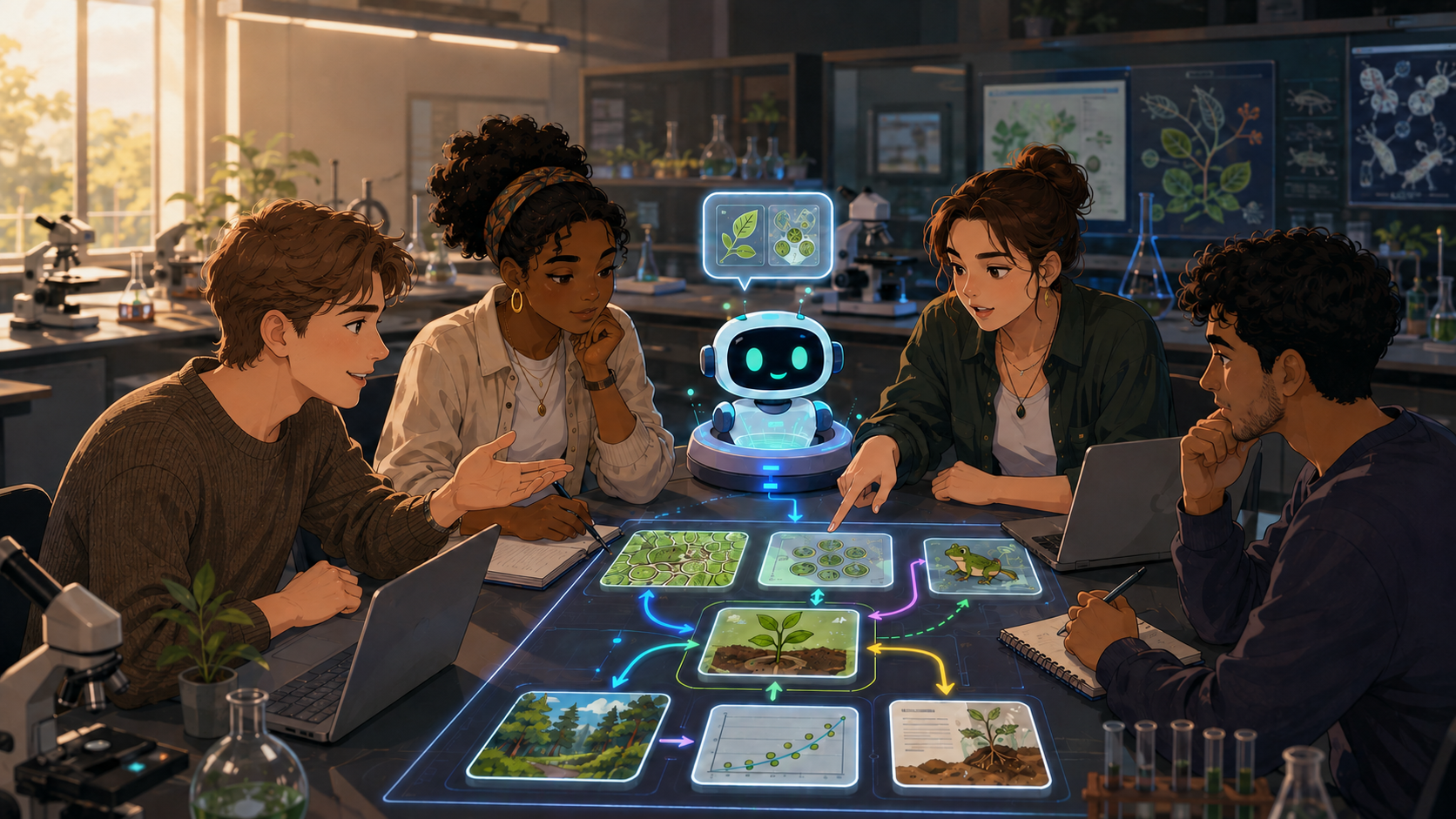
The Collaborative Argumentation with AI Agents (CA-AI) project investigates how humans and AI agents interact and co-construct knowledge during collaborative scientific argumentation. Rather than treating AI as a tool that simply provides answers, feedback, or assistance, the project examines AI as an active participant in collaborative reasoning—one that can respond to learners’ ideas, introduce alternative perspectives, and shape how claims, evidence, and explanations develop through interaction.
The project examines the interaction patterns and learning mechanisms that emerge as students and AI agents respond to one another, coordinate reasoning, negotiate claims and evidence, and build scientific knowledge together. By connecting science education, biology, learning sciences, and artificial intelligence, CA-AI seeks to understand when and how human–AI collaboration can strengthen science learning while supporting students’ intellectual autonomy and appropriate trust in AI.
See the NSF website.
02 /
Project Vision
Human–AI collaboration in learning should be understood not simply in terms of whether AI improves performance, but in terms of how interactions between humans and AI reshape reasoning, participation, and knowledge construction.
The CA-AI project is designed to uncover the mechanisms through which human and artificial agents jointly construct scientific knowledge. Ultimately, the project seeks to develop a theoretical framework, design principles, and a working platform for more responsible and learning-centered human–AI collaboration in education.
03 /
Project Goals
Investigate mechanisms of human–AI interaction
Examine how students and AI agents respond to one another, coordinate their reasoning, negotiate claims and evidence, and shape the trajectory of collaborative scientific argumentation.
Examine emergent knowledge co-construction and learning
Identify interaction patterns and learning mechanisms that emerge through human–AI collaboration and investigate how these processes influence students’ science learning.
Examine intellectual autonomy and trust in human–AI collaboration
Investigate how different forms of interaction with AI agents shape students’ intellectual autonomy, reliance on AI, and development of appropriate trust.
Develop principles for learning-centered human–AI collaboration
Translate empirical findings into a theoretical framework, design principles, and a working platform that can inform the development of responsible collaborative AI systems for learning.
04 /
Team & Collaborators
Project Leadership
- Andy Cavagnetto
- Hanjo Hellmann
- Tingting Li
- Peng He
Interdisciplinary Areas
- Science Education
- Biology
- Learning Sciences
- Artificial Intelligence