Research

The Food and Biomaterials Engineering Lab aims to enhance food safety and quality by tackling critical challenges at the interface of food, materials, and microbes within agricultural and food systems.

We employ a multidisciplinary approach that integrates food process innovation, advanced functional materials, and artificial intelligence to address key scientific questions in the field of food and biomaterials engineering.

The primary research areas are:

  • Biomaterials and biointerfaces engineering for microbial control and food protection
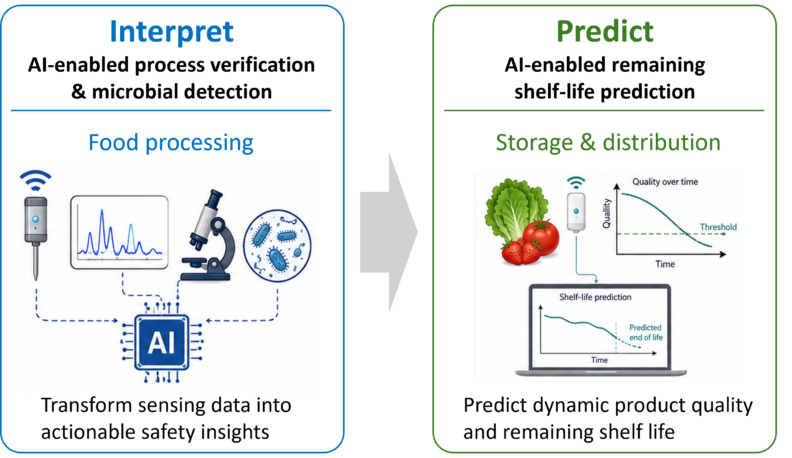
  • AI-enabled imaging and spectral analytics for process verification and hazard detection
  • Energy-efficient and high-performance processing for enhancing food safety and quality

Biobased Delivery Systems

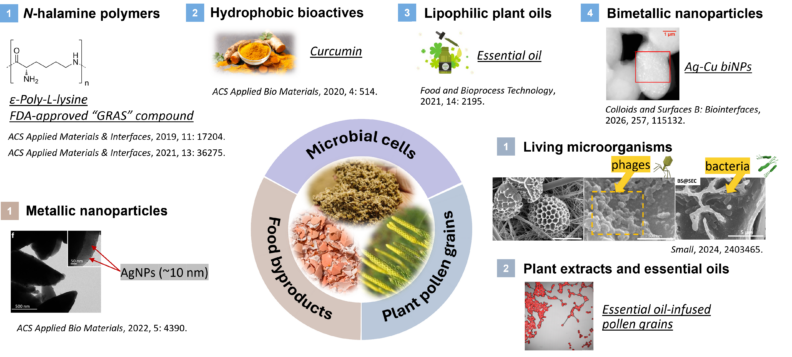
Innovations in biobased delivery systems offer powerful solutions to critical challenges in food safety and sustainability. Leveraging the intrinsic properties of biobased carriers derived from food byproducts and waste, these systems can stabilize encapsulated chemicals or microbes and enhance biocarrier binding affinity, resulting in more effective inactivation of pathogenic and spoilage microbes in food and agricultural systems. Such advancements can reduce dependence on conventional synthetic sanitizers and pesticides. Beyond food safety applications, these biobased microcarriers can also serve as targeted delivery systems for bioactives, promoting human health.

Selected References:

  • Liu, S., Quek, S., Huang, K.* An ecofriendly nature-inspired microcarrier for enhancing delivery, stability, and biocidal efficacy of phage-based biopesticides. Small, 2024, 2403465. https://doi.org/10.1002/smll.202403465
  • Huang, K., Dou, F., Nitin, N. Bio-based sanitizer delivery systems for improved sanitation of bacterial and fungal biofilms. ACS Applied Materials and Interfaces, 2019, 11(19): 17204-17214.  https://doi.org/10.1021/acsami.9b02428
  • Tao, M., Huang, K.* Bio-based chicken eggshell powder for efficient delivery of low-dose silver nanoparticles (AgNPs) to enhance their antimicrobial activities against foodborne pathogens and biofilms. ACS Applied Bio Materials, 2022, 5 (9), 4390-4399.  https://doi.org/10.1021/acsabm.2c00546
  • Liu, S., Tao, M., Huang, K.* Encapsulation of Mānuka essential oil in yeast microcarriers for enhanced thermal stability and antimicrobial activity. Food and Bioprocess Technology, 2021, 14(12): 2195-2206. https://doi.org/10.1007/s11947-021-02714-y  

Functional Materials and Interfaces

Our group explores advanced materials, such as coatings, hydrogels, and 3D scaffolds, to tackle critical challenges at the microbe-material interface in diverse food and agricultural settings. A central focus is the development of versatile, surface-independent antimicrobial and antifouling coatings derived from food processing byproducts and waste streams. These sustainable strategies aim to reduce cross-contamination from either food contact or non-food contact surfaces, limiting the transfer of pathogenic and spoilage microbes in the supply chain. Complementing this, we investigate bio-based materials and scaffolds designed to support the colonization, growth, and metabolic activity of beneficial microbes, even under harsh environmental conditions, enabling applications in areas such as fermentation and probiotic delivery.

Selected References:

  • Liu, Y., Xu, B., Li, Y., Quek, S., Huang, K.* Eco-friendly and self-sanitizing microporous cellulose sponge (MCS)-based cooling media for mitigating microbial cross-contamination in the food cold chain. Advanced Science, 2024. http://doi.org/10.1002/advs.202309753
  • Huang, K., Yang, X., Ma, Y., Sun, G., Nitin, N. Incorporation of antimicrobial bio-based carriers onto poly(vinyl alcohol-co-ethylene) surface for enhanced antimicrobial activity. ACS Applied Materials and Interfaces, 2021, 13(30): 36275-36285.  https://doi.org/10.1021/acsami.1c07311
  • Si, Y., Zhang, Z., Wu, W., Fu, Q., Huang, K., Nitin, N., Ding, B., Sun, G. Daylight-driven rechargeable antibacterial and antiviral nanofibrous membranes for bioprotective applications. Science Advances, 2018, 4: eaar5931.  https://doi.org/10.1126/sciadv.aar5931
  • Huang, K., Yi, J., Young, G.M., Nitin, N. Cell-based carriers incorporated antimicrobial coatings on diverse food contact surfaces for preventing cross-contamination of fresh produce. Food Control, 2022, 134: 108700.  https://doi.org/10.1016/j.foodcont.2021.108700

AI-Enabled Process Control

Many existing food system designs draw from established practices, leading to notable food safety concerns and significant waste/loss. Our research will create rapid-response platforms that combine cutting-edge material innovations with AI-driven analytics to transform food manufacturing in processing plants. These smart platforms will enable real-time detection of biological and chemical hazards, while AI-powered decision-support systems will optimize process control to enhance safety, efficiency, and sustainability. By integrating material science with AI, this approach will improve production efficiency, reduce waste, and proactively mitigate risks across the entire food supply chain.

Selected References:

  • Guo, M., Tian, S., Wang, W., Xie, L., Xu, H., Huang, K.* Biomimetic leaves with immobilized catalase for machine learning-enabled validating fresh produce sanitation processes. Food Research International, 2024, 179, 114027. https://doi.org/10.1016/j.foodres.2024.114028
  • Zheng, Y., Luo, X., Gao, Y., Sun, Z., Huang, K., Gao, W., Xu, H., Xie, L. Lycopene detection in cherry tomatoes with feature enhancement and data fusion. Food Chemistry, 2024, 463, 141183. https://doi.org/10.1016/j.foodchem.2024.141183