Significant progress has been made in understanding materials; however, given the demands of the modern world, materials are continually pushed to their limits, and there remains a persistent need to design materials with targeted functionalities. In this context, the PCM Lab focuses on developing a fundamental understanding of the physical and chemical mechanisms governing material behavior under extreme conditions.
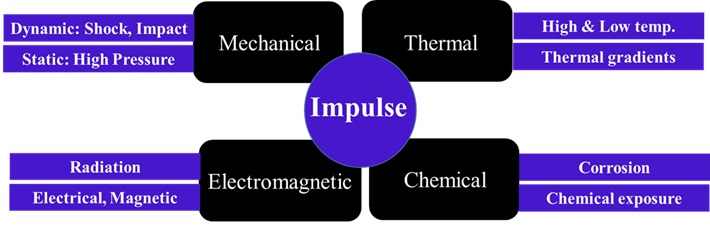
Examples of such conditions include: (1) space and hypersonic environments, where materials are subjected to combined extreme thermal and shock loading (e.g., atmospheric reentry of space vehicles), and (2) energy systems such as nuclear reactors, where materials experience coupled effects of corrosion and radiation.
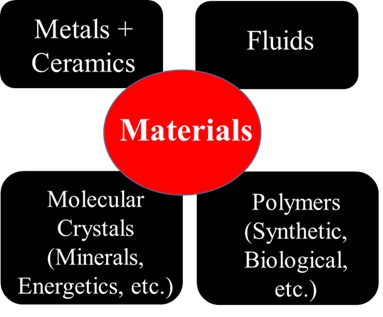
Accordingly, the primary objective of the PCM Lab is to elucidate the underlying physics and chemistry of materials to address critical challenges in defense, space, and nuclear applications. Our group investigates a wide range of materials—including metals, ceramics, polymers, composites, and fluids—focusing on their mechanical, thermal, optical, and electromagnetic properties, as well as quantum-level chemical processes.
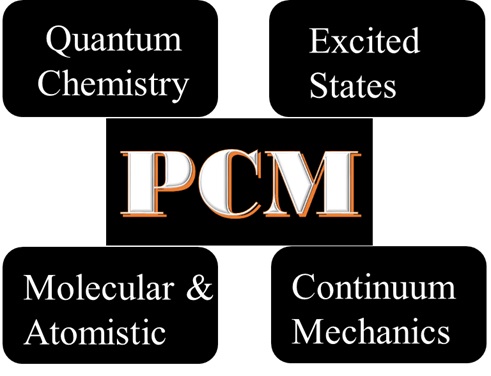
Our research integrates multiscale simulations—ranging from continuum to atomistic levels, including electronic-scale contributions—with experimental validation, often under extreme conditions such as shock, radiation, corrosion, and electromagnetic stimuli. The group’s work is primarily supported by funding from various Department of Defense (DoD) and Department of Energy (DoE) agencies.
n a nutshell, the lab conducts a broad range of investigations across multiple spatial and temporal scales, spanning from Newtonian mechanics to Schrödinger’s equation, and encompassing nearly all classes of materials.