Olympic Peninsula, Washington | October 3–6, 2026
Members of Washington State University’s SILviculture for Values and Ecosystem Resilience (SILVER) Lab participated in the 2026 Silviculture Instructors Tour, a four-day field experience focused on silvicultural practices, forest research, and the ecological characteristics of Pacific Northwest forests.
Hosted by Dr. Austin Himes of Washington State University and Dr. Zander Evans of the Forest Stewards Guild, the tour brought together silviculture instructors and forestry professionals for field discussions across western Washington.
The itinerary included visits to Seaquest State Park to examine operational-scale variable-density thinning, the Washington Department of Natural Resources’ Webster Forest Nursery, and Capitol State Forest to explore long-term treatments associated with the Silviculture Options Study. Participants also visited the Quinault Rainforest and sites associated with the T3 Watershed Experiment.
Exploring old-growth forests at Lake Quinault
One of the tour’s memorable stops was the giant Sitka spruce (Picea sitchensis) near Lake Quinault in the Olympic Peninsula’s temperate rainforest.
Interpretive signage at the site describes the tree as approximately 1,000 years old, with a circumference of 58 feet 11 inches and a height of 191 feet. The tree’s massive trunk and extensive root structure offered participants a close view of the size and structural characteristics that can develop in old-growth temperate rainforests.
The visit provided an opportunity to consider the ecological characteristics of mature and old-growth forests, including large-tree structure, stand development, and the conservation of long-lived forest ecosystems.
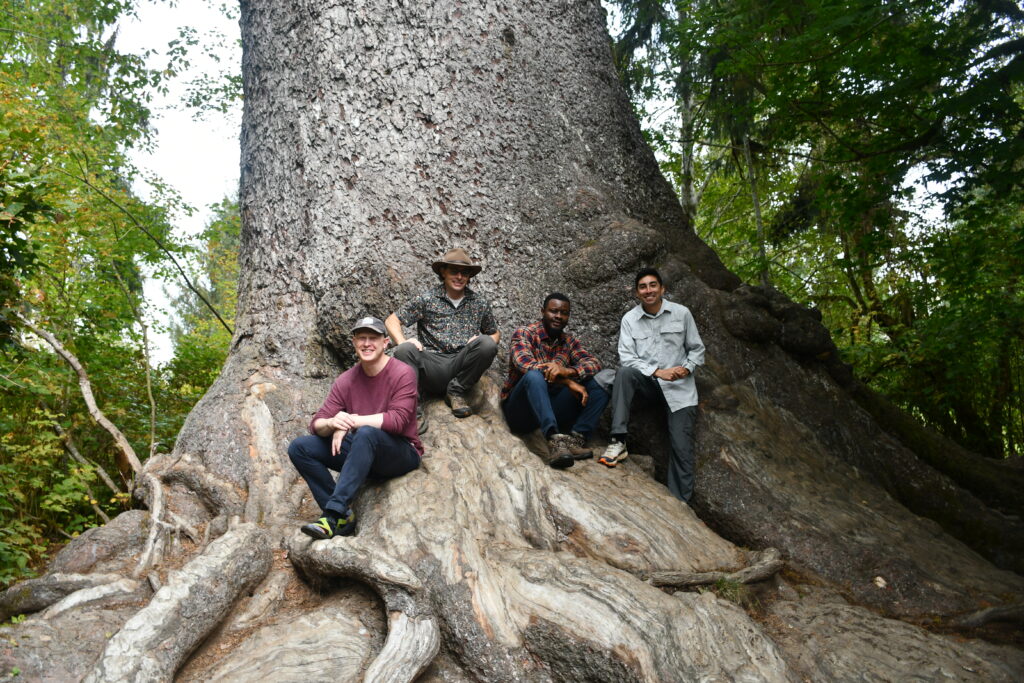
From left to right: Sam Kaiser, Dr. Austin Himes, Kelechi Ibeh, and Ruben Solorza at the base of the giant Sitka spruce near Lake Quinault, Washington, during the 2026 Silviculture Instructors Tour (Photo by Jeremy Stovall).
Connecting field observations with silvicultural research
For SILVER Lab, the tour offered opportunities to examine silvicultural treatments and forest conditions relevant to its research interests in forest ecosystem services, relational values, alternative management strategies, and responses to environmental change.
Observations from managed Douglas-fir stands, long-term silvicultural experiments, and old-growth temperate rainforests provided contrasting examples of forest structure and management across western Washington.
The tour also encouraged discussions among silviculture instructors, researchers, and forestry professionals about forest management objectives, silvicultural experimentation, and field-based teaching.
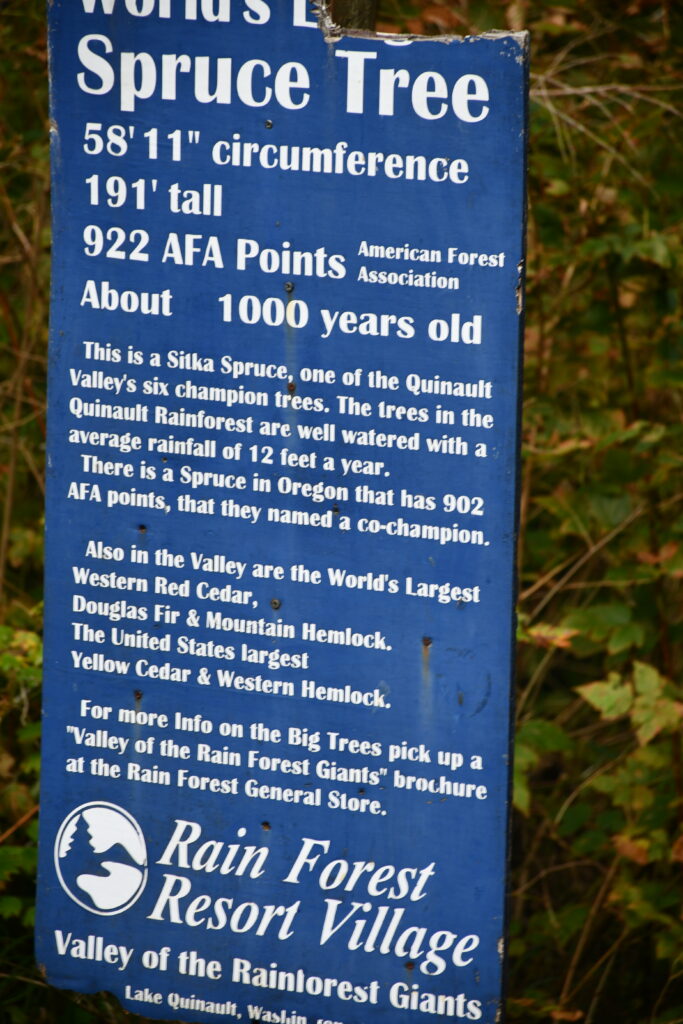
Interpretive signage at the giant Sitka spruce site provides the tree’s reported dimensions, estimated age, and historical champion-tree information (Photo by Jeremy Stovall).