Mitochondria and ER
Besides P-proteins and SE-plastids, mitochondria and ER belong to the most prominent structures in the sieve tube. The number of mitiochondria seems to be reduced compared to youg sieve elements, but their structure appears normal. Enzymatic activity has been detected, indicating that mitochondria are active in mature sieve tubes. In Arabidopsis, mitochondria are decorated with small protein “spikes”. The spikes are often attached to other sieve tube components and obviously provide an anchor for mitochondria not to be drifted away with the translocation stream.
The ER undergoes some structural changes during ontogeny. Initially ER cisternae are usually single and covered with ribosomes (rough ER). During maturation, ribosomes get lost and ER cisternae become stacked. A variety of fuctions of the sieve element ER have been proposed including anchoring of organelles, calcium storage and regulation etc. (for an overview see Knoblauch and Peters 2010 in the literature list). Since the sieve element ER is connected with the companion cell through specialized plasmodesmata (pore plasmodesma units, PPUs) it is likely that it plays an important role in molecular traffic between the cells. This is subject to ongoing investigations. We recently found that the sieve element ER is divided into specific domains with different lumen size exclusion limits (see
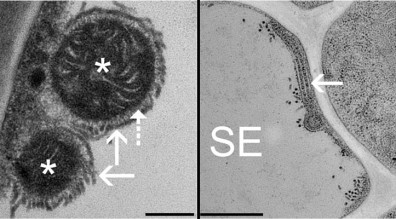
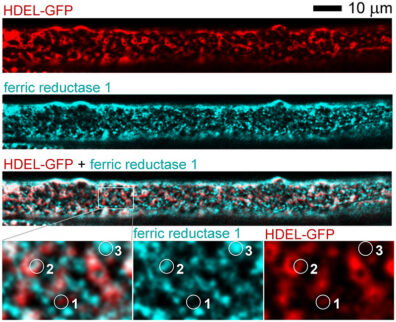
Super-resolution images of a sieve tube ER membrane protein (ferric reductase) and GFP freely expressed into the ER lumen showing two distinct ER domains. From: Proteomics of isolated sieve tubes from Nicotiana tabacum: sieve element–specific proteins reveal differentiation of the endomembrane system. PNAS 2021, https://doi.org/10.1073/pnas.2112755119 Copyright: Proceedings of the National Academy of Science.