EPM
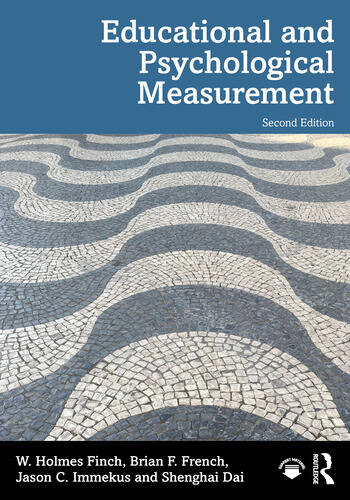
Educational and Psychological Measurement
Second Edition
W. Holmes Finch · Brian F. French · Jason C. Immekus · Shenghai Dai
Routledge, 2026
About the Book
Educational and Psychological Measurement, Second Edition, offers a broad, contemporary introduction to educational and psychological measurement and psychometrics. Beginning with foundational statistical concepts and classical test theory, the book progresses through reliability, generalizability theory, interrater agreement, factor analysis, validity, item analysis, and modern psychometric models.
The book also addresses advanced topics central to contemporary assessment, including item response theory (IRT), differential item functioning, cognitive diagnostic models, equating and scaling, standard setting, and computer adaptive testing. The second edition expands the coverage of emerging issues in assessment, including fairness and the use of artificial intelligence in testing and assessment.
What You’ll Find in the Book
Foundations of Measurement
- Basic statistical concepts
- Classical test theory
- Reliability
- Generalizability theory
- Interrater agreement
Validity & Measurement Development
- Exploratory and confirmatory factor analysis
- Validity
- Developing validity evidence
- Item analysis
Modern Psychometric Models
- Item response theory
- Differential item functioning
- Cognitive diagnostic models
- Equating and scaling
- Standard setting
- Computer adaptive testing
Contemporary Assessment
- Fairness in assessment
- Artificial intelligence in testing and assessment
- Computerized assessment
- Emerging assessment technologies
What’s New in the Second Edition
The second edition expands the book’s coverage of contemporary developments in educational and psychological measurement. New and expanded material addresses assessment ethics and fairness, alternative measurement models and scaling methods, computerized assessment, machine learning, and artificial intelligence in testing and assessment.
- Fairness and ethics in assessment
- Alternative measurement models and scaling methods
- Computerized assessment
- Machine learning and emerging computational approaches
- Artificial intelligence in testing and assessment
- Contemporary examples connecting psychometric theory with real-world assessment
The book also introduces pedagogical features such as “How it Works” and “Psychometrics in the Real World” boxes.
Resources for Students and Instructors
The book is designed as a resource for graduate-level courses in psychometrics, educational measurement, and related quantitative methods. Each chapter includes exercises and suggested readings, with additional online resources available through the publisher.
Online resources include:
- R, SPSS, and Excel examples and output
- Additional exercises
- Sample homework assignments
- Answer keys
- PowerPoint slides
- Additional data and instructional materials
These resources are specifically identified in the publisher’s description.
Authors
- W. Holmes Finch – George and Frances Ball Distinguished Professor of Educational Psychology at Ball State University, specializing in psychometrics, educational measurement, and quantitative methodology.
- Brian F. French – Regents Professor and Berry Family Distinguished Professor at Washington State University, specializing in educational and psychological measurement, validity, psychometric methods, and measurement fairness.
- Jason C. Immekus – Professor of Evaluation at the University of Louisville, specializing in latent variable modeling, structural equation modeling, item response theory, and educational and psychological measurement.
- Shenghai Dai – Associate Professor of Educational Psychology and Methodology at Washington State University and Director of the Large-Scale Data Laboratory, specializing in psychometrics, large-scale assessment, quantitative methods, and machine learning.
View the book at Routledge → Educational and Psychological Measurement — Routledge