Semitransparent organic photovoltaics (ST-OPVs) hold promise for agrivoltaics and building-integrated
photovoltaics (BIPVs) due to the ability to engineer device absorption profiles. While average visible transmittance
(AVT) has been used to address BIPV applications, nothing similar has been defined for agrivoltaics. We introduce
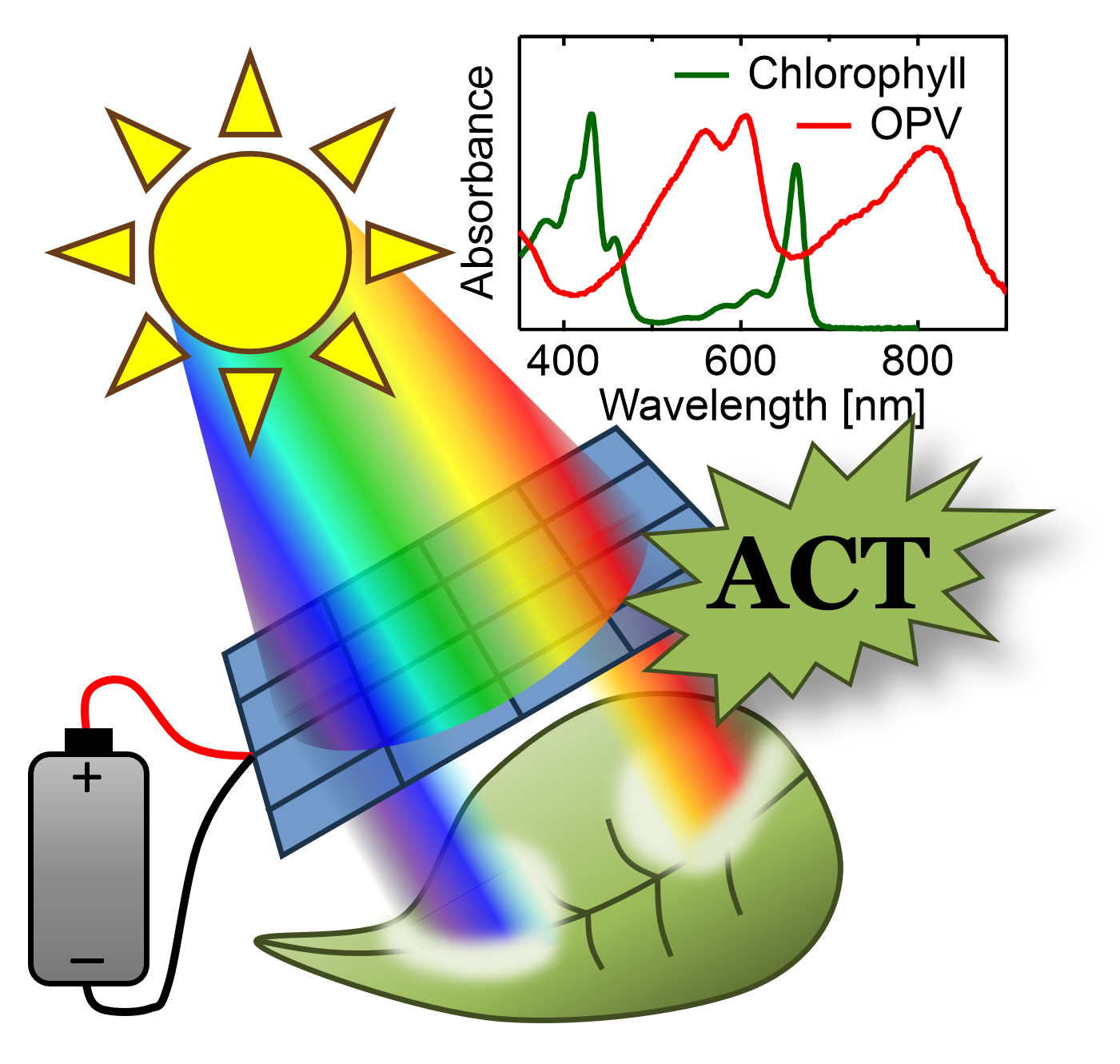
Average Chlorophyll Transmittance (ACT) to target agrivoltaics applications whose absorbance anticorrelates with
photopic response used in AVT. We tune an OPV system with a complementary absorption profile to maximize ACT
via blend ratio variation of the PTQ10 electron donor and DTY6 acceptor molecules processed in non-halogenated
o-xylene in air. We find that PTQ10 uniquely fits well between chlorophyl absorbance bands, resulting in an ACT
that is 2x higher than its AVT, and the highest of any system studied. While lowering the concentration of DTY6
molecules further increases ACT, the performance is reduced significantly due to ineffective acceptor domains as
analyzed through device dynamics and nanostructure measurements. The best blend results in a Light Utilization
Efficiency, LUEC= 6.1%, assuming no electrode absorbance. Finally, a fully blade-coated ST-OPV device, utilizing
transparent silver nanowires (AgNWs) top electrodes, reached full device LUEC of 3.17% with 41.3% ACT and
7.67% PCE. These findings highlight the interplay of ACT and PCE, emphasizing the potential for agrivoltaics and
large-scale ST-OPV production via roll-to-roll (R2R) processes.