Core X-ray Methods
| Technique | Probe Depth | Unique Capabilities |
|---|---|---|
| XAS (NEXAFS) | 5-1000 nm | Chemical fingerprinting: Oxidation states, bond angles, and electronic structure at target elements (C, O, N, … edges) |
| RSoXS | 2 nm – 3 μm | Nanostructure + chemistry: Domain purity, molecular orientation, and interfacial composition |
| RSoXR | .1-500 nm | Buried interfaces: Layer thickness, density gradients, and interfacial roughness |
| GIWAXS | 0.1 Å to 5 Å | Crystal Structure: (Non-resonant) Crystallinity, crystalline/polycrystalline disorder, molecular packing |
Why Resonance Matters
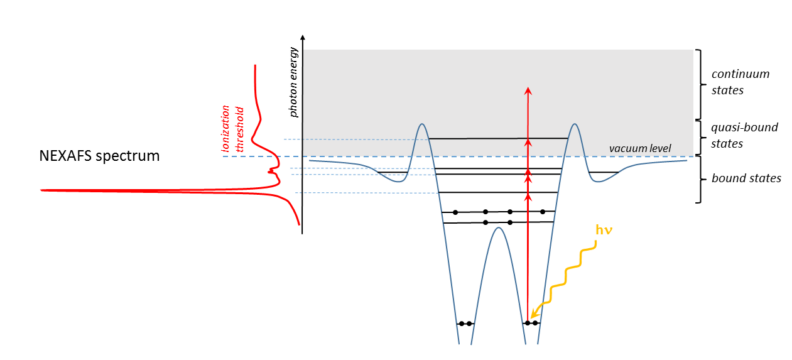
At specific energies near absorption edges, X-ray sensitivity increases 100-1000× for target elements. We exploit this to:
- Isolate chemical environments (e.g., carbonyl vs aromatic carbon)
- Map 3D molecular orientation using polarization control
- Quantify nanoscale composition in complex mixtures
Near Edge X-ray Absorption Fine Structure Spectroscopy
Spectroscopy methods are the primary drive for understanding the near edge electronic fine structure that dictates our resonant sensitivity enhancement. We host an open data collaborative project for the community that details this technique.
This open data project provides robust and detailed molecular metadata to facilitate future analyses from fundamental research to machine learning model training.
To see why this is so powerful, check out the spectral differences between these two very similar molecules!
Advancing RSoXS
Our innovations in Resonant Soft X-ray Scattering include:
- New tensor models for orientation analysis
- Developing multi component scattering models
- In-situ/operando measurement platforms
Probing Buried Structures with RSoXR
Our Resonant Reflectivity work with Lawrence Berkeley Lab enables:
- Interracial chemistry studies
- Thin film structure analyses
- Deep dives into light matter interactions
Crystallinity and GIWAXS
National lab resources, and our in house state of the art Xeuss 3.0 Instrument by XENOCS help us:
- Measure crystal Nano-structures and molecular orientation
- Connect molecular orientation and packing to device performance
- Collaborate with other scientists at WSU.