“Errors in reconstruction of dichroic X-ray orientation tomography due to polarization rotation of the incident beam” M. Marcus, H. Heilman, K. Andrle, J. Plumb, J. Synchrotron Rad. (2026) DOI: 10.1107/S1600577525011051.
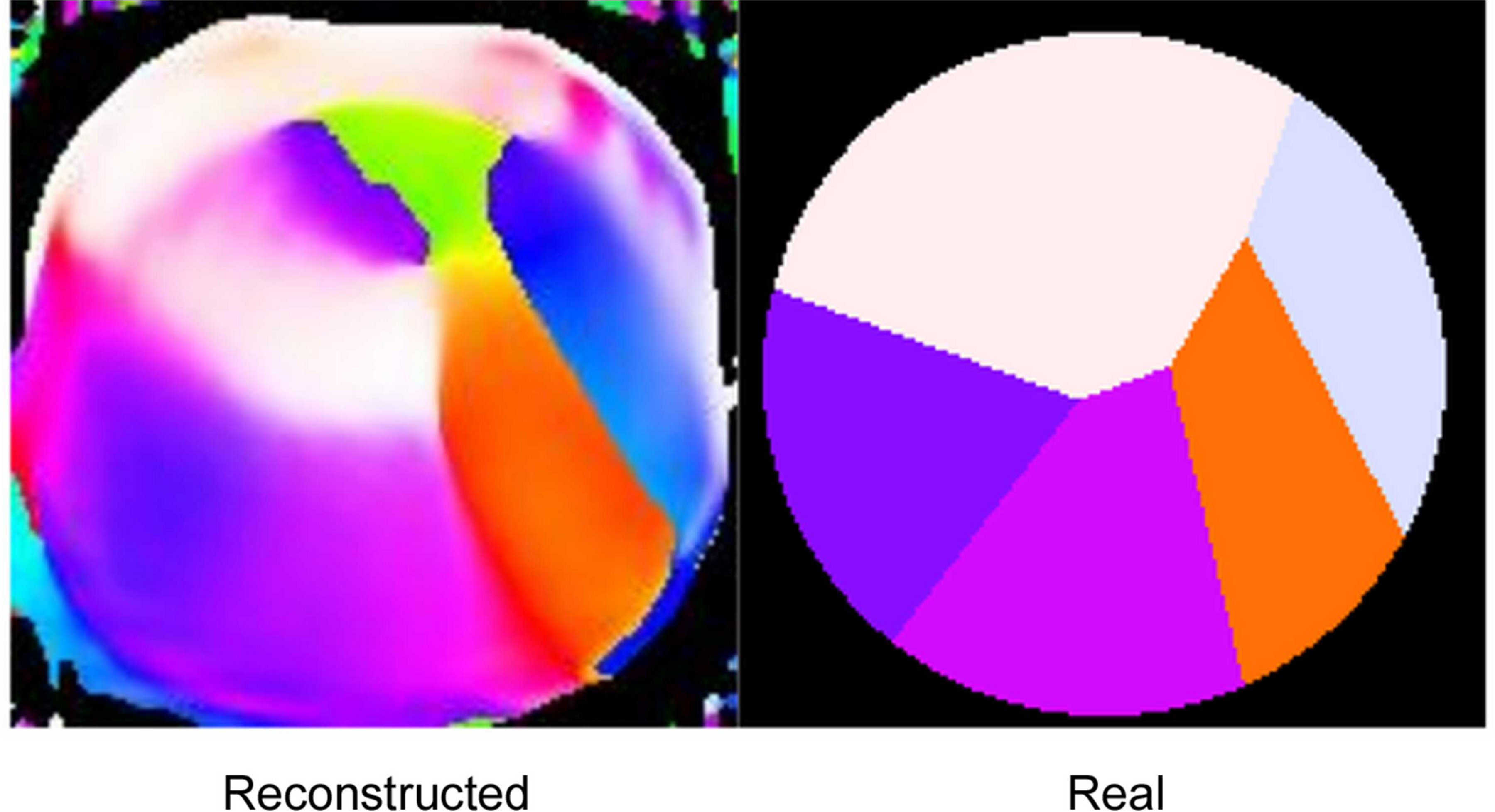 Dichroic X-ray tomography is a technique in which the crystal orientation or magnetization of a sample is resolved in three dimensions. The best-known uses of this technique are for observation of magnetic moments via using left- and right-handed circularly polarized X-ray beams. Another variant uses linear dichroism to resolve the crystal orientation. In both these techniques, it is assumed that the absorption of X-rays along a path inside a material can be computed as a line integral of a local along the ray path. For linear dichroism, this assumption is inaccurate because the polarization of the beam changes along the propagation direction when the optic axis of the material is not aligned along the polarization. In this work, a finite-element Maxwell solver is used to simulate tomography and reconstructions. The propagation effect can lead to significant errors in the reconstructed orientations. These errors may be mitigated by taking data at additional angles or by operating at energies at which the dichroism is weak. An iterative approach is proposed which may allow accurate reconstruction with fewer data than would otherwise be required.