Ongoing Research Projects
Our group works with a wide range of interdisciplinary topics, with a primary focus on understanding the physics of soft matter materials that play a key role in our technological future. Given this interdisciplinary nature, it is hard to put labels on the individual research projects that we work on. But as a whole, these projects focus on three primary research goals of this group.
Pushing The Limit of X-ray Science
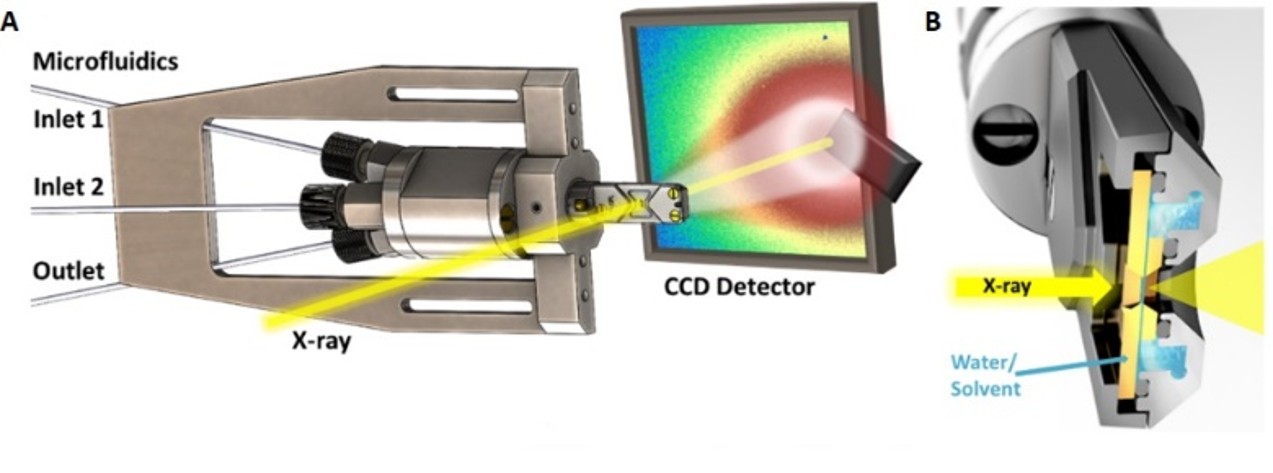
A primary goal of this group is the development and advancement of X-ray experimental methods. As a post doc at NIST Brian Collins was the first to use the polarized resonant scattering of soft X-rays (RSoXS) to uncover the orientational ordering on soft mater materials. Since then the group has worked to expand RSoXS to new domains, uncovering the secrets behind smart medicines, and the interfaces in exotic materials. We have developed in-situ measurement techniques, and expanded the technique to new geometries. In this work, we collaborate with innovative researchers across national and international labs primarily at Lawrence Berkley and Brookhaven National Labs. Find out more …
Unlocking the potential of novel organic materials
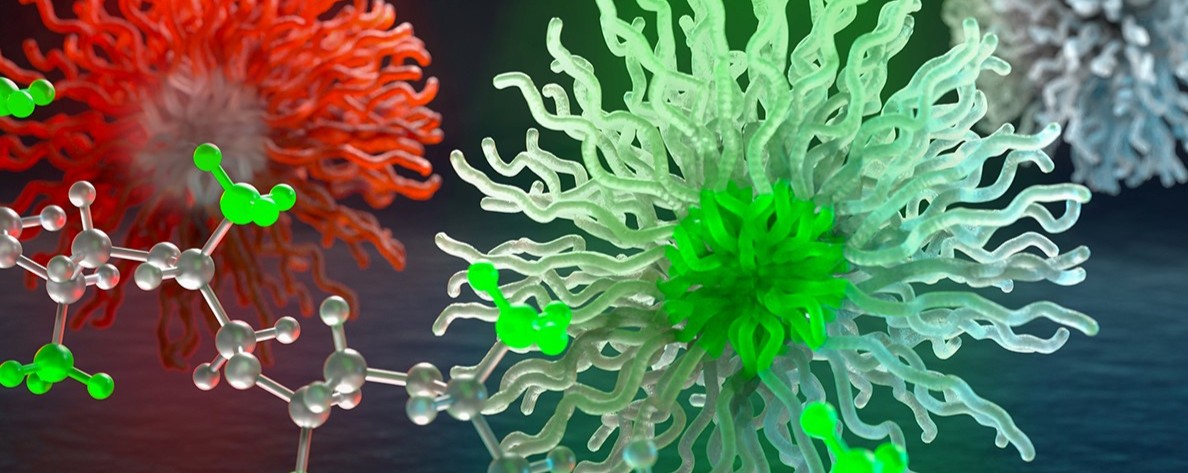
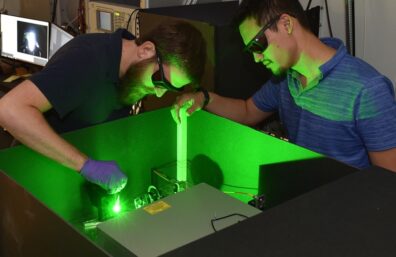
Organic materials are a revolutionary platform for electronic devices and applications. It was first discovered in the 1950’s that some organic polymers and molecules could have electrically conductive properties and could even convert electricity into light and vise vera! Today, these materials can be found in your phone’s screen that uses O-LEDs (Organic Light Emitting Diode), Solar Panels, and even transistors (OFETs: Organic Field Effect Transistors). They can be safer to manufacture that silicon based electronics and are more cost efficient. What makes these materials special is that they are electronically tunable and can also be fabricated on curved or stretchable surfaces! However, there is a lot of work that must be done to understand the relationship between processing conditions and energy efficiency of these organic electronic devices. Our group specialized in understanding the charge and ion dynamics in electronic materials, and X-ray characterization methods to construct spacial models of how the molecules are arranging themselves. Find out more …

State of the art simulation and modeling
Organic materials have several properties that make them a challenging system for simulation and modeling. Accurate and quantitative models require the intersection of electrodynamics, thermodynamics, statistical physics, quantum mechanics, and polymer physics. While at NIST PI Brian Collins worked with others on the first platform for simulating RSoXS scattering profiles. Since then we have combined first principles quantum theory with machine learning models and developed advanced resonant scattering models. Find out more …
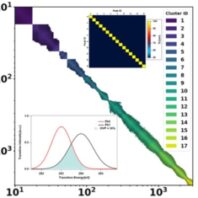
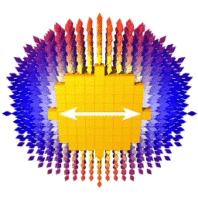
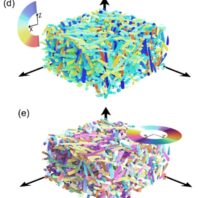
Center sourced from the NIST RsoXS Project. Right sourced from P. Nguyen et.al. JPC B (2024)