Core X-ray Methods
| Technique | Probe Depth | Unique Capabilities |
|---|---|---|
| XAS (NEXAFS) | 5-1000 nm | Chemical fingerprinting: Oxidation states, bond angles, and electronic structure at target elements (C, O, N, … edges) |
| RSoXS | 2 nm – 3 μm | Nanostructure + chemistry: Domain purity, molecular orientation, and interfacial composition |
| RSoXR | .1-500 nm | Buried interfaces: Layer thickness, density gradients, and interfacial roughness |
| GIWAXS | 0.1 Å to 5 Å | Crystal Structure: (Non-resonant) Crystallinity, crystalline/polycrystalline disorder, molecular packing |
Why Resonance Matters
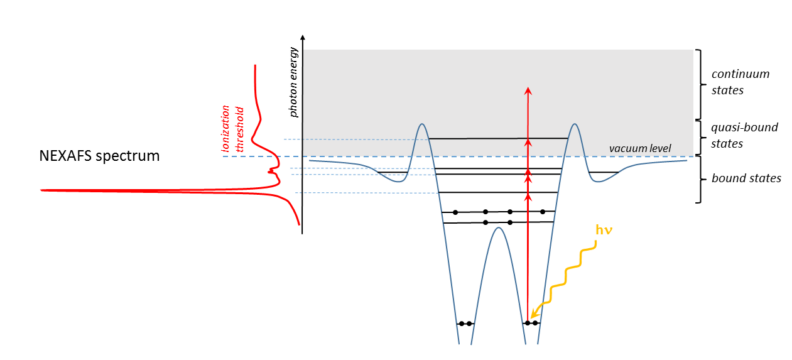
At specific energies near absorption edges, X-ray sensitivity increases 100-1000× for target elements. We exploit this to:
- Isolate chemical environments (e.g., carbonyl vs aromatic carbon)
- Map 3D molecular orientation using polarization control
- Quantify nanoscale composition in complex mixtures
Advancing RSoXS
Our innovations in Resonant Soft X-ray Scattering include:
- New tensor models for orientation analysis
- Developing multi component scattering models
- In-situ/operando measurement platforms
Probing Buried Structures with RSoXR
Our Resonant Reflectivity work with Lawrence Berkeley Lab enables:
- Interracial chemistry studies
- Thin film structure analyses
- Deep dives into light matter interactions
Crystallinity and GIWAXS
National lab resources, and our in house state of the art Xeuss 3.0 Instrument by XENOCS help us:
- Measure crystal Nano-structures and molecular orientation
- Connect molecular orientation and packing to device performance
- Collaborate with other scientists at WSU.