NSF-IRES and European Awards Support Cybersecurity Students in Sweden and the U.S.
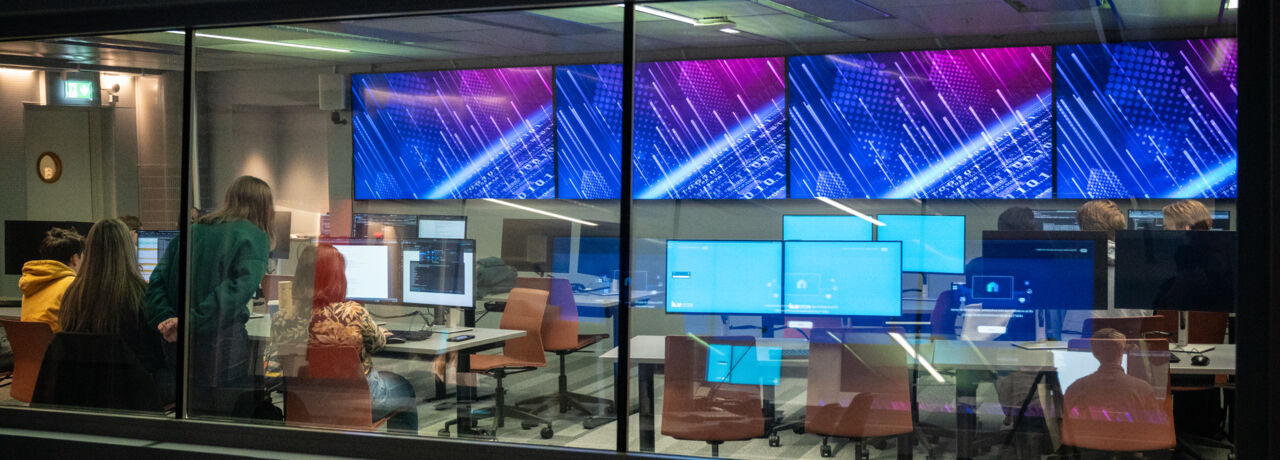
Cybersecurity lab at LiU – Photographer: Magnus Johansson
Researchers at Washington State University (WSU) and Sweden’s Linköping University (LiU) have received a three-year National Science Foundation grant and a two-year European-Union Erasmus+ grant that will train U.S. and Swedish students in cybersecurity research for artificial intelligence (AI) applications. The $450,000 grant from NSF’s International Research Experiences for Students (IRES) program will support semester-long exchanges for WSU undergraduates to conduct cybersecurity research together with a student cohort at LiU. This collaboration will foster international research as well as cultural exchange and cooperation. Separately funded by Sweden through a $50,000 Erasmus+ grant, the LiU student cohort will visit WSU in a subsequent semester. The collaborative research and training program will get underway in the fall 2025 semester, with the first cohort of WSU students traveling to Sweden in the spring semester of 2026. The students will conduct their research using some of the most advanced cybersecurity research facilities in Europe.
These awards are some of the anticipated outcomes of a long-term European-university engagement strategy developed by Joseph Iannelli, a professor in WSU’s School of Engineering and Applied Sciences and director of WSU’s recent externally-funded Scandinavia and European-Union Erasmus+ projects. Extending to several European universities and WSU colleges, the overarching objective of this strategy is to establish mutually beneficial partnerships with peer universities in order to secure substantial extramural international-collaboration funding and advance education and research collaboratively and more effectively than allowed by the resources of any single institution. In this strategy, Iannelli negotiated the MoU and Reciprocal Student Exchange Agreement that were signed by LiU and WSU. He then connected the WSU Cybersecurity faculty with counterparts at Linköping and provided them with guidance on the NSF-IRES program and a copy of one of his successful NSF-IRES grant proposals as a template for the grant proposal that resulted in this cybersecurity award. To date, the strategy has generated over $1,400,000 from domestic and European sources to provide WSU students in CAHNRS, CAS, Honors, and VCEA from Bremerton, Everett, Pullman, Tri-Cities and Vancouver with fellowships in the $5,000 – $12,000 range that remove students’ financial barriers. “It is exciting to contribute to graduating internationally-minded diverse students for leadership in multicultural global societies”, says Iannelli. The students will study at LiU’s Valla campus.

LiU’s Valla Campus
As AI applications have expanded within a growing number of devices, ensuring the security of generated data has become increasingly challenging, says Assefaw Gebremedhin, associate professor in WSU’s School of Electrical Engineering and Computer Science who is heading this cybersecurity project. “These cyber systems are pervasively targeted by sophisticated adversaries, who seek and exploit system vulnerabilities,” he said. “Securing cyber devices sustains national security and reflects strategic goals to maintain leadership in cybersecurity and AI innovation.”
Following in the footsteps of the 25 WSU students who have already been admitted to study at LiU under Iannelli’s strategy, the students in the program will each receive a $12,000 fellowship and will focus their research on developing security technologies that can protect AI-augmented government, industry, and private cyber installations. They will investigate machine learning algorithms with enhanced security, anomaly-detection and privacy-preserving features tailored for diverse systems, including for healthcare, autonomous vehicles, and smart cities. In their research, students will have access to Sweden’s high-performance computing and visualization centers while also taking courses taught in English. “The scholars will develop innovative cryptographic techniques designed to defend against the unique threats posed by AI applications in cyber environments,” said Gebremedhin.
WSU began offering a cybersecurity degree in 2023 to meet burgeoning demand for computer scientists with expertise in cybersecurity. An increasing number of companies use cloud services in their operations, and the number of cyberattack incidents have been steadily increasing. Data theft of critical information and ransomware that harms computer systems are challenges for companies across the world. The number of jobs for cybersecurity experts is expected to grow by 35% in the next decade with more than 19,000 available positions every year, according to the US Bureau of Labor Statistics. WSU’s cybersecurity program is offered in Pullman, the Tri-Cities, and Everett. Students from each of these three campuses will participate in this program.
“Professionals with expertise in AI and cybersecurity are in high demand among domestic and multinational corporations, as these skills are essential to ensure security of data, connections, and critical infrastructure,” said Gebremedhin. “The participating students will elevate their preparation to operate successfully in the cybersecurity and AI fields at the highest international levels and expand Sweden’s and the United States’ resilience against cyberattacks from malicious agents.”
Through their experiences in this program, the students will develop skills and international attitudes to adapt their behavior to interact effectively with those who are culturally different from them, interpret issues and situations from more than one cultural perspective, accept cultural differences as well as manage cultural ambiguity, seek out international or intercultural opportunities, and use diverse cultural frames of reference and alternative perspectives to think critically and solve cybersecurity problems that transcend national boundaries.
By living in a different country and culture, the participants will also sharpen their interaction, resilience, and resourcefulness skills in navigating distinct cultures, expectations, and processes. These transferable skills are highly valued by employers and multinational corporations. In order to continue to deliver services and products to their markets and sustain local economies, these corporations need to engage globally educated and multi-culturally oriented professionals, who have had personal direct experiences with the cultures of these corporations’ home and host countries. These benefits to local economies are realistic not only for the U.S., but also for Sweden in view of the multitude of U.S. and Sweden corporations that successfully operate in both countries.
In addition to Gebremedhin and Iannelli, collaborators on the project include Mohamed Elmahallawy at WSU Tri-Cities and Sergey Lapin from WSU Everett. Applications for the program will be available later this fall.