mehanistic design procedure for pervious concrete pavements
snassiri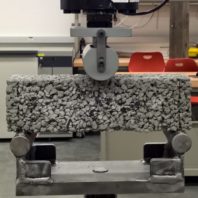 This research explores Pervious Concrete Pavement (PCP), a technology that is often a desirable pavement option for city streets, bike lanes, parking lots, and sidewalks due to its fast infiltration of storm water. PCP minimizes ponding, spraying, and hydroplaning. While PCP is gaining in popularity for low-volume applications, no fatigue model is currently calibrated for use in mechanical pavement design procedures. This project will perform field and laboratory testing on several PCP installments to study how CPC fatigues. Findings from this project will be integrated into pavement design procedures, specifically PerviousPave and will be coupled with future field performance in order to create a workable fatigue model for PCP.
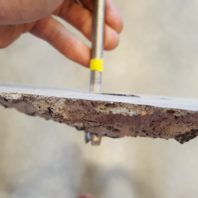 Anchor systems used in concrete structures are critical in all types of applications, including infrastructure (bridges, tunnels, and dams), industrial structures (heavy machinery footings, nuclear power plants) and residential projects (pipes attached to the wall or the ceiling). They must be reliable and durable, manufactured and designed to ensure of their intended application. Our industry partner-Simpson Strong-Tie (SST)’s- years of experience in the field has shown that more often than not, the hole is drilled at the wrong location for anchor installation. We are testing anchors installed in concrete slabs to establish any reduction effect that an adjacent abandoned hole may have on concrete anchor tensile capacity. Two types of anchors: torque-controlled mechanical anchors and adhesive anchors with different diameters, embedment depths from different manufacturers will be tested to build a database. The test results will be first statistically analyzed. Then, Finite Element Models (FEM) based on elasticity theory, plasticity theory, bond-slip relationship, and fracture mechanics will be developed and validated by the results.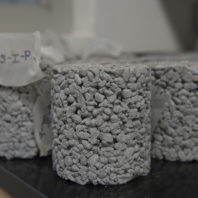
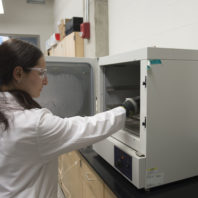
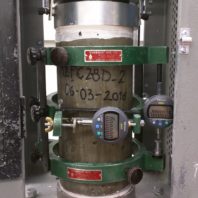 Every step- small or large- towards making our pavement design procedures more mechanistic and field data-based, gets us closer to more durable infrastructure. With this goal in mind, we are partnered with Idaho Transportation Department (ITD) in developing a state-wide concrete material properties library. At this library, state engineers can check out concrete properties such as strength, stiffness, the coefficient of thermal expansion and drying shrinkage to design pavement sections in their region. The test results database will be ready for use in the newly developed mechanistic-empirical pavement design guide set forward by the American Association of State Highway and Transportation Officials (AASHTO).
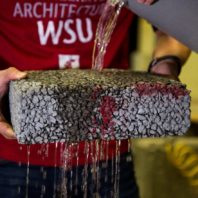 Pervious concrete pavements are to help control stormwater runoff from the heavy showers in the Pacific Northwest. Pervious concrete is intentionally designed to contain more than 20 percent air voids in the mixture and allow for at least 500 inch/hr infiltration rate. Runoff travels through the pervious concrete slab, passes through the underlying stone reservoir and percolates into the natural subgrade soil or is collected by underdrains. The picture shows that as the water is being poured over a pervious concrete slab, it infiltrates through the slab. Like any other new products that become popular too quickly, pervious concrete pavements are falling behind in design and testing. We are working on material testing and design method development for pervious concrete with several entities such as the Washington state department of transportation (WSDOT), The Boeing Company, American Concrete Institute (ACI), Airport Cooperative Research Program (ACRP), and local University Transportation Centers.