CMCL at ACI fall 2019 convention
snassiriOthman AlShareedah from CMCL presented his work on developing a mechanistic thickness design method for pervious concrete pavement (PCP) at the American Concrete Institute (ACI) 2019 Fall Convention in Cincinnati, Ohio. The mechanistic method involved investigating the in-situ elastic modulus and modulus of subgrade reaction of 14 PCPs across Washington State and developing a flexural fatigue model for pervious concrete pavement. The fatigue model was developed using a total of 66 PC beams made with two aggregate types (angular and round) and three porosity levels (20%, 25%, and 30%) under flexural fatigue loading in three stress ratios (SR): 0.75, 0.8, and 0.85. Recommended PCP thicknesses were proposed using the developed fatigue model, the in-situ mechanical properties of PCP, and traffic categories based on the American Concrete Institute (ACI) guide for the design of concrete parking. The developed thickness design method and the database will bridge the current knowledge gap in the structural design of pervious concrete pavement. The results are published in two papers in ASCE and C&BM journals.
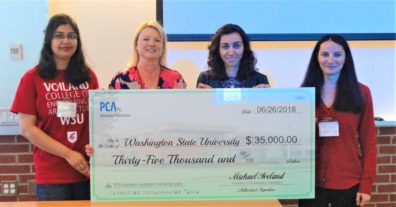 PULLMAN, Wash. – A Portland Cement Association grant to improve concrete durability testing methods has been presented to Washington State University researcher Somayeh Nassiri.
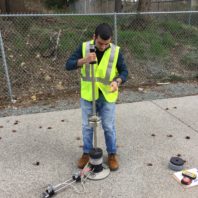 The use of pervious concrete pavement is increasing nationwide and hence it is important to understand the structural behavior of this type of concrete. In this research, we used Lightweight Deflectometer (LWD), a simple and non-destructive test, to obtain the structural properties of pervious concrete pavement. The test is conducted by dropping the weight on a circular plate and measuring the deflection of the pavement by three sensors (as seen in the photo). LWD test was conducted on different pavement locations across Washington State including a number of streets, parking lots, and sidewalks in different structures. The goal is to use the resulted deflections from different layer thicknesses to obtain the elastic modulus and modulus of subgrade reaction (k-value) of pervious concrete which are the key parameters in rigid pavement thickness design. This will provide a database for the properties of pervious concrete at different layer thicknesses. The LWD test results will be combined with further research work on a fatigue model to provide a mechanistic design procedure of pervious concrete pavements.
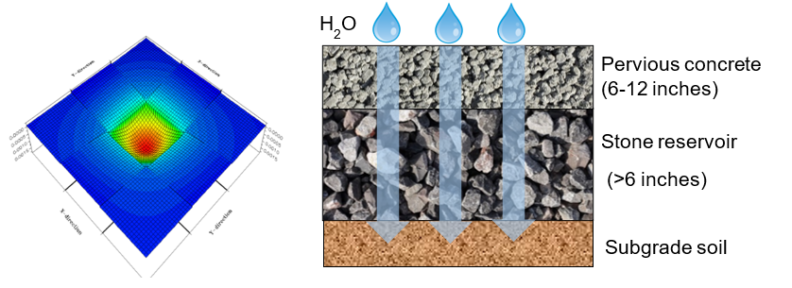
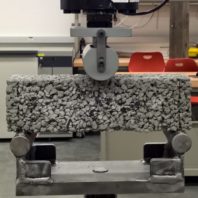 This research explores Pervious Concrete Pavement (PCP), a technology that is often a desirable pavement option for city streets, bike lanes, parking lots, and sidewalks due to its fast infiltration of storm water. PCP minimizes ponding, spraying, and hydroplaning. While PCP is gaining in popularity for low-volume applications, no fatigue model is currently calibrated for use in mechanical pavement design procedures. This project will perform field and laboratory testing on several PCP installments to study how CPC fatigues. Findings from this project will be integrated into pavement design procedures, specifically PerviousPave and will be coupled with future field performance in order to create a workable fatigue model for PCP.
 Anchor systems used in concrete structures are critical in all types of applications, including infrastructure (bridges, tunnels, and dams), industrial structures (heavy machinery footings, nuclear power plants) and residential projects (pipes attached to the wall or the ceiling). They must be reliable and durable, manufactured and designed to ensure of their intended application. Our industry partner-Simpson Strong-Tie (SST)’s- years of experience in the field has shown that more often than not, the hole is drilled at the wrong location for anchor installation. We are testing anchors installed in concrete slabs to establish any reduction effect that an adjacent abandoned hole may have on concrete anchor tensile capacity. Two types of anchors: torque-controlled mechanical anchors and adhesive anchors with different diameters, embedment depths from different manufacturers will be tested to build a database. The test results will be first statistically analyzed. Then, Finite Element Models (FEM) based on elasticity theory, plasticity theory, bond-slip relationship, and fracture mechanics will be developed and validated by the results.