EasyXAFS300+
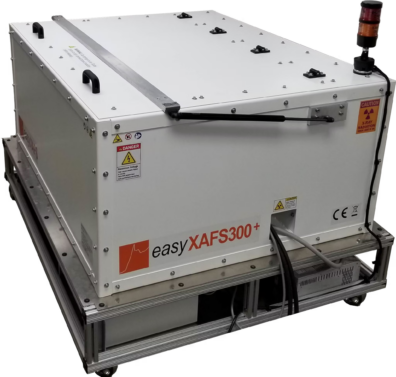
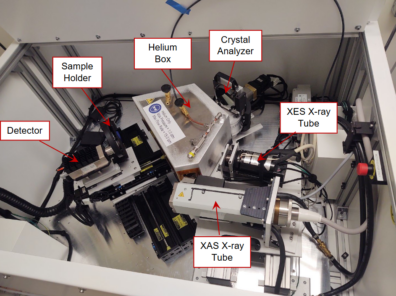
The easyXAFS300+ is a high-powered X-ray absorption and emission spectrometer. This system enables transmission-mode X-ray absorption fine structure (XAFS) measurements and X-ray emission spectroscopy (XES) measurements that are typically made at a synchrotron to be made in the lab. The instrument is made possible with modern x-ray optics and detectors, a 1.2 kW XRD-type tube (either Mo or Ag) for XAFS, and a 100 W XRF-style tube for XES (either W or Pd). Most of the beam path is in a He environment to maximize flux at the sample. Transmission samples are mounted over a ~12 mm x 2 mm area, and an automatic sample changer with seven spots is available. One possible sample preparation procedure might include powdering and homogeneously mixing with polyethylene glycol to form a pellet with a thickness corresponding to ~1 absorption length just over the absorption edge of interest. Due to the lower flux compared to a synchrotron, more care than for synchrotron measurements can be required.
Specifications:
Measurement Mode: XAFS and XES
XAFS X-ray Source, Mo or Ag: 1.2 kW liquid-cooled x-ray tube
XES X-ray Source, W or Pd: 100 W air-cooled x-ray tube
Energy Range: 5-~20 keV.
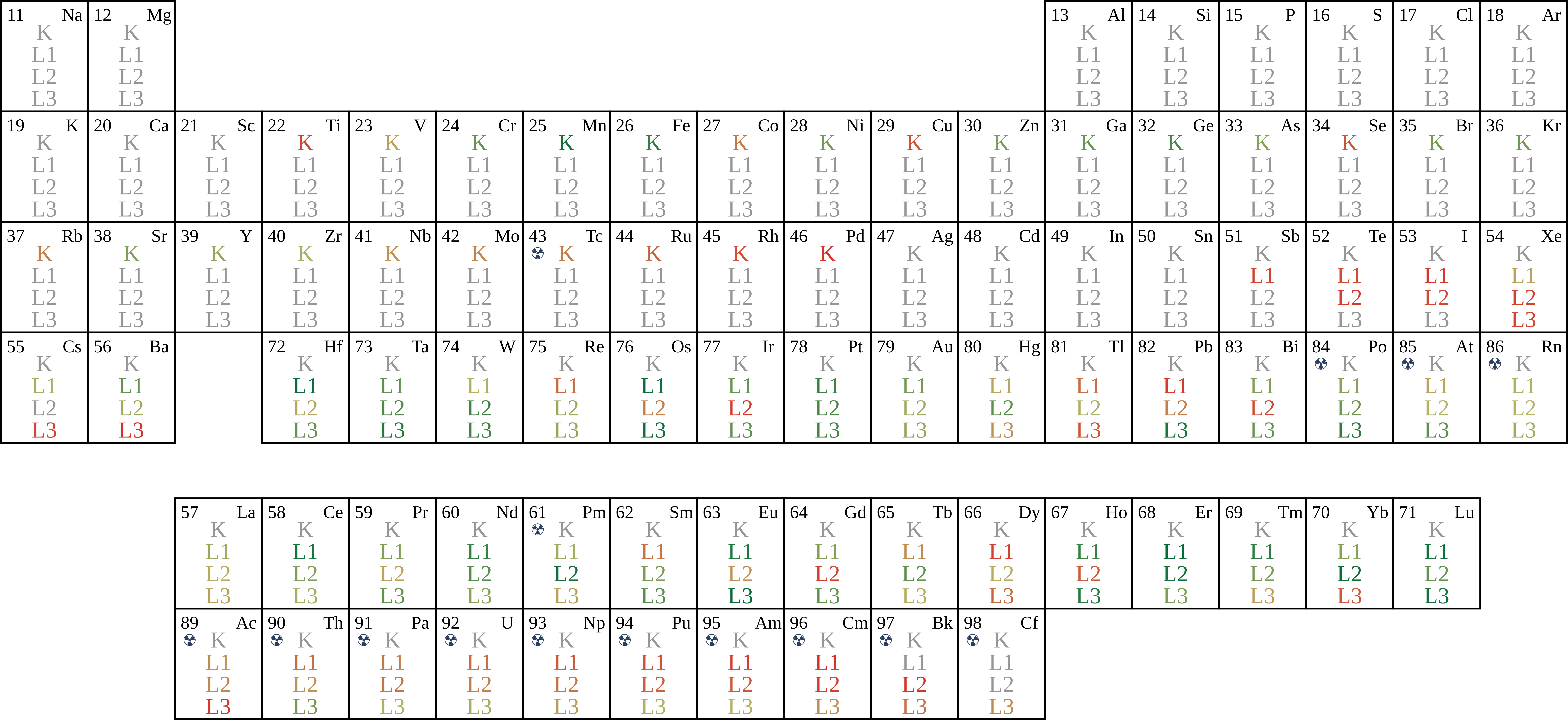
See figures below for available edges. Note that there is lower flux for higher energy edges (above ~12 keV). Up to ~25 keV theoretically possible with Ag tube (normal operation with Mo tube).
Spherically bent monochromator crystals: Si(100), Si(110), Si(111), Si(211), Ge(211), Ge(620)
Rowland Circle Size: ~0.5 m
This instrument is located in the Nuclear Science Center building, and is available for reservation after training from the NSC staff.
Overview of the reacheable absorption edges. Grey labels indicate edges that are not measurable on our instrument. The red-to-green color scale reflects the relative energy coverage score, with red edges being more “difficult” to analyse, and green ones “easier”.
Available bent monochromator crystal harmonics overlayed with possible absorption edges. The lowest energies on each harmonic (farther to the left) have the best energy resolution (better energy resolution at higher Bragg angles).
Successful measurements on the easyXAFS by the NOME group include the Fe, Br, and Zr K edges, the La, Ce, and U L3 edges, and the I L2,1 edges:
Example easyXAFS XANES spectra for reference compounds at the U L3 edge. 2-hour measurements with the Mo tube and Si(12 6 6) harmonic.
Example easyXAFS XANES spectra for iodate sorbed on hydrothermal Fe-S (green), and some I-containing reference compounds. Measurements were made at the I L2 (a) and L1 (b) edges with the Mo tube and Si(4 0 0) harmonic.
← Back to Characterization equipment