
Current Research Projects
| Advanced Characterization Techniques to Improve Understanding of Glass Phenomena This project aims to introduce and develop unconventional techniques for characterizing glass structure and performance. Past work in this area has focused on magnetometry techniques for iron-containing glasses. Current work is focused on positron annihilation spectroscopy applications to glass, as well as laboratory-based X-ray instruments, including small-angle X-ray scattering (SAXS) and nano-computed tomography (nano-CT). (Funding: various) Related publications |
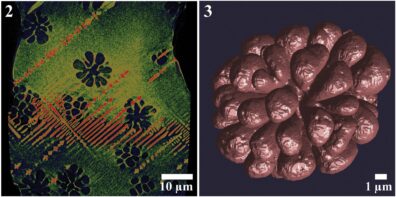
Phase separated LaCaMo-X silicate glass displaying dendtritic powellite crystals, and segmented silica-rich phase separation. (From Bussey et al., 2023) |
|
| Expanded High-Level Waste Glass Processing Envelope This project proposes to increase the loading of potential HLW feeds in glass by expanding the existing database and glass property-composition models. The general approach is to build on previous studies that obtained data with high quality assurance pedigree and expand those datasets into more aggressive waste loading regimes for the target properties outlined here, including high-Al2O3, high-SO3, and high-Na2O compositions. The target properties include SO3 solubility, nepheline formation upon canister centerline cooling, crystallization or immiscible liquid separation in the melt as a function of temperature, product consistency test response, toxicity characteristic leaching procedure response, viscosity, and electrical conductivity. The general experimental approach highlighted here includes simultaneous optimization of the component fractional loadings through empirical data collection and sample analysis coupled with modeling. (Partners: PNNL, U North Texas; Funding DOE-EM)Related Publications |
||
| Glass Research Providing Risk Reduction for Direct-Feed Low Activity Waste (DF-LAW) Vitrification Plant Startup This research involves glass-melting, thermal treatments, structural characterization of the crystalline and glassy phases, and chemical durability assessments in support of the DOE/ORP Waste Treatment Processing efforts. Primary technical focuses are: the suppression of foaming due to redox effects, increase of Na2O and SO3 loading, increase the solubility of volatile radionuclides, suppression of crystallization in LAW glass, and control of K-3 refractory corrosion. (Partners: Rutgers, PNNL; Funding DOE-EM) Related Publications Formation and Alteration of Old Glass |
||
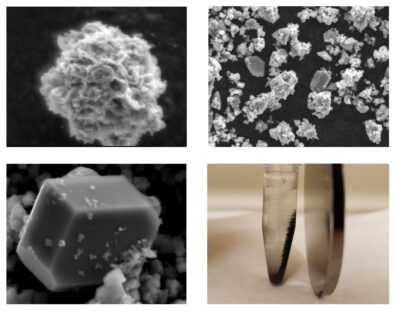
Fe-S particles synthesized via different protocols, and under the influence of a magnetic field. (Partly adapted from Shuvo et al., 2025) |
Iron sulfide nanoparticles for capture of volatile contaminants: Consortium for Risk Evaluation with Stakeholder Participation (CRESP) |
Pioneering a Cermet Waste Form for Disposal of Waste Streams From Advanced Reactors (PACE-FORWARD)
Cermets have long been recognized as potential WFs for disposal of ceramic and metal-based nuclear waste. We aim to combine our scientific understanding of materials science with the strength of rapid processing technologies, that is, HIP and SPS, to deliver a simple and scalable route to produce cermet WFs which can immobilize the combined HLW (metal + salt + oxide + carbon) from each target advanced reactor fuel cycle, i.e., molten salt fuel reactors, metallic fuel reactors and TRISO fuel.
(Partners: Rutgers, PNNL, SRNL, MS&T, Alfred, U S Carolina; Funding: ARPAe)
Related publications
Understanding of Degradation Pathways and Thermodynamic Properties of UN and UC based Spent Nuclear Fuels from Pool Storage and Dry Disposal
This research proposal aims to develop a fundamental understanding of possible degradation pathways of spent nuclear fuel forms of advanced non-oxide fuels: uranium nitride (UN) and uranium carbide (UC), under various storage and disposal conditions, using modern spectroscopic and calorimetric techniques.
(Partners: WSU Chemistry; Funding: Nuclear Regulatory Commission)
Related publications
Accelerated Discovery, Design, and Development of Ceramic Materials (Cer3D)
Through this project, we propose to develop advanced experimental, theoretical, and data science methods and apply them to illustrate means to rapidly address many of key problems in design, modeling, manufacturing, and testing of advanced ceramic materials.
(Partners: WSU MME, IMR, ISP; Funding: Army Research Laboratory)
Related Publications