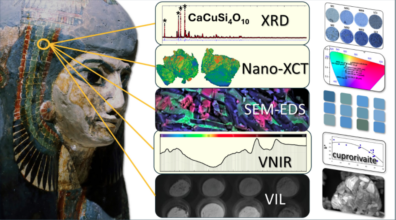
Egyptian blue isn’t just a pretty pigment—it’s science, history, and art all rolled into one. Washington State University’s John S. McCloy led a team to recreate this ancient pigment and figure out how ancient artisans achieved those iconic shades. With a mix of natural minerals, intense heat, and modern tools, they reverse-engineered 5,000-year-old color technology.
The team, including scientists from the Smithsonian and the Carnegie Museum of Natural History, experimented with materials like malachite and azurite and ran them through heating processes at 1000°C. They discovered that the tiniest changes—like adding sodium carbonate or cooling slowly—could drastically alter the pigment’s final hue. They used modern tech like nano-computed tomography imaging and spectrometry to analyze it all.
Not only did the color change based on chemistry and heat, but how particles stuck together mattered too. Smaller grains made the pigment appear duller, while the presence of glass made it shift toward green. Their work proves that ancient Egyptians were material scientists in their own right.
The findings go beyond just art history. Egyptian blue’s glow in the near-infrared makes it a contender for use in biomedical devices, security inks, and even lasers. This study, published in npj Heritage Science, bridges ancient creativity with modern innovation.
Read the open access paper here and a press release here.
John McCloy, Edward Vicenzi, Thomas Lam, Julia Esakoff, Travis Olds, Lisa Haney, Mostafa Sherif, John Bussey, M. C. Dixon Wilkins, Sam Karcher, “Egyptian Blues: Assessment of Process Variability and Color in Synthesized and Ancient Pigments,” npj Heritage Science, 13(1), 202 (2025). https://doi.org/10.1038/s40494-025-01699-7