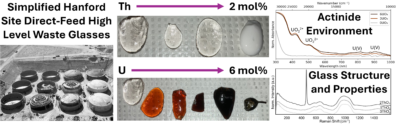
At Washington State University, John Bussey and his collaborators tackled a big challenge in nuclear cleanup: how to safely trap uranium and thorium in glass. Working within the Hanford Site’s high-level waste plan, they tested glass recipes that mimic real nuclear waste, melting them at high temperatures to see what uranium and thorium would do.
They found that uranium, especially in its glowing orange U6+ form called uranyl, fits well into the glass structure—until there’s too much, and it starts to form crystals. Thorium, on the other hand, doesn’t mix in as easily and tends to crystallize sooner. These insights are crucial because different behaviors affect the safety and durability of nuclear waste storage.
Using tools like X-ray absorption and Raman spectroscopy, the team—Malin Dixon Wilkins, Gavin McCloy, Rachael Bergman-Underwood, and John McCloy—measured changes in color, density, and temperature resistance of the glasses. They even watched the uranium glow and shift color as its chemistry changed.
Their work helps make vitrification—a process where waste is turned into glass—smarter, safer, and more effective. As the U.S. plans long-term disposal at sites like Hanford, this research brings us one step closer to locking toxic materials safely away for thousands of years.
Read the whole paper here.
John Bussey, Malin C. J. Dixon Wilkins, Gavin McCloy, Rachael Bergman-Underwood, John McCloy, “Uranium and Thorium in simulated Hanford Site direct feed-high level waste aluminoborosilicate glass,” MRS Advances, (2025) http://doi.org/10.1557/s43580-025-01271-2