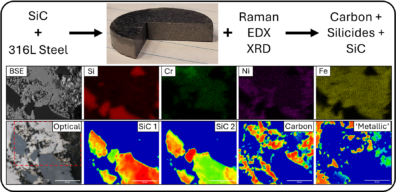
At Washington State University, researchers Malin C. Dixon Wilkins and John S. McCloy are reimagining nuclear waste storage by combining two powerful materials—silicon carbide and stainless steel. The goal? Develop a composite, or “cermet,” capable of safely containing tricky waste from next-generation TRISO nuclear fuels.
Their experiments involved hot-pressing different mixes of SiC and 316L steel. The best results came from a 50:50 mix, which formed a dense material. As they added more SiC, the samples became weaker and more porous, but still offered insights into how these materials interact.
They discovered that SiC and steel react during heating, forming complex compounds like silicides and carbides. These reactions could actually help lock radioactive particles in place, improving the durability of the wasteforms.
While adding uranium oxide created challenges, the study lays important groundwork. Future efforts aim to fine-tune the process for higher durability and less reactivity—bringing us one step closer to safer, smarter nuclear waste solutions.
Read more here.
Malin C. J. Dixon Wilkins, John McCloy, “Interactions of Silicon Carbide and Stainless Steel in Cermet Wasteforms,” MRS Advances, (2025). https://doi.org/10.1557/s43580-025-01298-5