Skip to main content Skip to navigation

Cracking the Code of Thorutite: Dixon Wilkins and Washington State University Reveal a New Path for Safer Nuclear Materials

Washington State University researchers, led by Malin C. Dixon Wilkins, have made a major advance in understanding thorutite (ThTi₂O₆), a compound considered for nuclear waste storage. Working alongside Natalie Yaw, Xiaofeng Guo, John S. McCloy, and Neil C. Hyatt, the team synthesized a previously hard-to-make version of thorutite—the α-polymorph—using a solid-state route, marking a first in the field.

The team compared this α-polymorph with the more common β form (brannerite structure). Using neutron diffraction and Raman spectroscopy, they identified subtle differences in structure and occupancy, showing a tiny but consistent substitution of titanium into the thorium site. These detailed observations help explain why the α form forms at lower temperatures and stays stable even when other forms break down.

Importantly, they measured how much energy it takes to create each form. The α-thorutite was shown to be enthalpically stable, meaning it holds together naturally at lower temperatures. In contrast, the β form is only stable under heat. This insight is essential for long-term storage of radioactive elements like thorium, where even minor changes in stability can make or break a wasteform’s safety.

Their discovery offers a safer, scalable, and less energy-intensive method to prepare materials that could one day be used to contain dangerous nuclear waste. And with many compositions still unexplored, the future for thorutite research looks promising.

Malin Christian John Dixon Wilkins, Natalie Yaw, Xiaofeng Guo, John Stuart McCloy, Neil C. Hyatt, “Synthesis, structure, and thermodynamic analysis of the polymorphs of thorutite, ThTi2O6,” Journal of Solid State Chemistry, 350, 125476 (2025). https://doi.org/10.1016/j.jssc.2025.125476

Rust with a Mission: How Shuvo and Washington State University Are Cleaning Up Nuclear Waste

At Washington State University, a team led by Nabil Ashraf Shuvo, with John M. Bussey and John S. McCloy, is revolutionizing how we think about cleaning radioactive waste. They’ve explored how iron sulfide particles—commonly found in nature and known for their magnetic qualities—can remove dangerous iodine from water. This is a big deal, especially for iodine-129, which is highly mobile and toxic.

The study compared lab-made iron sulfide particles to commercial ones, focusing on how they react with iodate in water. By using tools like Raman and UV–Vis spectroscopy, the researchers tracked how the particles transformed iodine. Notably, greigite-rich samples from hydrothermal synthesis were the most effective, not just trapping iodine but reducing it into safer forms.

They even spotted the formation of triiodide and sulfate, key signs of redox reactions. Using advanced X-ray absorption techniques, they confirmed that most of the iodine ends up chemically bound to the particles—paving the way for possible magnetic removal methods.

This exciting development could lead to safer nuclear cleanup strategies using cost-effective, magnetically separable materials. The work opens doors to better waste management and environmental safety with clever chemistry and materials science.

Read more about it here!

Nabil Shuvo, John Bussey, John McCloy, “Iodine Sorption on Iron Sulfide Particles for Nuclear Waste Treatment: A Raman, UV-Vis and I L2,1 Edge X-ray Absorption Spectroscopy Study,” MRS Advances, in press, (2025). https://doi.org/10.1557/s43580-025-01313-9

Blending Silicon and Steel: A New Recipe for Safer Nuclear Waste Storage

At Washington State University, researchers Malin C. Dixon Wilkins and John S. McCloy are reimagining nuclear waste storage by combining two powerful materials—silicon carbide and stainless steel. The goal? Develop a composite, or “cermet,” capable of safely containing tricky waste from next-generation TRISO nuclear fuels.

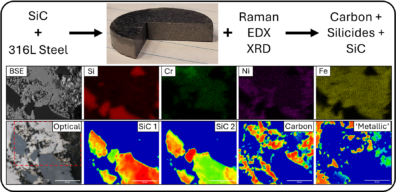
Their experiments involved hot-pressing different mixes of SiC and 316L steel. The best results came from a 50:50 mix, which formed a dense material. As they added more SiC, the samples became weaker and more porous, but still offered insights into how these materials interact.

They discovered that SiC and steel react during heating, forming complex compounds like silicides and carbides. These reactions could actually help lock radioactive particles in place, improving the durability of the wasteforms.

While adding uranium oxide created challenges, the study lays important groundwork. Future efforts aim to fine-tune the process for higher durability and less reactivity—bringing us one step closer to safer, smarter nuclear waste solutions.

Read more here.

Malin C. J. Dixon Wilkins, John McCloy, “Interactions of Silicon Carbide and Stainless Steel in Cermet Wasteforms,” MRS Advances, (2025). https://doi.org/10.1557/s43580-025-01298-5

Mixing Science and History: McCloy and the Washington State Team Decode Egyptian Blue

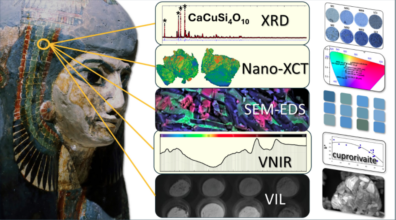
Egyptian blue isn’t just a pretty pigment—it’s science, history, and art all rolled into one. Washington State University’s John S. McCloy led a team to recreate this ancient pigment and figure out how ancient artisans achieved those iconic shades. With a mix of natural minerals, intense heat, and modern tools, they reverse-engineered 5,000-year-old color technology.

The team, including scientists from the Smithsonian and the Carnegie Museum of Natural History, experimented with materials like malachite and azurite and ran them through heating processes at 1000°C. They discovered that the tiniest changes—like adding sodium carbonate or cooling slowly—could drastically alter the pigment’s final hue. They used modern tech like nano-computed tomography imaging and spectrometry to analyze it all.

Not only did the color change based on chemistry and heat, but how particles stuck together mattered too. Smaller grains made the pigment appear duller, while the presence of glass made it shift toward green. Their work proves that ancient Egyptians were material scientists in their own right.

The findings go beyond just art history. Egyptian blue’s glow in the near-infrared makes it a contender for use in biomedical devices, security inks, and even lasers. This study, published in npj Heritage Science, bridges ancient creativity with modern innovation.

Read the open access paper here and a press release here.


John McCloy, Edward Vicenzi, Thomas Lam, Julia Esakoff, Travis Olds, Lisa Haney, Mostafa Sherif, John Bussey, M. C. Dixon Wilkins, Sam Karcher, “Egyptian Blues: Assessment of Process Variability and Color in Synthesized and Ancient Pigments,” npj Heritage Science, 13(1), 202 (2025). https://doi.org/10.1038/s40494-025-01699-7

Glowing Glass and Safer Storage: John Bussey and WSU Tackle Uranium and Thorium Waste

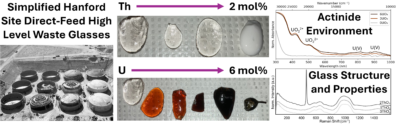
At Washington State University, John Bussey and his collaborators tackled a big challenge in nuclear cleanup: how to safely trap uranium and thorium in glass. Working within the Hanford Site’s high-level waste plan, they tested glass recipes that mimic real nuclear waste, melting them at high temperatures to see what uranium and thorium would do.

They found that uranium, especially in its glowing orange U6+ form called uranyl, fits well into the glass structure—until there’s too much, and it starts to form crystals. Thorium, on the other hand, doesn’t mix in as easily and tends to crystallize sooner. These insights are crucial because different behaviors affect the safety and durability of nuclear waste storage.

Using tools like X-ray absorption and Raman spectroscopy, the team—Malin Dixon Wilkins, Gavin McCloy, Rachael Bergman-Underwood, and John McCloy—measured changes in color, density, and temperature resistance of the glasses. They even watched the uranium glow and shift color as its chemistry changed.

Their work helps make vitrification—a process where waste is turned into glass—smarter, safer, and more effective. As the U.S. plans long-term disposal at sites like Hanford, this research brings us one step closer to locking toxic materials safely away for thousands of years.

Read the whole paper here.


John Bussey, Malin C. J. Dixon Wilkins, Gavin McCloy, Rachael Bergman-Underwood, John McCloy, “Uranium and Thorium in simulated Hanford Site direct feed-high level waste aluminoborosilicate glass,” MRS Advances, (2025) http://doi.org/10.1557/s43580-025-01271-2

Undergraduate student awards, Spring 2024

Congratulations to the following students for new awards!

  • John Bussey, DOE-NE University Nuclear Leadership Program (UNLP) Scholarship, 2024-5
  • John Bussey, DOE-NE Innovations in Nuclear Energy Research and Development Student Competition (INSC), 2024
  • Josie Soles, outstanding Sophomore MSE student
  • Audra Totten, outstanding Junior MSE student
  • Raine Antonio, outstanding Senior MSE student

SURCA 2024

It’s sad how long it’s been since I last posted here.  Blame it on the MME Director job.  Anyway..

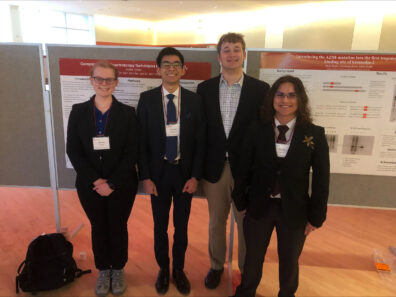
Congrats to Audra, Nathan, John, and Raine for their excellent posters at the 2024 WSU Showcase for Undergraduate Research and Creative Activities (SURCA).

SURCA 2023

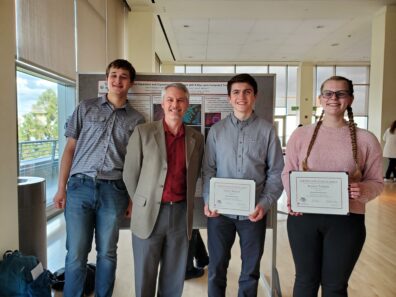
Congratulations to the students that showed posters at our 2023 Showcase for Undergraduate research.

MSE Students Brooke Downing, Raine Antonio, and John Bussey representing our group with excellent posters.

John was honored with the Crimson Award at the showcase. Congratulations all!